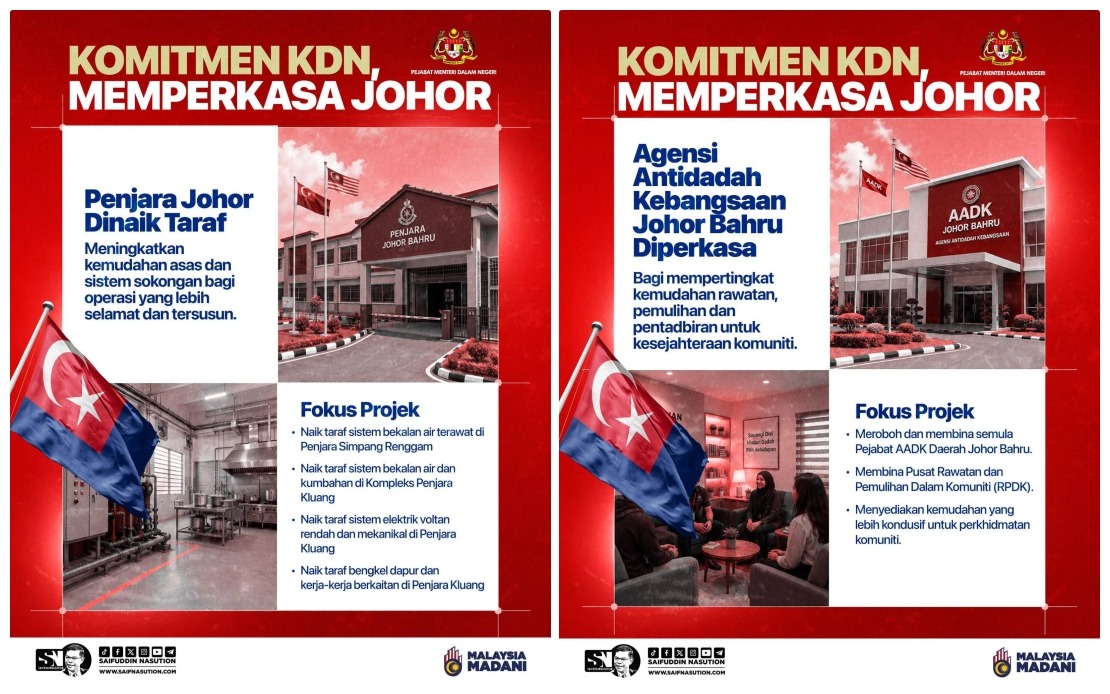
The Malaysian Home Ministry is embarking on an ambitious infrastructure programme in Johor, with Home Minister Datuk Seri Saifuddin Nasution Ismail announcing a series of development initiatives designed to modernise security operations and public service delivery across the southern state. Speaking in Johor Bahru on July 10, the minister positioned the projects as essential investments that recognise Johor's critical role as a gateway for national security, border management and regional connectivity.
Johor occupies a strategically vital position within Malaysia's security architecture. As the country's southernmost peninsular state and home to major international entry points including Johor Port and road borders with Singapore, the state serves as a frontline for managing cross-border flows of people, goods and information. This geographical significance underpins the ministry's decision to concentrate resources on upgrading facilities that directly support security and administrative functions. The infrastructure investments reflect an acknowledgement that outdated or undersized facilities can create operational bottlenecks and compromise service quality for the millions of travellers and residents who depend on these systems annually.
The police component of the development agenda encompasses multiple district-level initiatives. Construction of a new Segamat district police headquarters represents a significant commitment to establishing dedicated, purpose-built facilities in one of Johor's larger inland towns. Complementing this flagship project, the ministry has earmarked land acquisition for a Pengerang district police headquarters, suggesting plans to extend formal police infrastructure into areas currently underserved. The agenda also addresses maintenance deficits, with repair and upgrade work scheduled for police quarters and lift systems at existing premises throughout the state. These seemingly mundane maintenance items carry operational importance, as deteriorating accommodation and access systems can affect officer morale and efficiency.
Immigration and border management represent another pillar of the planned investments. The Home Ministry intends to upgrade facilities at the Sultan Iskandar Building and the Sultan Abu Bakar Complex, two key nodes in Johor's immigration infrastructure that handle considerable daily traffic from Singapore and beyond. These facility enhancements aim to improve organisational efficiency and service standards at immigration checkpoints, where congestion and delays can cascade into broader economic effects across the Malaysia-Singapore corridor. The emphasis on modernising these facilities suggests current capacity or design limitations that impact border processing times and passenger experience.
The National Registration Department's footprint in Johor will expand with construction of a dedicated office in Batu Pahat, a town with substantial residential and commercial populations. This project addresses service accessibility for residents requiring identification documents and registration services. Within the corrections system, the ministry is prioritising system upgrades at Kluang Prison and Simpang Renggam Prison, focusing on basic infrastructure modernisation rather than expansion. Prison facilities, often neglected in public discourse, form an essential component of the broader security apparatus, and technical system improvements can enhance both operational safety and inmate welfare.
The National Anti-Drugs Agency and Maritime Enforcement Agency also feature prominently in the development portfolio. Office redevelopment and treatment centre upgrades for AADK signal heightened commitment to drug rehabilitation capacity in Johor, where transnational drug trafficking remains a persistent security challenge. The Malaysian Maritime Enforcement Agency's planned jetty and building upgrades at Abu Bakar Maritime Base reflect recognition of MMEA's role in patrolling Johor's extensive coastal waters and surrounding straits, critical for maritime security and protecting shipping lanes from piracy and smuggling.
The timing of these announcements, arriving just as Johor prepared for state elections on July 11 with some 2.7 million registered voters set to elect 56 state assemblymen, invites consideration of the political context. Infrastructure and security spending often feature prominently in pre-election messaging, as such investments demonstrate tangible government commitment to constituent welfare and state development. The comprehensive nature of the Home Ministry's agenda—spanning police, immigration, prisons, drug enforcement and maritime security—suggests a deliberate effort to present a broad-based security and development narrative.
For Malaysian readers and the broader Southeast Asian context, these investments underscore the strategic importance of Johor beyond its role as Malaysia's economic engine. The state functions as a crucial buffer and interface point managing regional connectivity, and infrastructure deficiencies in security and administrative agencies can create vulnerabilities that extend beyond Johor's borders. Neighbouring Singapore, which maintains extensive economic and security linkages with southern Johor, has vested interests in smooth, efficient border operations and functional immigration systems.
The Home Ministry's declaration that every allocation and project will deliver direct benefits to residents and strengthen security agency preparedness reflects official understanding that modern security infrastructure cannot remain disconnected from public service quality. Citizens encounter security and immigration systems regularly, and their experiences shape perceptions of government effectiveness. Modernised facilities, efficient procedures and professional environments contribute to public confidence in institutions responsible for maintaining order and protecting national interests.
Looking forward, successful implementation of these projects will require sustained funding beyond the announcement phase, coordinated management across multiple agencies with distinct operational cultures, and attention to maintenance planning once facilities become operational. Johor's scale and complexity demand sustained focus from federal authorities. The ministry's public commitment provides a benchmark against which future progress can be measured, and residents will eventually evaluate whether promised improvements materialise into tangible operational enhancements across police stations, immigration counters, prisons and maritime bases throughout the state.

