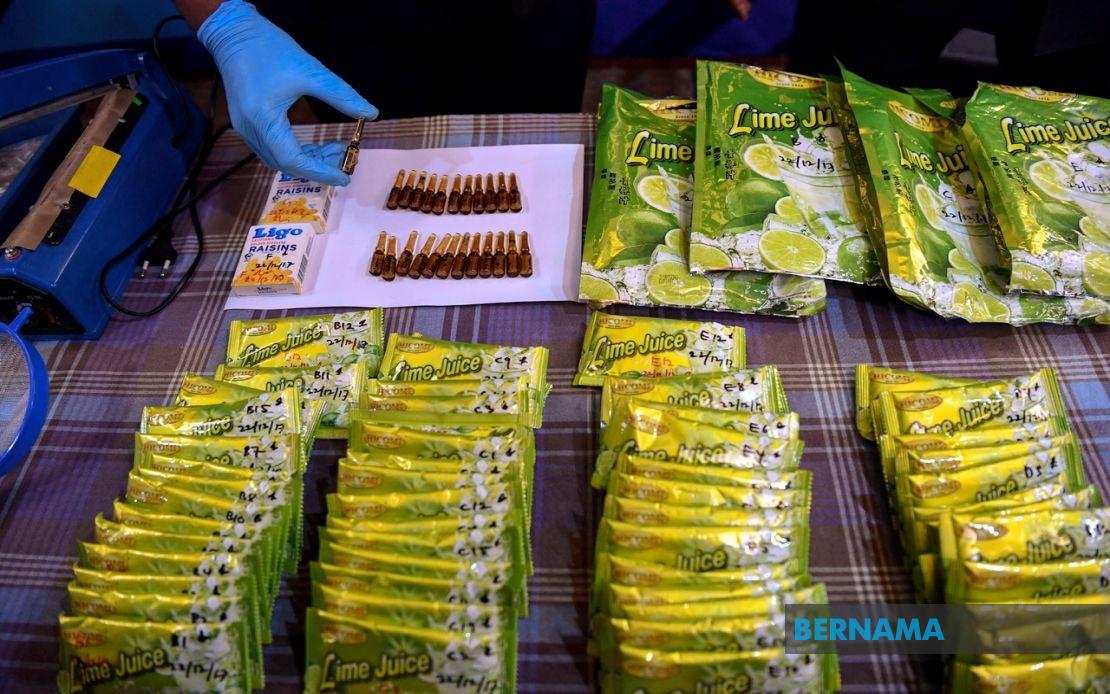
The Home Ministry is intensifying its campaign against synthetic drugs, which have become an urgent national security challenge. Home Minister Datuk Seri Saifuddin Nasution Ismail has flagged methamphetamine, fentanyl, and psychoactive pills colloquially known as "piu-piu" as particularly troubling substances currently circulating in Malaysian communities. These drugs carry exceptional dangers: they are highly addictive, prone to causing fatal overdoses, and are increasingly connected to violent crime and broader social deterioration. The emergence of these substances represents a shift in Malaysia's drug problem, moving beyond traditional narcotics toward more potent and unpredictable synthetic alternatives that pose novel challenges for enforcement and public health responses.
The scale of the problem has prompted police to mobilise considerable resources across the country. Between 2023 and June 2026, the Royal Malaysia Police recorded 238,704 arrests nationwide for various synthetic drug-related offences. This figure underscores both the prevalence of synthetic drug activity and the intensity of police efforts to combat distribution networks. The breadth of these arrests—spanning urban centres, rural communities, and remote areas—indicates that synthetic drugs are no longer confined to cities but are spreading into previously less affected regions, creating a nationwide public order concern that demands coordinated responses.
Police operations have become more sophisticated and multi-agency in character. The flagship initiatives, Operation Tapis and Operation Tapis Khas, represent sustained enforcement drives operating across diverse geographical and demographic terrain in partnership with the National Anti-Drugs Agency and the Royal Malaysian Customs Department. This inter-agency coordination reflects recognition that tackling drug trafficking requires breaking down bureaucratic silos and pooling investigative capabilities. Modern technology plays an increasingly central role in these operations, with drones and surveillance camera systems deployed to monitor trafficking routes and detect distribution points that might otherwise escape detection in sprawling urban and remote areas.
Legislative frameworks are being modernised to keep pace with the evolving drug landscape. The government is actively considering amendments to the Dangerous Drugs Act 1952 to formally schedule newly emerging synthetic drugs and New Psychoactive Substances under the legislation. This legal adaptation is necessary because traffickers continuously modify chemical formulations to circumvent existing prohibitions, creating novel compounds that technically fall outside current regulatory schedules. By updating legislation proactively, authorities aim to close loopholes that allow chemically-altered drugs to circulate temporarily before regulatory action can be taken.
Beyond enforcement, the ministry is emphasising prevention through community engagement strategies. From 2023 to June 2026, authorities conducted 1,144 drug prevention programmes nationwide designed to educate the public about synthetic drug dangers. These initiatives represent a recognition that enforcement alone cannot solve drug problems—sustained demand reduction requires public awareness campaigns that reach families, schools, workplaces, and community organisations. Prevention programmes that successfully reduce drug initiation rates, particularly among young people, address the problem at its source rather than merely processing arrests downstream.
Sarawak has emerged as a particular concern area, reflecting the challenge these substances pose to less densely populated regions where law enforcement resources are typically stretched. Between January 1 and June 7 this year, authorities arrested 7,097 individuals in Sarawak in drug-related cases. This figure breaks down into 342 drug traffickers—suggesting active supply-side activity—1,314 people found in possession of drugs for personal consumption, and 5,441 drug users. The high proportion of users relative to traffickers indicates that while trafficking networks exist, the state is grappling primarily with widespread consumption, suggesting that prevention and treatment responses are as critical as supply interdiction.
Police seizures in Sarawak demonstrate the material scale of drug operations being dismantled. During the first half of 2026, authorities confiscated 418.01 kilogrammes of drugs valued at RM53.73 million—a substantial quantity indicating either large individual trafficking shipments or cumulative seizures from numerous smaller operations. Beyond personal seizures, authorities also confiscated syndicate assets worth RM1.95 million, targeting the financial infrastructure that sustains trafficking networks. This asset-forfeiture approach addresses not only drug supply but the economic incentives that attract individuals into trafficking.
Enforcement under preventive detention powers complements criminal prosecution. During the same period in Sarawak, 13 individuals were detained under the Dangerous Drugs (Special Preventive Measures) Act 1985, which allows authorities to hold suspected major traffickers without immediate trial based on intelligence assessments. Additionally, action was taken against 131 individuals under Section 39C of the Dangerous Drugs Act 1952, which targets repeat offenders and those deemed at high risk of reoffending. These powers represent enforcement beyond traditional criminal prosecution, enabling authorities to manage high-risk individuals through administrative detention when criminal evidence may be limited.
Forensic capabilities are being enhanced to address the technical challenges posed by synthetic drugs. Laboratory enhancements focus on profiling emerging trends involving fentanyl analogues and synthetic opioids, which often have subtle chemical variations that standard testing equipment may not reliably detect. Faster and more accurate forensic analysis enables swifter prosecution and provides intelligence about emerging drug variants circulating in the market. This scientific approach allows law enforcement to stay ahead of trafficking networks that deliberately create new chemical variants to circumvent detection methods, creating an ongoing technological arms race between authorities and drug manufacturers.
The Home Minister's parliamentary response to Mohamad Shafizan Kepli of GPS–Batang Lupar highlights that synthetic drug challenges are being raised at the highest policy levels, particularly regarding their penetration into Sarawak's rural and remote areas. This indicates that the issue transcends routine law enforcement and is being treated as a matter requiring ministerial attention and whole-of-government coordination. The detailed statistics and policy responses provided in the parliamentary reply demonstrate that the government is tracking the problem systematically and is prepared to justify its responses through transparent reporting mechanisms.
The intensification of anti-synthetic drug operations reflects a strategic pivot in Malaysia's drug enforcement priorities. While traditional narcotics remain problematic, the emergence of methamphetamine, fentanyl, and designer psychoactive substances represents a qualitatively different challenge characterised by greater addiction potential, higher overdose mortality, and stronger association with secondary crime. The government's multifaceted response—combining enforcement operations, legislative updates, technology deployment, asset seizures, and community prevention—suggests recognition that no single approach will resolve synthetic drug problems. However, critics might note that while enforcement metrics are impressive, data on treatment availability, rehabilitation success rates, and long-term reductions in drug use prevalence would provide a more complete assessment of programme effectiveness. The sustained nature of these operations and the scale of resources being mobilised indicate that synthetic drugs will remain a major policy focus for the foreseeable future.

