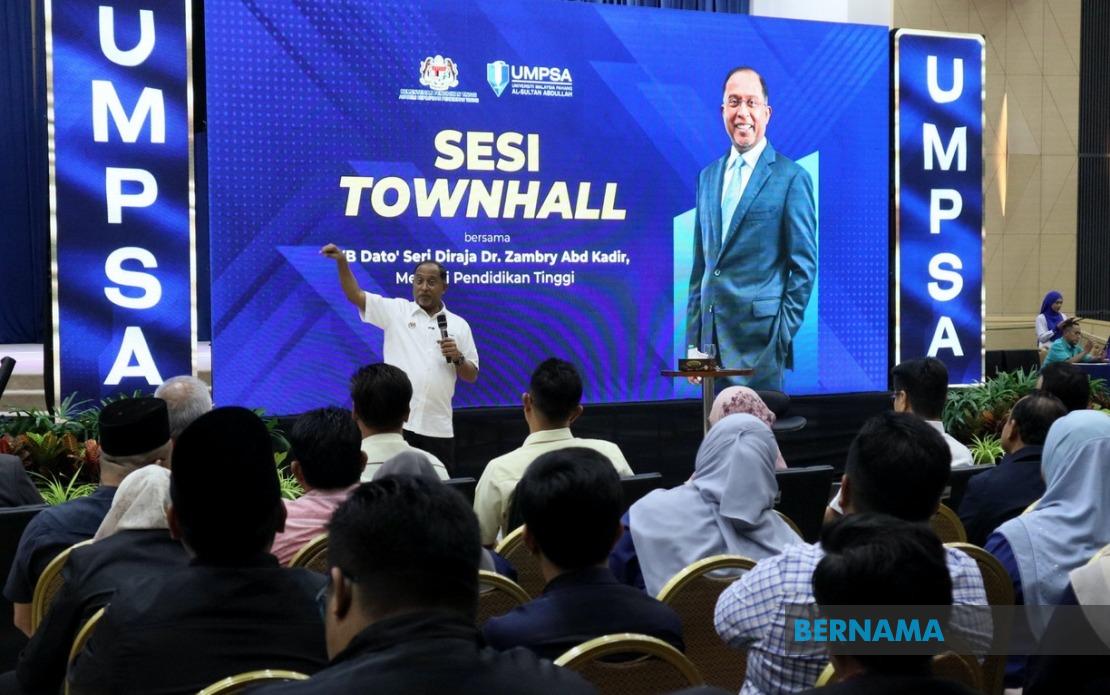
The Ministry of Higher Education has initiated coordinated action across Malaysia's university system following Prime Minister Datuk Seri Anwar Ibrahim's recent instruction to reassess disciplinary measures taken against students. Minister Datuk Seri Dr. Zambry Abd Kadir revealed the scope of this initiative while addressing academics at Universiti Malaysia Pahang Al-Sultan Abdullah, emphasizing that the overhaul touches on established legislative frameworks governing student conduct and institutional autonomy.
The directive represents a substantive recalibration of how Malaysian universities handle student infractions, particularly those stemming from political expression. Zambry's comments suggest the review encompasses multiple regulatory layers, from departmental student affairs procedures to formal institutional policies. The explicit acknowledgment that vice-chancellors have convened with the director-general of Higher Education signals a coordinated, system-wide response rather than ad-hoc institutional adjustments. A formal statement from this collective consultation is expected to provide clearer guidance on implementation timelines and scope.
Central to this initiative is Anwar's recent pronouncement that students disciplined for criticising government policies or leadership should be exonerated of related breaches. This represents a marked departure from decades of practice under the Universities and University Colleges Act (AUKU) 1971, which had restricted student political expression and activism. While comprehensive amendments to AUKU are underway, Anwar emphasized that absolution of current offences should proceed immediately rather than await formal legislative change, reflecting his administration's commitment to expanding institutional freedoms ahead of formal statutory reform.
The timing is significant within Malaysia's broader governance transformation. The repeal of AUKU restrictions represents a cornerstone of Anwar's administration's "Malaysia Madani" framework, positioning expanded intellectual freedom as compatible with social stability. The decision to fast-track the removal of disciplinary records for politically motivated cases demonstrates executive willingness to operate within existing legal frameworks while progressively dismantling restrictions viewed as incompatible with contemporary democratic norms. This approach allows immediate relief for affected students while permitting the parliamentary process to develop more comprehensive institutional reforms.
However, critical distinctions shape the practical implementation of this directive. Anwar explicitly clarified that exoneration applies only to internal university disciplinary matters; students facing criminal charges under Royal Malaysia Police investigation fall outside this amnesty framework. This boundary is operationally significant, as it preserves law enforcement capacity to investigate conduct constituting criminal offences while restricting university-level punishment for political expression alone. The distinction underscores the difference between reforming institutional culture and undermining criminal justice processes.
The extension of these principles to private higher education institutions presents complex implementation challenges. Malaysia's private university sector operates under the Private Higher Educational Institutions Act 1996 (Act 555), creating a distinct regulatory environment from public universities. Zambry acknowledged this differentiation while expressing hope that private institutions, particularly those with state ownership or government relationships, would voluntarily align their disciplinary practices with the new public sector framework. This soft-power approach recognizes legal limits on mandating changes across the independent sector while leveraging institutional relationships to encourage harmonization.
For public universities specifically, the recalibration carries implications for student recruitment, institutional culture, and academic freedom. Universities have historically served as channels for state-directed social engineering, with restrictions on student expression justified as maintaining institutional order and political stability. The shift toward absolution of political speech disciplinary cases signals recognition that contemporary Malaysia's governance model prioritizes open intellectual discourse over managed conformity. This repositioning may attract students and faculty previously discouraged by perceptions of restricted academic freedoms.
The initiative also reflects generational evolution in Malaysian political culture. The gathering of 500 younger academics and administrators at UMPSA, deliberately convened through the Kembara KARISMA Pemimpin Muda MADANI programme, suggests the government is cultivating emerging educational leadership aligned with reformed governance principles. By demonstrating commitment to intellectual openness while addressing historical grievances, the administration seeks to establish legitimacy among the emerging cohort of university leaders who will implement these frameworks operationally.
Regionally, Malaysia's recalibration of university disciplinary regimes contributes to evolving Southeast Asian governance debates. The region has witnessed periodic tensions between state authority and institutional autonomy, with countries like Thailand maintaining restrictive frameworks around campus activism. Malaysia's trajectory toward expanded intellectual freedom, while maintaining security-focused boundaries, offers a middle-ground model that other regional democracies may observe closely. The explicit preservation of criminal justice authority alongside disciplinary amnesty suggests calibrated rather than wholesale deregulation.
Implementation effectiveness will depend significantly on institutional capacity and cultural adaptation. University administrators accustomed to restrictive frameworks may struggle initially with expanded discretion regarding student expression. The promised formal statement from the director-general will likely provide operational guidance clarifying which historical cases qualify for retroactive exoneration and establishing baseline standards for future disciplinary decisions. The coordination mechanism involving all vice-chancellors suggests the Ministry recognizes that coherent implementation across Malaysia's university system requires sustained institutional engagement rather than directive issuance alone.
Longer-term implications for student life and campus culture remain to be observed. Expanded political space may energize campus activism and foster more robust institutional debates around governance and social policy. Conversely, institutions must develop alternative mechanisms for addressing genuine misconduct unrelated to political expression, ensuring that disciplinary reform does not create perception of institutional permissiveness. The challenge for university leadership involves maintaining institutional order while respecting intellectual freedoms—a balance requiring sophisticated judgment rather than formulaic rule application.
The directive's execution will provide useful indicators of the government's commitment to institutional autonomy as a governance principle. Substantive implementation, including retroactive case review and clear guidance preventing future political speech disciplinary actions, would signal genuine reform orientation. Conversely, symbolic gestures followed by continued institutional restrictions would suggest rhetorical commitment without operational substance. Malaysian academic observers and students affected by historical disciplinary actions will likely scrutinize implementation closely as evidence of the government's philosophical commitment to the Malaysia Madani framework.

