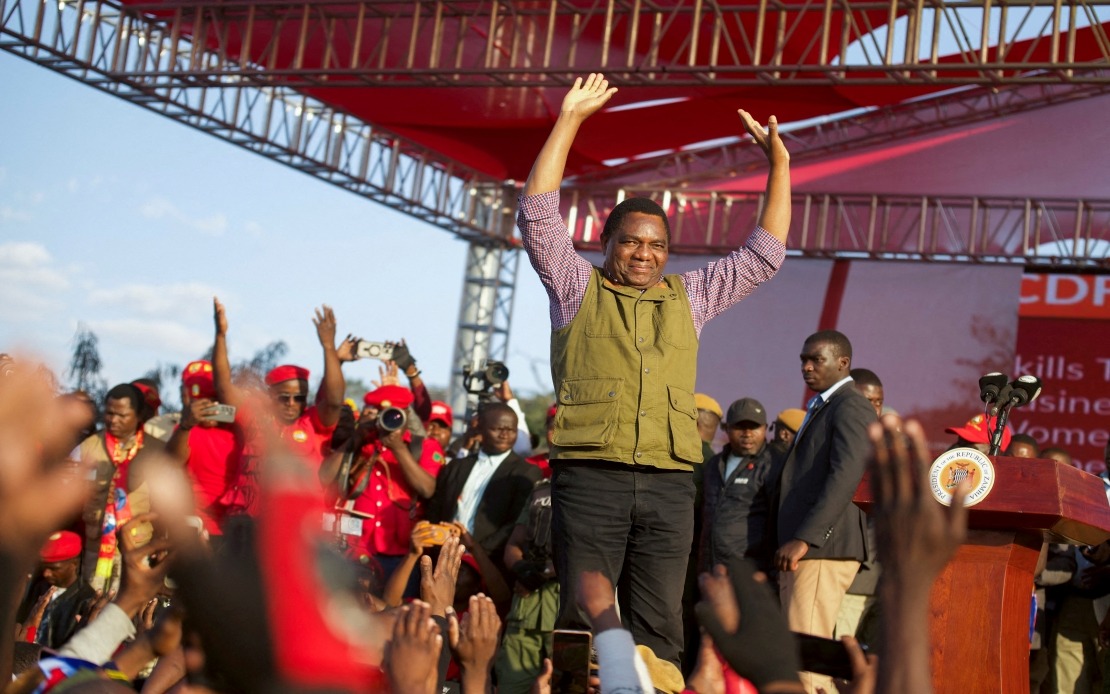
Zambian President Hakainde Hichilema is heading towards a second consecutive term in office after securing a substantial lead in Sunday's presidential election, with preliminary tallies from the Electoral Commission of Zambia (ECZ) showing the 64-year-old incumbent well ahead of the competition. With results announced from 135 of the 226 constituencies at the National Election Results Centre in Lusaka, Hichilema has accumulated 1,544,140 votes, a commanding margin that reflects his party's continued appeal to Zambian voters since his historic 2021 victory.
The ruling United Party for National Development (UPND) candidate's nearest competitor, Brian Mundubile of the National Reconciliation Party for Unity and Prosperity (NRPUP), has managed only 1,030,662 votes, trailing by more than 500,000 ballots. This gap, combined with the number of constituencies still being processed, suggests Hichilema is unlikely to face a second-round runoff. The electoral commission confirmed the results through its chairperson Mwangala Zaloumis during an announcement at approximately 2130 GMT, providing transparency in a process that involved 12 other candidates competing for the presidency.
Under Zambian constitutional requirements, a presidential candidate must secure more than 50 per cent of valid votes to claim outright victory. If this threshold is not reached, the two leading contenders proceed to a second ballot. However, Hichilema's current performance suggests he will likely exceed this requirement when all votes are eventually tallied, thereby avoiding a runoff election and providing clarity on the country's political direction for the next five-year term.
The economist and rancher's path back to the presidency represents a consolidation of the remarkable turnaround he orchestrated since 2021, when he ousted incumbent Edgar Lungu with a victory margin exceeding one million votes. That landslide reflected public frustration with the previous administration's handling of the economy and was widely interpreted as a mandate for significant reform. Since assuming office, Hichilema has focused on three principal policy areas that appear to have resonated with voters now returning him to power.
His administration has prioritized restructuring Zambia's accumulated external debt, a burden inherited from previous governments that had constrained public spending and investor confidence. By pursuing creditor negotiations and implementing fiscal discipline, Hichilema has sought to restore the country's creditworthiness and create fiscal space for development investments. Simultaneously, his government has worked to revive the mining sector, which underpins Zambia's economy and export earnings. These efforts have included regulatory reforms and outreach to international mining companies, aiming to attract capital and expand production of copper and other minerals.
Beyond economic restructuring, the UPND administration has expanded social sector programming, most visibly through the introduction of free education for students in public primary and secondary schools. This flagship initiative directly affects millions of Zambian families and represents a tangible improvement in citizens' daily lives, particularly benefiting lower-income households. These three policy pillars—debt management, mining revival, and expanded social services—have formed the basis of Hichilema's campaign messaging and appear to have consolidated support among diverse voter groups.
Mundubile, a 55-year-old lawyer heading the opposition coalition, has nevertheless achieved notable success in parliamentary contests, particularly within Zambia's urbanized corridor stretching from Lusaka through the Copperbelt mining region. This concentration of opposition strength in economically vital areas suggests persistent grievances in mining communities and urban centres, potentially related to employment, local development, or perceived benefits distribution. The opposition's parliamentary gains, even if the presidential race is decided, will shape the legislative environment Hichilema must navigate during his second term and could constrain his policy implementation.
For Malaysia and other Southeast Asian democracies observing Zambian politics, this election cycle offers instructive lessons about electoral competition in resource-dependent nations. Zambia's reliance on copper exports and vulnerability to global commodity price fluctuations parallel challenges faced by mining-dependent economies across Southeast Asia. The manner in which Hichilema has balanced austerity measures necessary for debt reduction while simultaneously expanding social spending has regional relevance, as many developing nations grapple with similar constraints on fiscal policy.
The geographic concentration of Hichilema's support in certain regions and Mundubile's strength in others also mirrors political fragmentation patterns emerging across the developing world, where urban-rural divides and resource-extraction-dependent communities vote differently based on perceived economic interests. This regional polarization, while less extreme than in some countries, suggests that Hichilema's second term will require careful attention to inclusive growth policies and benefits distribution to prevent further alienation of opposition strongholds.
Hichilema's likely return to office validates his administration's claim that its reform agenda is working, at least in terms of voter approval. However, the substantial opposition vote share and concentration in key economic regions indicate that meaningful segments of the population remain unconvinced by the government's strategy or believe it has not yet delivered sufficient tangible improvements. As final results are processed and Hichilema prepares for his second five-year term, his challenge will be to accelerate the visible benefits of his policies while addressing the specific concerns of communities that voted for alternatives.
The election's outcome will be formally confirmed as remaining constituencies complete their tallying, but the trajectory appears settled. Hichilema's victory would represent a rare African success story of a popularly elected leader delivering on reform promises sufficiently convincing enough to earn voters' confidence for a second term. Whether this second mandate enables deeper transformation of Zambia's economic fundamentals or whether governance constraints and external factors limit progress will bear watching, both for Zambian observers and for international audiences tracking democratic governance and economic management in resource-dependent developing nations.

