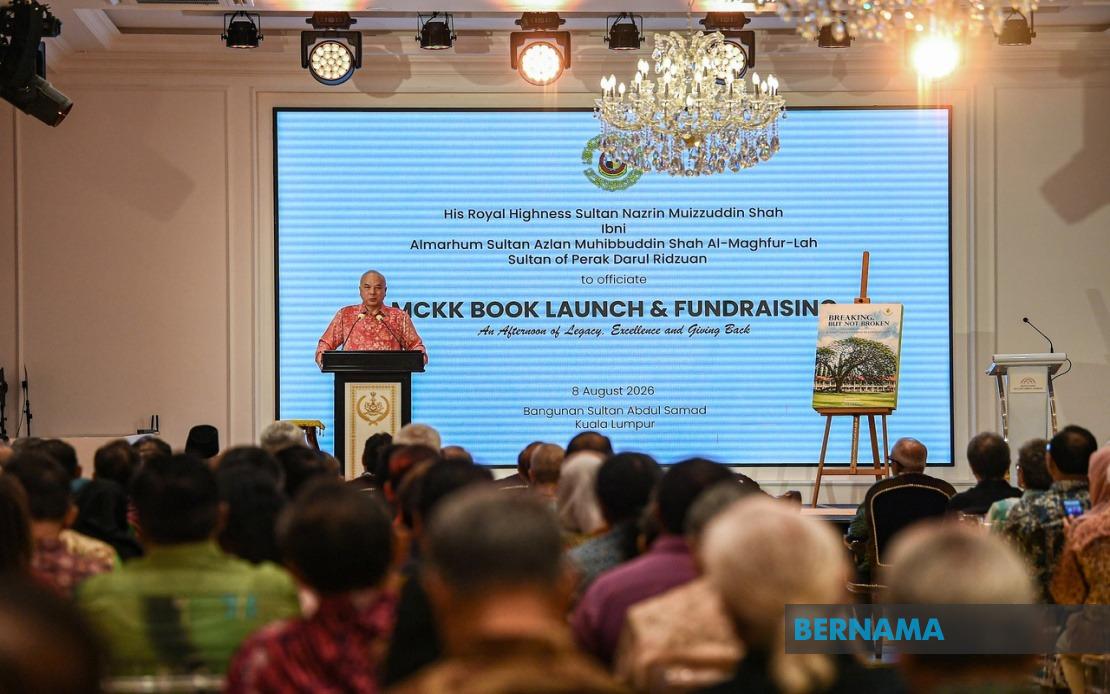
The Malay College Kuala Kangsar and other selective boarding schools can carve out meaningful roles in contemporary Malaysia by fundamentally rethinking how they operate, according to Sultan Nazrin Shah, the Perak ruler who serves as Royal Patron of the institution's Board of Governors. Speaking at a book launch event in Kuala Lumpur, His Royal Highness articulated a vision where heritage educational institutions leverage their historical strengths—rigorous moral instruction and academic excellence—while simultaneously embracing the imperatives of a rapidly evolving technological landscape.
The challenge facing Malaysia's venerated residential schools extends beyond cosmetic updates to curricula or facilities. Sultan Nazrin framed the transformation required as a fundamental reimagining of educational purpose itself. Rather than merely tinkering with subjects or teaching methods, these institutions must reckon with a future fundamentally altered by artificial intelligence capabilities and the accelerating pace of technological disruption. The Ruler stressed that education systems nationwide require wholesale restructuring to equip younger generations not just with technical competencies but with the adaptive capacity necessary to thrive amid constant, unpredictable change.
What distinguishes Sultan Nazrin's intervention is his emphasis on a dual mandate: producing both practical, economically viable human capital and cultivating well-rounded individuals equipped with the softer qualities that define meaningful citizenship. This balance, he suggested, has always mattered, but grows increasingly critical during periods of profound upheaval. Technical skills alone, without corresponding development of critical thinking, ethical sensitivity, and a service-oriented mindset, will leave graduates ill-equipped for leadership roles in society. Conversely, purely character-focused education divorced from contemporary skill requirements produces individuals unsuited for modern economies.
The diagnosis embedded within a newly published book—authored by Ghazally Ismail, Ahmad Ibrahim and Hisham Badrul Hashim—painted a sobering picture of decline at these storied institutions. Sultan Nazrin commended the authors for their unflinching candour in documenting how what were once designated as "power schools" have experienced a marked dimming of their former lustre. The book's assessment extends beyond MCKK to encompass the broader cohort of elite residential schools, institutions that once reliably produced graduates of exceptional calibre but can no longer make such guarantees.
The specific deficits identified carry particular weight coming from the Perak ruler. Graduates of these establishments are increasingly criticised for inadequate language proficiency, underdeveloped critical faculties, and a seeming absence of commitment to public service—qualities that once distinguished alumni and justified their privileged access to elite education. This trajectory represents a sharp reversal from the past, when these schools consistently delivered individuals marked by intellectual rigour, communicative fluency across multiple languages, and genuine dedication to national development.
For Malaysian policymakers and educational administrators, Sultan Nazrin's remarks carry significant implications. The decline of heritage schools cannot be written off as merely cyclical or attributable to nostalgic overestimation of past achievements. Rather, it reflects genuine institutional sclerosis—a failure to evolve alongside societal demands. The call for adaptation does not mean abandoning foundational values but rather repositioning them within contemporary contexts. Schools must integrate technological literacy and AI-era competencies while maintaining emphasis on ethical development and civic responsibility.
The MCKK Foundation's financial performance, detailed by Board chairman Tan Sri Dr Ahmad Tajuddin Ali, demonstrates that resource constraints need not be the limiting factor. Since its 2008 establishment, the Foundation has mobilised more than RM36 million in donations and contributions. Infrastructure investments exceeding RM19 million have modernised facilities, including construction of an International Baccalaureate Complex and the Auditorium Tun Abdul Razak. Simultaneously, restoration work valued at RM3.5 million has preserved heritage structures and enhanced residential facilities.
Beyond physical infrastructure, the Foundation has accumulated endowment funds surpassing RM16 million, with major contributors including PETRONAS and Sultan Hassanal Bolkiah of Brunei Darussalam. Investment income from these endowments—exceeding RM7 million to date—has been systematically directed toward scholarships, leadership development programmes, teacher training, international competition participation, and campus maintenance. This financial architecture provides the material foundation necessary for genuine institutional transformation.
The question then becomes whether accumulated resources can catalyse the deeper organisational and pedagogical changes Sultan Nazrin's remarks imply are necessary. Money alone cannot ensure that heritage schools successfully navigate the transition from twentieth-century models to twenty-first-century effectiveness. Leadership must articulate clear visions of what these institutions should become. Curricula must be reconceived to develop adaptability alongside domain expertise. Teaching methodologies must evolve to emphasise problem-solving and creative thinking rather than rote mastery.
For Malaysian parents and students, the stakes of this institutional renewal carry particular resonance. Elite boarding schools have historically served as mechanisms for cultivating national leadership cohorts and facilitating social mobility for exceptionally gifted students regardless of family background. A decline in their effectiveness represents a loss not merely for the institutions themselves but for Malaysian society's capacity to identify and develop exceptional talent. Conversely, successful transformation of these schools could model pathways through which other educational institutions might similarly reinvent themselves.
The regional dimension also warrants consideration. Southeast Asian nations increasingly compete for talent and investment by emphasising educational quality and the capacity to prepare graduates for knowledge economies. Malaysia's heritage schools, if revitalised, could represent distinctive competitive advantages—combining English-medium instruction, residential developmental experiences, and historical prestige with contemporary educational innovation. Their decline, by contrast, sends negative signals about institutional adaptability and forward-thinking leadership.
Sultan Nazrin's intervention ultimately articulates a sophisticated vision of educational evolution. Heritage schools need not become generic institutions indistinguishable from others, abandoning distinctive identities in pursuit of contemporary relevance. Rather, their historical foundations can become springboards for innovation when complemented by genuine engagement with emerging technological realities and societal demands. The RM36 million mobilised by the MCKK Foundation suggests philanthropic appetite exists for supporting such transformation. Whether schools possess the institutional will to undertake fundamental change remains the critical unanswered question.

