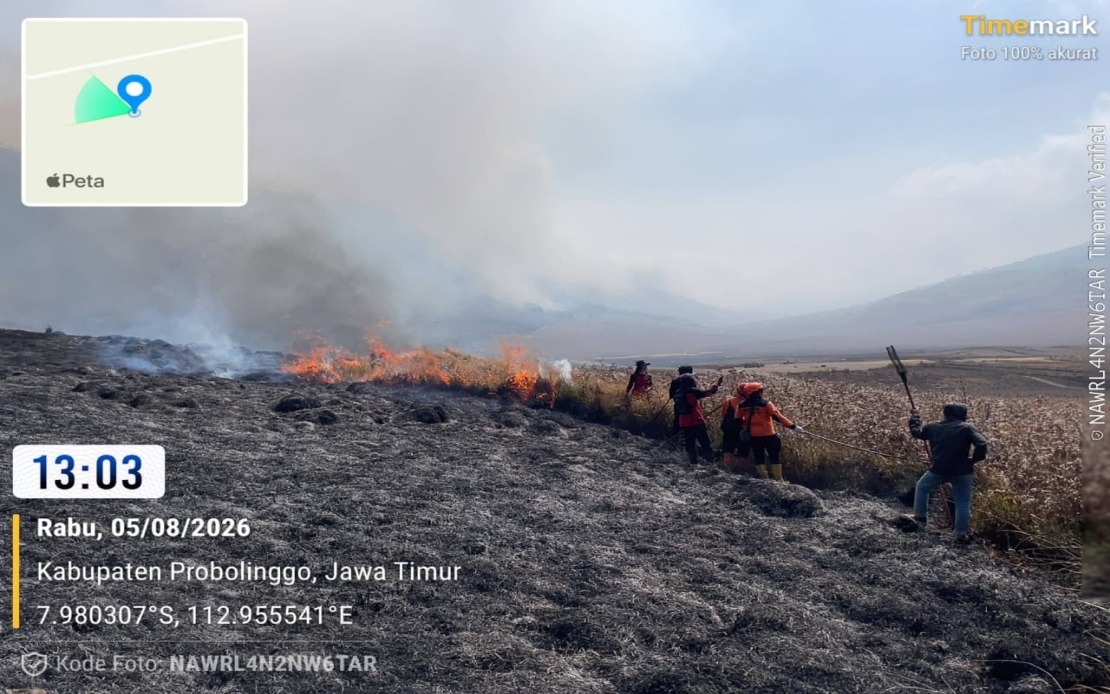
Indonesia's National Disaster Management Agency (BNPB) has escalated its response to a significant wildfire ravaging Mount Bromo, deploying two water-bombing helicopters to combat flames that have engulfed roughly 60 hectares across East Java's Probolinggo and Malang regencies. The decision to introduce aerial firefighting assets underscores the severity of a blaze that ignited on Monday and has proven difficult for ground crews to contain, particularly in terrain too steep and treacherous for conventional firefighting operations.
According to Abdul Muhari, head of BNPB's Disaster Data, Information and Communication Centre, the fire's footprint is divided between two distinct areas. Approximately 10 hectares have burned within Probolinggo Regency, whilst the remaining 50 hectares lie within the Bromo Tengger Semeru National Park located in the adjoining Malang Regency. This distribution reveals the fire's unpredictable spread pattern and the challenges posed by the protected area's mountainous topography, which presents unique obstacles to firefighting coordination and resource deployment.
Whilst emergency personnel made substantial progress by Wednesday afternoon in bringing most of the fire under control, the situation remains precarious. Stubborn hotspots persist in elevated and inaccessible zones where conventional ground teams cannot safely operate. The continued presence of these active ignition points necessitated the helicopter deployment, as aerial water-bombing offers the only viable method for reaching isolated pockets of flame across the mountain's steepest slopes and most treacherous ridges.
Beyond helicopter operations, Indonesian authorities are preparing a Weather Modification Operation to supplement existing firefighting efforts. This advanced intervention, contingent on favourable atmospheric conditions, represents an additional tool in the emergency response arsenal. The technique, which involves cloud seeding, could potentially induce rainfall across the affected slopes and substantially accelerate fire suppression efforts when conditions permit its implementation.
The incident has prompted authorities to maintain a temporary closure of sections of the Mount Bromo tourist attraction, a decision prioritising public safety over economic considerations. The national park authority recognises that allowing visitor access during active firefighting operations would compromise both emergency response efficiency and endanger tourists. Mount Bromo ranks among Indonesia's most visited natural attractions, drawing international and domestic visitors throughout the year, making the closure decision economically significant but necessary given current fire conditions.
Investigations into the fire's origin point toward negligence rather than natural causes. Local officials have indicated that the blaze likely originated from a campfire inadequately extinguished by hikers, a recurring problem in mountain tourism regions across Southeast Asia. However, the investigation remains ongoing, and authorities have not yet issued definitive conclusions regarding responsibility or preventive measures. This preliminary finding highlights the broader challenge of managing visitor behaviour in protected natural areas where educational campaigns and enforcement mechanisms remain inconsistent.
The Mount Bromo wildfire emerges within Indonesia's broader struggle with forest and land fires, which seasonal dry weather exacerbates. East Java's position in Indonesia's eastern archipelago means it experiences distinct seasonal patterns that can intensify fire risk, particularly during months when rainfall becomes sporadic. The national disaster management system must balance competing priorities: containing immediate threats whilst developing long-term strategies to reduce fire frequency and severity through landscape management and visitor education.
For Malaysia and other Southeast Asian nations, the Mount Bromo incident carries implications beyond Indonesia's borders. Transboundary smoke and haze from major forest fires in Indonesia have historically affected Malaysian air quality, particularly in Peninsular Malaysia's eastern states and in Sarawak and Sabah. Whilst this particular incident remains localised and of manageable scale, it underscores the region's interconnected environmental challenges and the need for cooperative monitoring and rapid-response protocols between neighbouring countries.
The deployment of sophisticated aerial firefighting resources reflects Indonesia's investment in disaster management infrastructure, yet also reveals the inherent limitations of reactive approaches. The BNPB's capacity to mobilise helicopters and contemplate weather modification demonstrates institutional capability, but preventive measures remain comparatively underfunded. Sustainable fire reduction requires investments in forest management, community education, and enforcement mechanisms that deter dangerous behaviour in protected areas—interventions far less visible than dramatic helicopter operations but substantially more cost-effective over time.
As firefighting operations continue, the incident serves as a reminder of the precarious balance between tourism development and environmental protection in Southeast Asia's most biodiverse regions. Mount Bromo's status as a national park reflects recognition of its ecological and cultural significance, yet tourism pressures and visitor behaviour management remain ongoing challenges. The temporary closure, whilst necessary, imposes economic costs on local communities dependent on park-related activities, highlighting the tension between short-term economic interests and long-term environmental sustainability that characterises conservation efforts across the region.

