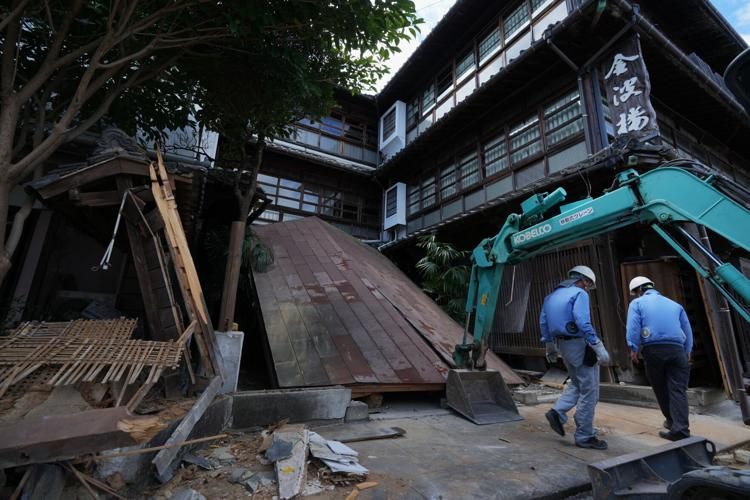
Japan's southwestern Kumamoto Prefecture is grappling with a compounding humanitarian crisis following last week's powerful earthquake, with authorities now confronting a secondary wave of deaths linked to the disaster's aftermath. An elderly woman in her seventies succumbed to heat stroke while taking shelter inside a parked car without fuel, becoming what officials and disaster response experts had long anticipated as the earthquake's toll extended beyond the initial destruction. The incident, discovered Thursday, brings the confirmed death toll from the magnitude 7.1 tremor that struck Kyushu's main island on Tuesday to 36 people, with concerns mounting that the figure will climb further as rescue operations persist and environmental conditions deteriorate.
The woman's death crystallizes a paradox facing disaster management in Japan: whilst immediate earthquake casualties capture public attention, the subsequent cascade of health emergencies—driven by extreme heat, inadequate shelter, and resource scarcity—often claims additional lives with less public visibility. Kumamoto Governor Takashi Kimura responded to the tragedy with visible emotion, characterizing the loss as heartbreaking whilst urging the tens of thousands of residents still displaced to either maintain continuous air-conditioning in vehicles or relocate to proper cooling facilities. The governor's appeal underscores the desperation facing evacuation coordinators who must balance limited resources across competing needs whilst simultaneously managing the prefecture's infrastructure collapse.
Temperature conditions in the region have reached dangerous extremes, with Japan Meteorological Agency recordings showing 36.6 degrees Celsius in Kumamoto city on Saturday and forecasts suggesting further increases. Such heat, combined with physical and psychological stress from displacement, creates fertile conditions for cascading health crises. The prefecture's authorities have initiated a public education campaign, distributing leaflets to vehicle-sheltering evacuees advising hydration, regular movement to prevent deep vein thrombosis, and the critical importance of maintaining fuel supplies for air-conditioning. These interventions, whilst sensible, essentially place survival responsibility on individuals already traumatized and potentially exhausted from the disaster itself.
The infrastructure underpinning evacuation operations remains severely compromised across the affected zone. Nearly 47,000 households lack access to fresh water supplies, a situation that intensifies heat-stress vulnerabilities and compounds sanitation challenges. Simultaneous fuel shortages have created queues extending from reopened petrol stations as supply chains gradually normalize, forcing evacuees into difficult choices between fuel consumption for vehicle cooling and fuel availability for other essential transportation needs. This resource contention reflects the broader challenge facing disaster response: the earthquake's damage extends across multiple critical systems simultaneously, preventing authorities from concentrating resources on any single recovery dimension.
More than 9,000 people remain sheltering in institutional facilities, including converted community centers, school gymnasiums, and classroom spaces, many operating without air-conditioning capacity. Crowded conditions amplify health risks whilst degrading psychological wellbeing for occupants. Research on disaster shelter conditions consistently demonstrates that inadequate space, poor sanitation facilities, and absence of privacy create stress-related illnesses and exacerbate existing health conditions. Many evacuees have therefore chosen to sleep in vehicles at municipal parking areas and parks, accepting inferior conditions in exchange for personal autonomy. Prime Minister Sanae Takaichi responded to deteriorating shelter conditions by committing governmental resources toward delivering water, food, portable sanitation facilities, and air-conditioning units to evacuation centers, alongside physical partitions to improve privacy—interventions representing recognition that shelter quality directly impacts post-disaster health outcomes.
Search and rescue operations have uncovered additional tragedy within specific disaster sites. The Aeon Mall in Kashima town, devastated by a gas explosion that followed the initial earthquake, has yielded seven bodies following the extraction of five survivors. The explosion, attributed by company officials to a gas leak occurring after approximately 3,000 shoppers had been evacuated, caused second-floor structural collapse and trapped employees inside. The multi-day search operation at this location has now concluded, though authorities continue pressing rescue efforts at other sites, deploying thousands of Self Defence personnel, police officers, rescue workers, and detection dogs. The Nippon Paper Industries factory in Yatsushiro city experienced chimney collapse, resulting in eleven employee casualties, with nine confirmed dead and two rescued.
Structural damage extends extensively across the prefecture, encompassing over 180 completely destroyed homes and more than 3,800 damaged buildings, with twenty assessed as severely compromised. These figures represent not merely statistical indicators but rather lived realities for thousands of families whose housing stock has been rendered uninhabitable, forcing extended displacement periods that amplify vulnerability to secondary health threats. The overall count of missing persons remains officially undetermined, perpetuating uncertainty for families and complicating resource allocation within the response infrastructure.
Infrastructure restoration has achieved partial progress, with power outages declining to fewer than 900 households as of the latest assessment, though the regional utility company serving Kyushu reported no concurrent outage notifications. This discrepancy illustrates the complexity of coordinating information across multiple agencies during major disasters, where communication delays and jurisdictional boundaries can obscure actual conditions. Water supply restoration lags considerably behind electrical service recovery, reflecting the severity of damage to underground distribution networks and the technical complexity of restoring such systems without contaminating supplies.
For Malaysian and broader Southeast Asian observers, the Kumamoto earthquake sequence demonstrates how disaster mortality extends substantially beyond initial seismic forces, encompassing indirect fatalities attributable to heat stress, inadequate shelter infrastructure, and resource scarcity. The region's experience challenges conventional disaster preparedness frameworks that typically emphasize immediate rescue operations whilst underestimating secondary health crises. Japan's technological sophistication and institutional capacity have still proven insufficient to prevent heat-related deaths within the evacuation process, suggesting that developing nations throughout Southeast Asia confronting comparable seismic and climatic vulnerabilities face substantially elevated risks without comparable resources. The tragedy underscores why comprehensive disaster management must integrate climate adaptation, shelter infrastructure standards, and long-term recovery planning rather than concentrating exclusively on immediate response phases.

