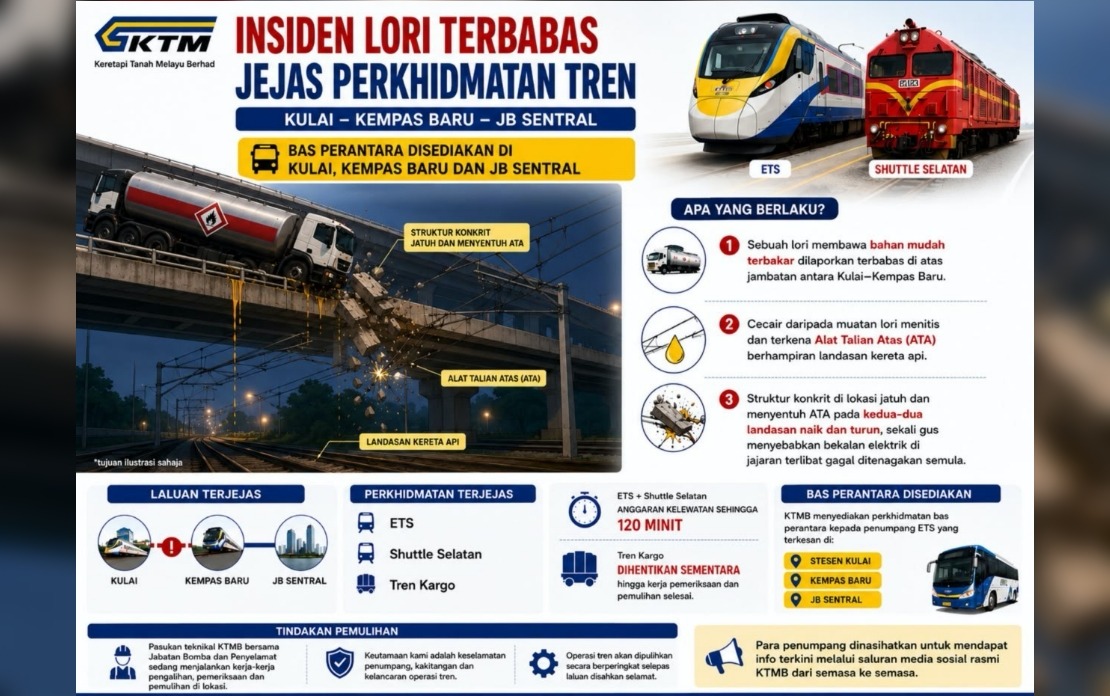
A hazardous cargo incident near Johor Bahru's railway infrastructure on August 5 threw commuter operations into disarray, with both the Electric Train Service and Shuttle Selatan experiencing significant disruptions along the busy Kulai–Kempas corridor. The trouble began when a lorry transporting flammable liquid veered off course and skidded dangerously close to railway tracks, an incident with immediate cascading consequences for thousands of daily travellers relying on these critical transport arteries in Malaysia's southern industrial heartland.
The root cause was a loss of electrical supply triggered directly by the lorry's proximity to the rail infrastructure, forcing Keretapi Tanah Melayu Berhad (KTMB) to suspend normal operations while emergency teams mobilised to secure the scene and initiate repairs. The power outage represented not merely a temporary inconvenience but a systemic disruption affecting the entire signalling and operational capacity of the line, necessitating a swift and coordinated response from multiple agencies.
In its public statement released through Facebook, KTMB acknowledged the operational impact and outlined immediate mitigation measures to minimise passenger hardship. The operator confirmed that cleanup operations and restoration work were already underway at the incident site, though the timeline for full restoration remained uncertain given the nature of the hazardous material involved and safety protocols that had to be observed.
To manage the sudden surge of stranded commuters, KTMB activated contingency arrangements by deploying shuttle bus services at three key stations: Kulai, Kempas Baru, and JB Sentral. This alternative transport provision aimed to maintain connectivity for ETS passengers who would otherwise have faced complete service interruption. The decision reflected established protocols for managing major service disruptions on Peninsular Malaysia's rail network, where backup systems are factored into operational planning.
Shuttle Selatan passengers faced more severe disruption, as the national express coach service operates on a different operational model with fewer redundancies than the ETS system. Authorities advised these travellers to seek alternative transport options, recognising that no direct substitute could replicate the Shuttle Selatan's capacity or coverage. This placed additional pressure on road-based alternatives and public transport competitors during peak travel periods.
To cushion the financial impact on affected passengers, KTMB announced fare adjustments would be provided, though specific details regarding the extent and mechanism of compensation were not immediately elaborated. This gesture acknowledged the principle that passengers experiencing service failures should not bear the full financial cost, a measure that carries particular significance given the essential nature of rail services for working-class and middle-income commuters in the Johor economic zone.
As evening progressed, KTMB released real-time delay statistics that painted a picture of cascading schedule deterioration across the network. ETS9449 was running approximately 32 minutes late as of 10.37 pm, while the parallel service ETS9533 faced more severe 55-minute delays, suggesting that restoration efforts were advancing slowly and inconsistently across different train formations. The operator cautioned that these figures remained subject to operational conditions, a diplomatic way of acknowledging that further complications could emerge as cleanup work continued.
The incident underscores persistent vulnerabilities in Malaysia's rail infrastructure, particularly regarding the exposure of critical power systems to roadside hazards. The Kulai–Kempas route forms a crucial segment of the southern ETS corridor, connecting Johor Bahru's urban centre with the broader Peninsula via key stations and industrial zones. Any prolonged disruption carries economic implications for logistics operators, manufacturing facilities, and service providers dependent on reliable rail connectivity for workforce mobility.
For commuters navigating these disruptions, the incident highlighted the importance of maintaining awareness of alternative transport routes and keeping contact with station staff during emergencies. KTMB explicitly directed affected passengers to approach on-duty staff members for additional assistance and real-time updates, recognising that information dissemination during crises is as important as physical infrastructure repair.
The incident also reflects broader concerns about hazardous material transport alongside civilian rail corridors in one of Malaysia's most densely populated and industrialised regions. While safety regulations govern such transport, the proximity of roadways to critical rail infrastructure creates inherent risks that require continuous monitoring and potentially strengthened separation measures.
As cleanup and restoration activities progressed through the night, railway authorities focused on restoring full power supply capacity to enable signal systems and safety protocols to resume normal function. Only once electrical systems were verified as fully operational could scheduled services resume with confidence, a process that typically requires thorough testing before trains are permitted to operate at normal speeds and frequencies.
The disruption served as a reminder that despite Malaysia's modernised transport infrastructure, unexpected incidents can still generate widespread passenger impact. The readiness with which KTMB deployed shuttle bus alternatives and adjusted fares demonstrated institutional capacity to respond, though the underlying fragility of single-point-of-failure scenarios in critical infrastructure warrants ongoing attention from both operators and regulatory authorities tasked with overseeing transport safety and resilience across the nation.

