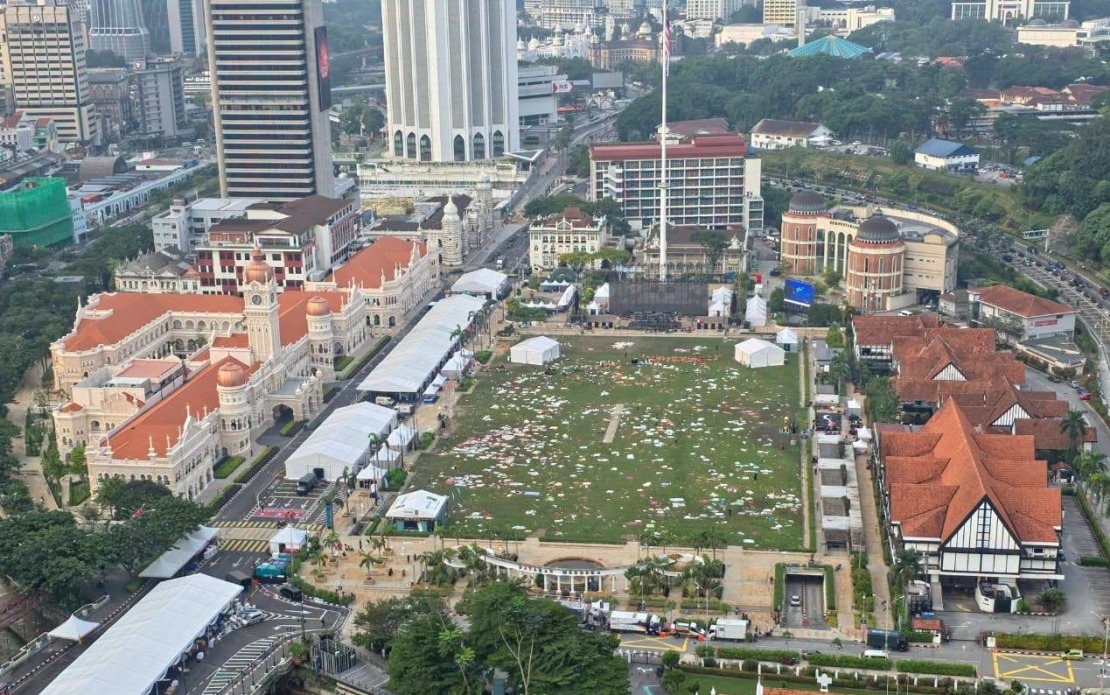
Hannah Yeoh, the Minister in the Prime Minister's Department overseeing Federal Territories, has acknowledged the dedication of Kuala Lumpur City Hall (DBKL) personnel who undertook extensive cleaning operations at Dataran Merdeka following the public screening of the 2026 FIFA World Cup final. The cleanup effort became necessary after crowds attending the outdoor event left considerable amounts of refuse scattered across the historic venue, drawing public attention to the state of Malaysia's most symbolically significant public spaces.
While recognizing DBKL's performance of its municipal obligations, Yeoh used the occasion to articulate a broader message about collective responsibility in maintaining civic spaces. She emphasized that the disposal of waste into provided receptacles represents a fundamental civic duty that extends beyond the remit of public employees, noting that contemporary citizens often view cleanliness in shared spaces as exclusively the responsibility of government agencies rather than as a shared commitment.
The minister's intervention reflects growing concerns among government officials about deteriorating standards in public space maintenance across major urban centers. Her statement underscores a tension that has emerged in Southeast Asian cities where rapid urban development and high-volume public usage create cleaning challenges that municipal services alone cannot adequately address without corresponding behavioral changes among residents and visitors.
Yeoh articulated this position clearly through a social media statement, rejecting the notion that taxpayers' financial contributions absolve individuals of personal responsibility. She stressed that the implicit social contract underlying public services operates in both directions—government agencies must deliver expected standards, but citizens simultaneously bear responsibility for not deliberately creating additional burdens through negligent disposal of waste. This framing challenges the increasingly prevalent attitude that paying taxes entitles individuals to treat communal spaces without regard for consequences.
The significance of Dataran Merdeka itself factored prominently in Yeoh's messaging. As Malaysia's independence monument and the historic heart of Kuala Lumpur, the venue transcends its role as an event space, functioning instead as a national symbol requiring protection and dignified maintenance by all Malaysians. The minister's invocation of this heritage dimension transforms the litter issue from a simple cleanliness concern into a matter touching on national pride and historical preservation.
The Malaysia MADANI framework, the government's overarching developmental agenda, featured centrally in the minister's articulation of broader civic expectations. Yeoh positioned individual responsibility for public space maintenance as integral to this national aspiration, arguing that societal advancement requires more than physical infrastructure development. The concept demands that citizens internalize values of respect and care for their surroundings, behaviors that government policies alone cannot mandate but must encourage through cultural reframing.
Prime Minister Datuk Seri Anwar Ibrahim's perspective on national progress, which Yeoh referenced, emphasizes that development metrics extending beyond economic indicators and construction projects must encompass how populations treat shared environments. This philosophical approach, increasingly prominent in development discourse across Asia, acknowledges that sustainability and livability cannot be achieved through government intervention exclusively but require fundamental shifts in public consciousness regarding environmental stewardship.
The minister's colloquial phrasing—"Don't dirty our own home and expect someone else to clean it"—demonstrates an attempt to make the concept resonant for ordinary Malaysians rather than framing it purely through administrative or policy language. This rhetorical strategy aims to trigger recognition of the paradox inherent in treating public spaces with less care than private residences, despite their importance to collective wellbeing.
For Malaysia and the broader Southeast Asian region, the Dataran Merdeka incident and official response illuminate persistent challenges in urban governance. Many cities in the region struggle with similar issues where high-volume public events generate substantial refuse management requirements, straining municipal resources. The situation highlights how individual behavioral change, while essential, often occurs slowly without concurrent infrastructure improvements, enforcement mechanisms, and sustained public awareness campaigns.
The incident also raises questions about event management protocols at major venues in the Federal Territories. Whether adequate refuse facilities were provided during the World Cup screening, how clearly signage directed attendees to proper disposal methods, and whether post-event cleaning costs factor into future event approval processes remain pertinent considerations. These operational questions intersect with the broader civic responsibility message Yeoh articulated.
The response from government officials suggests recognition that Singapore's more pristine public spaces, achieved partly through strict enforcement and public education, represent a model that Malaysia could aspire toward, though implementing similar approaches requires both institutional capacity and genuine shifts in community attitudes. The cultural messaging emphasizing shared responsibility may precede structural changes that make compliance easier or more automatic for users of public spaces.
Moving forward, sustaining momentum around public space maintenance will require coordination between multiple stakeholders. DBKL must continue delivering reliable cleaning services while government communications channels continuously reinforce civic responsibility messaging. Civil society organizations could amplify these messages through community programs, while event organizers might implement enhanced waste management protocols. Only through such multifaceted approaches can Malaysian cities hope to maintain standards befitting their status as modern metropolitan centers and repositories of national heritage.

