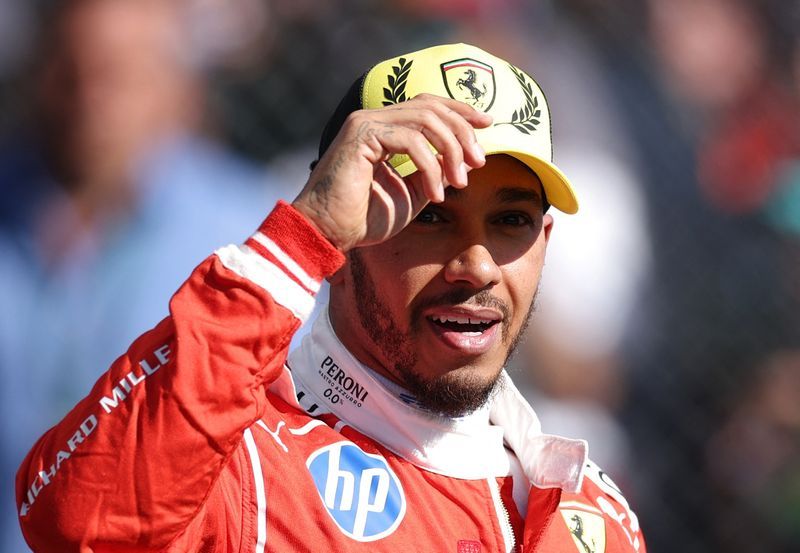
Lewis Hamilton arrives at the Hungaroring this weekend with momentum on his side, positioned to deliver Ferrari a confidence-building result before the Formula One season pauses for its August break. The seven-time world champion's transition to the Italian team is beginning to show tangible promise at a circuit that has historically favored his driving style and where circuit characteristics may finally neutralize some of the performance gaps that have plagued Mercedes' campaign thus far.
The Hungarian Grand Prix arrives at a critical juncture for the championship contenders. Mercedes finds itself in an unexpectedly defensive position, with George Russell's recent struggles threatening to derail what began as a season of title ambition. The Briton, once positioned as a championship frontrunner with the nickname 'Mr Consistency', has watched his campaign unravel dramatically. After suffering his third points-scoring failure of the season through a spin into the gravel at Belgium last Sunday, Russell now trails series leader Kimi Antonelli by a substantial 50 points. This reversal is particularly notable given Russell's pre-season credentials as the favorite for the drivers' crown.
In stark contrast, Antonelli's maiden Formula One season has blossomed into a masterclass in adaptation and consistency. The 19-year-old Italian Mercedes driver has accumulated six victories from ten races, a trajectory that has dominated paddock discussions and fundamentally altered the title narrative. His performance stands as a remarkable achievement for a rookie, particularly one operating within the framework of a team that should theoretically prioritize the experience and stability of an established world champion. Russell's struggles have been particularly acute on high-speed circuits where Mercedes' engine deficiency becomes most pronounced, with the car hemorrhaging substantial time on straights—a vulnerability that has systematized his difficulty in competitive qualifying and race situations.
Hamilton's recent uptick in competitiveness has repositioned him within striking distance of the title fight. Sitting 45 points behind Antonelli in second place overall, the Ferrari driver can utilize the Hungaroring's unique characteristics to his advantage. His historical dominance at this Budapest venue is simply staggering by contemporary standards. Hamilton has recorded eight victories in Hungary over his career, an unmatched tally at a single circuit, and stands within one victory of equaling his all-time record of nine wins at Silverstone. His most recent pole position came at this very track in 2023, demonstrating his continued competitive edge when conditions favor his approach to setup and tire management. The psychological advantage of competing at a familiar hunting ground cannot be underestimated, particularly as he seeks to rebuild momentum following his Ferrari switch.
The Hungaroring presents an entirely different strategic puzzle compared to the preceding rounds on the F1 calendar. Unlike Spa and other high-speed facilities where Mercedes' engine power deficit becomes mathematically insurmountable, Budapest's technical demands emphasize driver precision, car balance, and tactical decision-making over pure horsepower. Ferrari team principal Fred Vasseur has remained characteristically cautious in assessing his squad's prospects, resisting the temptation to declare the circuit a guaranteed advantage despite the obvious theoretical benefits. His measured commentary reflects the unpredictable nature of modern Formula One, where setup subtleties and tire preparation variables can quickly transform anticipated advantages into neutral or challenging conditions.
Vasseur's assessment of Ferrari's recent trajectory demonstrates calculated optimism rather than unbridled confidence. Charles Leclerc has emerged as the form driver for the Scuderia across the last two rounds, securing victory at Silverstone and second place in Belgium, while Hamilton claimed success in Barcelona before finishing third in Britain and fourth in the Belgian encounter. This performance gradient suggests that Ferrari's driver pairing has found some mechanical harmony, though consistency remains elusive. Leclerc's demonstrated speed across diverse track characteristics indicates that the team possesses a fundamentally capable package, with results increasingly dependent upon extracting maximum performance from available resources.
Antonelli's perspective on the forthcoming contest acknowledges the transformed competitive landscape that unfolds at technical circuits like Budapest. The Mercedes teenager has identified a four-way championship battle involving his own team, Max Verstappen's Red Bull operation, and the McLaren partnership, each capable of delivering strong performances when high-speed straightline advantage becomes less determinative. His comparison to Monaco—where raw pace and precision determine outcomes more than aerodynamic efficiency—captures the essence of how the Hungaroring strips away the technological advantages that have defined much of the season's hierarchy. Antonelli's measured confidence reflects his maturity in recognizing that championship momentum can shift rapidly when venue characteristics change.
McLaren's preparation for Hungary underscores the competitive intensity permeating the grid. The Woking-based outfit will introduce a comprehensive aerodynamic package featuring a new floor and various efficiency updates, while simultaneously trialing an experimental rear wing configuration designed to extract additional performance for upcoming high-speed contests. The team has also arranged for reserve driver Leonardo Fornaroli, winner of last year's Formula Two championship, to participate in Friday's opening practice session, allowing Oscar Piastri to preserve mental and physical freshness ahead of race day. Notably, McLaren achieved a one-two finish at Budapest last year with Lando Norris victorious and Piastri second, providing a template for success at this venue.
Aston Martin's Hungarian visit will involve the long-awaited introduction of their new chassis configuration, though the anticipated Honda power unit upgrade remains scheduled for the Dutch Grand Prix finale in late August. This staggered approach to development reflects the complex logistics of contemporary Formula One, where component integration and aerodynamic validation demand careful coordination. The team's willingness to debut a new chassis at a technical circuit suggests confidence in their upgrade trajectory and recognition that maximum grid competitiveness requires tactical sequencing of development initiatives.
The championship implications of this weekend extend beyond immediate points accumulation. Hamilton's opportunity to claim victory would provide Ferrari with crucial momentum entering the summer break, simultaneously offering the narrative of a former Mercedes legend establishing immediate success with his new team. Russell's need to reestablish consistency cannot be overstated, as extended underperformance risks fundamentally altering internal team dynamics and championship strategy calculations. Antonelli faces the dual challenge of maintaining his commanding points advantage while navigating a circuit that theoretically diminishes his team's power unit benefits.
For Malaysian and Southeast Asian motorsport enthusiasts, this weekend represents the culmination of the season's first distinct chapter, with the August break providing opportunity for teams to reset and implement major upgrades ahead of the campaign's closing phase. The uncertainty surrounding form reversals at different circuit types—a theme repeated throughout 2024—emphasizes that the championship remains genuinely unpredictable. Budapest historically proves that no single team can claim unassailable superiority, a characteristic that sustained Formula One's global appeal and explains why the sport maintains fervent followings across the region despite the geographic distance from European racing centers.

