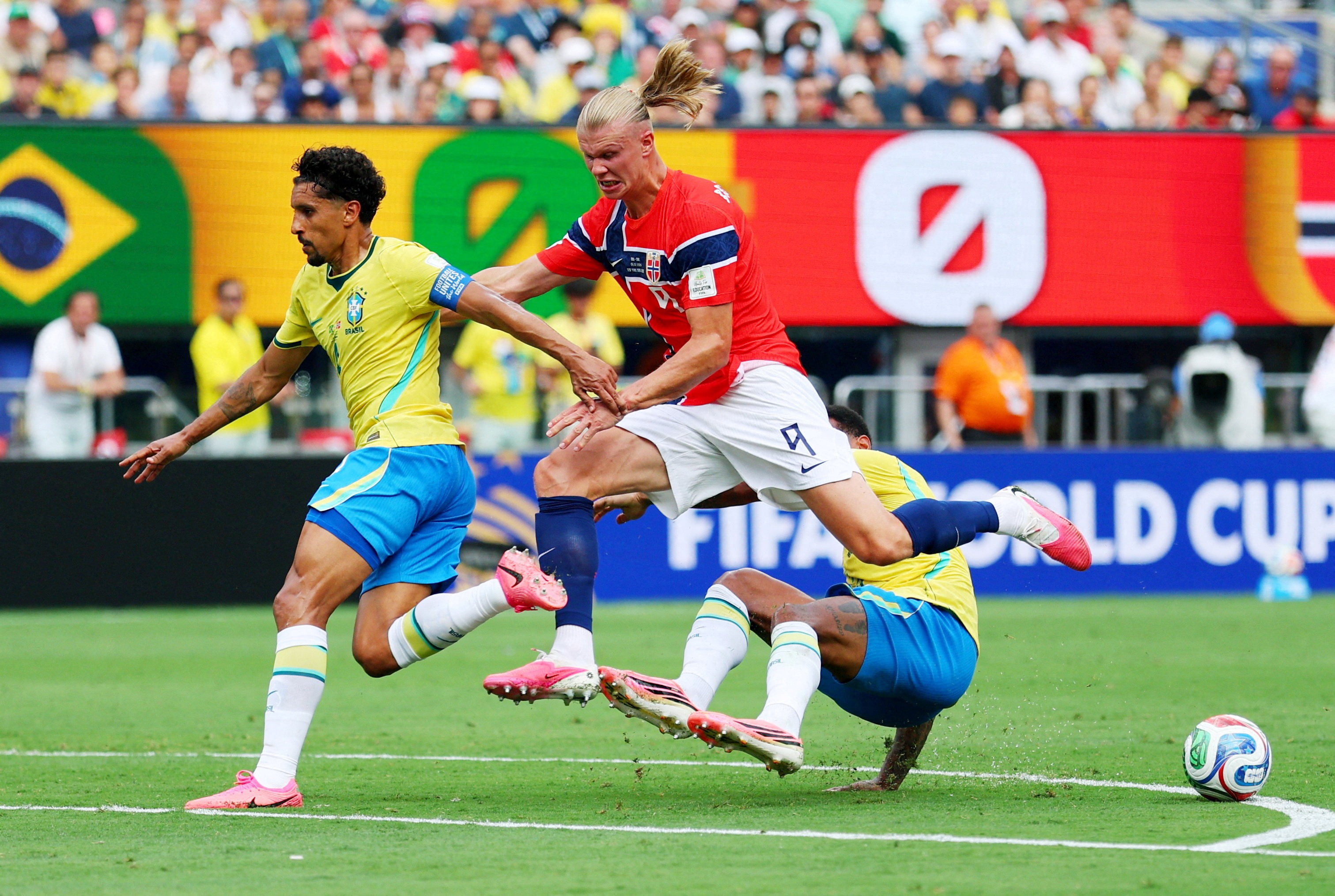
Norway has pulled off one of the tournament's greatest shocks, eliminating five-time world champions Brazil with a dramatic 2-1 victory at New York/New Jersey Stadium in the Round of 16. The result sends the Nordic nation into uncharted territory—their debut World Cup quarterfinal—while ending Brazil's long-standing aspirations in this edition of the competition. Erling Haaland's clinical finishing in the closing stages proved decisive, with both Norwegian goals arriving in a frantic final quarter-hour that turned the match on its head.
The decisive phase of the contest compressed into just 25 minutes, during which the three goals that decided the outcome found the back of the net. Haaland opened his account in the 79th minute when he capitalized on a pass from Andreas Schjelderup near the penalty area. The striker required only a single touch to set himself before unleashing a low header that deceived goalkeeper Alisson Becker, giving Norway a crucial one-goal advantage. The breakthrough appeared to catch Brazil off guard after a tightly contested match that had remained delicately balanced.
Haaland completed his brace in the 90th minute with a strike of equal composure and precision. Receiving possession outside the box, he struck a low drive that arrowed into the bottom corner with the kind of clinical finishing that has defined his tournament performance. The goal extended Norway's lead to two and virtually extinguished any realistic Brazilian comeback, demonstrating why the Manchester City forward has been among the tournament's most lethal finishers. This second goal elevated Haaland to seven goals in the competition, placing him level with Argentina's Lionel Messi and France's Kylian Mbappe at the summit of the 2026 World Cup's scoring standings.
Brazil did manage to reduce the deficit in stoppage time when Neymar converted a penalty kick in the 100th minute, offering a final dramatic moment that proved insufficient to alter the overall result. However, the late consolation could not mask a significant defensive collapse in the final stages. Notably, Brazil had earlier squandered a penalty opportunity of their own during the first half, with Bruno Guimaraes' spot kick being saved by Norwegian goalkeeper Orjan Nyland—a moment that might have shifted the momentum considerably had it been converted.
The result represents a remarkable achievement for Norway, a nation without prior World Cup quarterfinal experience. Breaking through to this stage constitutes the most significant milestone in their tournament history, affirming their status as genuine contenders despite entering as relative underdogs against Brazil's pedigree. The performance showcases how the expanded 48-team format of this World Cup has introduced genuine uncertainty to established hierarchies, allowing nations historically outside the elite tier to demonstrate championship-calibre football on the world's biggest stage.
Brazil's elimination marks a disappointing conclusion to their campaign, particularly as one of the tournament's traditional powerhouses with a decorated history of five world championships. The defeat will trigger significant reflection within Brazilian football circles regarding team construction, tactical preparation, and the pressure of maintaining expectations against emerging challengers. For a nation accustomed to deep tournament runs, early elimination by a Scandinavian opponent unfolds as a sobering outcome.
The 2026 World Cup, jointly hosted by the United States, Canada, and Mexico, has already produced multiple upset results that underscore the competitive balance within football's premier tournament. The expanded field of 48 teams means that margins for error have narrowed, and matches can swing decisively on individual moments of clinical finishing. Haaland's performance exemplifies how a single player operating at peak efficiency can determine outcomes against even the most accomplished opponents.
Haaland's continued goal-scoring prowess throughout the tournament has positioned him as a central narrative thread in this World Cup edition. His progress toward the Golden Boot award keeps his name in constant contention with Messi and Mbappe, generating sustained interest throughout the remaining matches. For Manchester City supporters and Norwegian football enthusiasts, his performances have delivered genuine world-class entertainment alongside tangible rewards for his national team.
The tournament is scheduled to conclude on July 19, with Argentina entering as defending champions. The remaining matches will continue to test whether the expanded format can sustain the quality of earlier rounds and whether traditional football powers can reassert dominance. Norway's advancement ensures that the quarterfinal stage will feature at least one compelling underdog narrative, while the remaining matches between now and the final will determine whether this World Cup truly represents a watershed moment in competitive football or merely an exceptional tournament run by a single Scandinavian nation.

