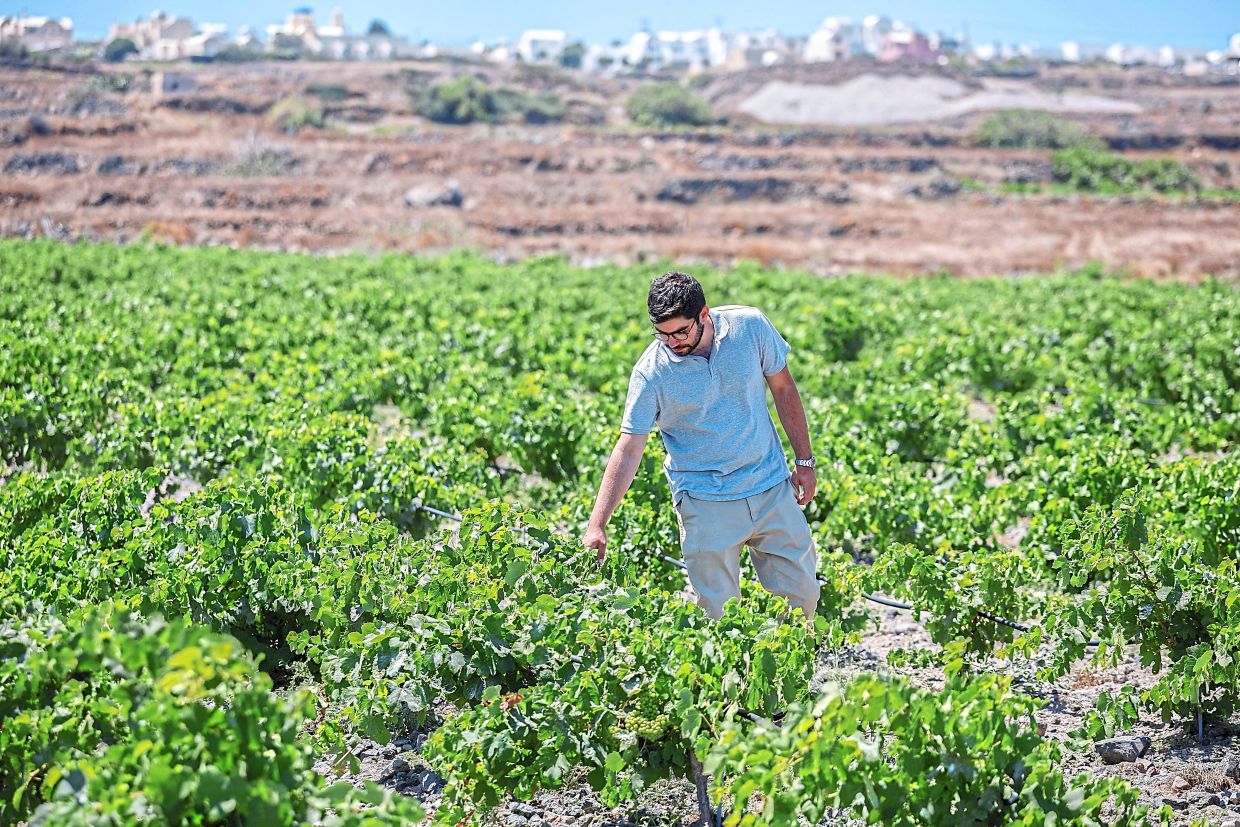
The sight of a 90-year-old vineyard withering away on the Greek island of Santorini encapsulates a crisis reshaping one of Europe's most storied wine regions. Yiannis Boutaris, a sixth-generation winemaker at Domaine Sigalas, watched as the distinctive basket-shaped "kouloura" vine succumbed to consecutive years of punishing heat and minimal rainfall. What once seemed like simply another seasonal challenge has become a defining existential threat as climate patterns shift decisively across the Mediterranean, forcing growers to fundamentally reimagine how they cultivate their prized grapes.
The transformation unfolding on Santorini mirrors a broader environmental emergency engulfing Greece. Between 2023 and 2025, the island has experienced persistently low precipitation combined with temperatures reaching their highest levels in six decades. This climatic squeeze has triggered a cascading series of economic and logistical problems: grape prices have surged, overall wine output has declined, and the already precarious freshwater supply has become dangerously strained. For an island economy heavily dependent on both tourism and viticulture, the twin pressures of mass visitor demand and agricultural collapse create an almost impossible situation.
The immediate consequences are visible in grape pricing, which reveals the severity of the shortage. Santorini's grapes now command premium prices reflecting scarcity, while in northern Greece's comparatively cooler regions, a kilogram fetches just €0.80. This price differential underscores how localized yet severe the crisis has become. According to Stefanos Koundouras, a viticulture professor at Aristotle University in Thessaloniki, Santorini experienced what he describes as "dramatic conditions" in 2023 and 2024, with temperatures pushing beyond any benchmark recorded in the preceding 60 years. Such extremes are no longer anomalies but signals of a new climatic reality.
For winemakers determined to preserve their tradition while acknowledging hard realities, innovation has become essential rather than optional. Boutaris and colleagues are piloting an approach borrowed from California: recycling wastewater from residential areas and hotels to irrigate vineyards. This represents a dramatic departure from conventional practice, yet proponents argue it offers dual advantages over the energy-intensive desalination plants that currently supply much of the island's water. By redirecting what would otherwise be treated discharge into agricultural use, growers reduce strain on already depleted freshwater reserves while avoiding the substantial operational costs of salt-water conversion.
Beyond wastewater reuse, Boutaris is experimenting with additional adaptive strategies. He is testing a shift from the traditional scattered planting pattern toward organized rows, a modification that makes mechanical and drip irrigation dramatically more efficient. Simultaneously, his team is investigating atmospheric water harvesting, a technology that sounds futuristic yet relies on straightforward principles: hydrogel compounds absorb moisture directly from air, and solar panels generate the thermal energy needed to release that captured water. This approach transforms humidity into a harvestable resource, particularly valuable during periods when conventional rainfall has virtually ceased.
Another prominent Santorini vintner, Yiannis Papaeconomou, is pursuing parallel adaptations. His six-year-old vineyard participates in the same wastewater initiative while employing subsurface irrigation systems that deliver water directly to roots rather than spraying from above. This technique dramatically reduces evaporative losses, a critical consideration when every drop counts. Additionally, Papaeconomou has restructured how his vines are trained on trellises, optimizing their positioning to receive irrigation more efficiently and reducing the total volume required to sustain healthy growth.
These individual efforts, while commendable, sit within a much larger contest for finite resources across Greece. During peak tourist seasons, Santorini's population swells with international visitors seeking beaches and wineries, creating competing demands from hotels, recreational facilities, and agricultural producers. Water that might have irrigated vineyards flows instead toward swimming pools and hospitality infrastructure. This dynamic places winemakers in a vulnerable position, forced to negotiate with more profitable tourism sectors for their share of scarce supplies. The broader Mediterranean wine industry faces similar pressures, suggesting that Santorini's struggles foreshadow challenges emerging across southern Europe.
Professor Koundouras articulates a sobering assessment: Europe's wine sector, particularly Mediterranean production zones, risks becoming fundamentally unsustainable if temperatures continue rising and precipitation becomes increasingly erratic. The stakes extend beyond economics to cultural and qualitative dimensions. "We are already seeing problems in the quality and special character of the wines," Koundouras noted, highlighting how climate stress alters not merely yield but the distinctive attributes that define regional wines. Consumers accustomed to Santorini's crisp, mineral-inflected whites may find those profiles shifting as heat-stressed vines produce different chemical compositions.
The willingness of Santorini's winemakers to embrace these experimental approaches reflects both pragmatism and determination to honor their heritage through adaptation rather than abandonment. Boutaris explicitly frames his work as preserving tradition by updating methods—a philosophy recognizing that viticulture has always evolved in response to environmental conditions, but the pace and magnitude of current changes demand unprecedented innovation. His wastewater project, conducted alongside local government and scientific institutions, represents a commitment to collaborative problem-solving rather than isolated crisis management.
For Southeast Asian observers, Santorini's experience carries instructive warnings and potential lessons. Mediterranean countries lie relatively distant from the region, yet the underlying dynamics—climate-driven water scarcity affecting agricultural productivity and forcing adaptation across entire sectors—directly apply to tropical and subtropical zones. Agricultural regions across Malaysia, Thailand, Vietnam, and Indonesia already confront rising temperatures, shifting monsoon patterns, and competing water demands between farming, manufacturing, and rapidly urbanizing populations. Santorini's pivot toward alternative water sources and efficient cultivation techniques offers a tested model for regional policymakers and farmers contemplating their own climate resilience strategies.
The island's response also illustrates how climate adaptation requires institutional coordination alongside individual innovation. Boutaris's wastewater initiative succeeds because it involves not merely a single winery but local authorities and scientific researchers working toward shared objectives. This institutional approach—bringing together government, academic expertise, and private enterprise—represents a framework increasingly essential as environmental pressures intensify globally. Southeast Asian nations developing climate adaptation policies might note how Santorini integrates multiple perspectives and resources rather than expecting winemakers alone to solve water crises.
Looking forward, the question is whether these incremental adaptations can scale sufficiently to preserve viticulture on Santorini and across Greece as climatic shifts continue. Individual innovations like atmospheric water harvesting and wastewater recycling demonstrate ingenuity, yet their collective capacity remains uncertain. Some agricultural scientists worry that technological fixes, while valuable, cannot fully compensate if temperatures and rainfall patterns shift beyond historical ranges within which Mediterranean agriculture evolved. This tension between optimism about human adaptability and concern about planetary-scale environmental change will likely define the coming decade for wine regions globally, with Santorini serving as both laboratory and cautionary tale.

