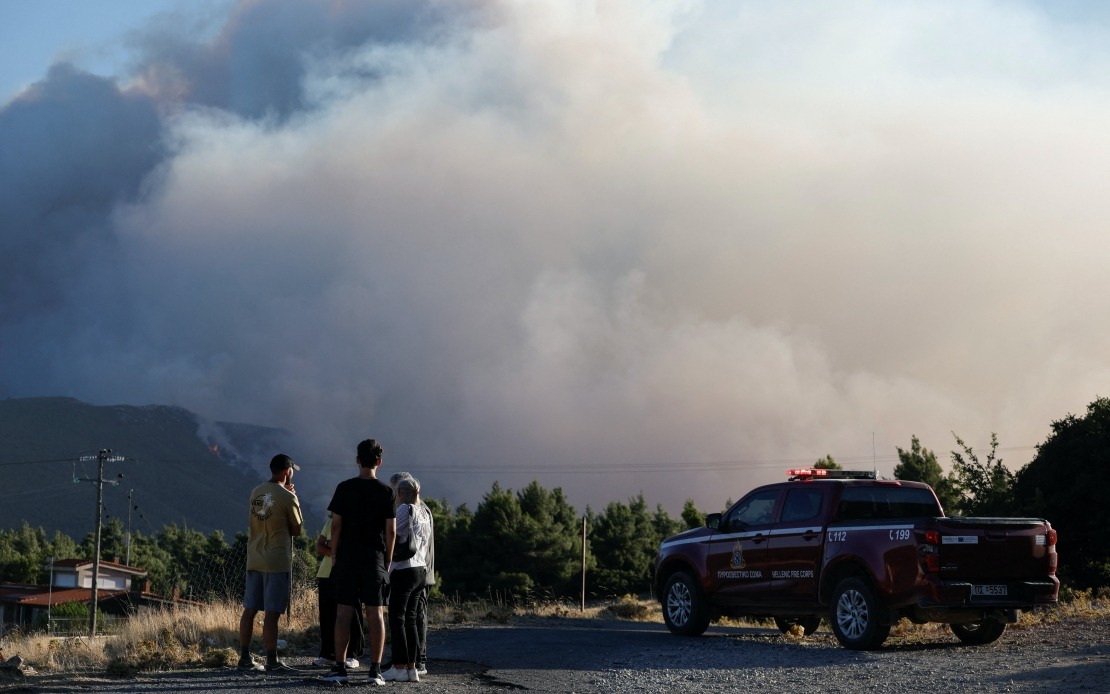
Greek authorities mobilised an unprecedented firefighting operation on Sunday as a sprawling wildfire consumed vast tracts of land west of Athens, advancing toward populated areas with alarming speed. The emergency response saw hundreds of firefighters, backed by military equipment and volunteer teams, work through the night in the Kithairon Mountains region to contain the rapidly spreading flames. As dawn broke, authorities intensified aerial operations, deploying firefighting aircraft and helicopters to attack the fire from above—a critical tactic in Greece's arsenal against such catastrophic blazes.
The scale of the operation underscores the severity of the situation. At least 500 firefighters were engaged in direct combat with the flames, a mobilisation that drew international support with crews from Romania and France joining their Greek counterparts on the ground. This international collaboration reflects the increasingly transnational nature of environmental crises in the Mediterranean region, where extreme heat and drought conditions transcend national boundaries. The deployment of heavy machinery and military vehicles alongside conventional firefighting units suggests authorities recognised early that conventional methods alone would prove insufficient against the ferocity of this particular blaze.
Meteorological conditions significantly exacerbated the crisis. Strong winds drove the fire's expansion in unpredictable directions, with flames advancing most aggressively toward the east. This wind-driven spread presented tactical challenges for firefighting teams, who struggled to anticipate the flames' trajectory and establish effective containment perimeters. The areas of Veniza and Psatha, situated in the fire's initial path, bore the brunt of the initial assault, with reports indicating substantial destruction across these communities. The meteorological context is crucial for regional readers: Greece's summer fire season, driven by high temperatures and low humidity, creates conditions where even controlled burns can escalate into uncontrollable infernos within hours.
Perhaps most alarming was the fire's approach to Megara, a city approximately 50 kilometres west of Athens with a population of around 28,000. Within days, the flames had advanced to within several kilometres of the urban centre, raising the spectre of an urban fire disaster that could dwarf recent Mediterranean precedents. The proximity of the advancing wildfire to a major population centre transformed what might otherwise be classified as a serious rural incident into a genuine threat to metropolitan infrastructure and residents. Authorities faced the dual challenge of simultaneously managing the spreading fire and potentially coordinating large-scale evacuations should the flames reach the city's outskirts.
Investigations into the fire's origins revealed a troubling pattern. Authorities arrested 13 individuals nationwide on charges related to negligent arson, indicating that human carelessness—whether through unattended campfires, discarded cigarettes, or agricultural burning practices—contributed significantly to the disaster. This criminal dimension adds a layer of policy complexity for Greek officials, who must balance emergency response with accountability mechanisms. For Southeast Asian countries with similar wildfire vulnerabilities, the arrest pattern highlights the necessity of robust public awareness campaigns and strict enforcement of fire management regulations, particularly during high-risk seasons.
The geographic scope of destruction extended well beyond the immediate fire zone. Meteorological assessments indicated that approximately 10,000 hectares of land across the northwest and western Athens region had been consumed by the current fires. To contextualise this for regional readers, 10,000 hectares represents roughly the area of 14,000 football fields—a landscape-scale transformation that will require decades of ecological recovery. This destruction pattern carries implications for watershed management, soil stability, and regional air quality, challenges that will persist long after emergency responders have extinguished the final flames.
The wildfire crisis was not confined to the Athenian region. Simultaneously, authorities contended with a major wildfire raging on Cephalonia, an island in the Ionian Sea, though state broadcaster ERT reported that immediate threats to populated areas appeared contained at the time of reporting. Additionally, the island of Crete had experienced severe wildfires, though media reports indicated these had largely been brought under control. Several communities on Crete had been evacuated preventatively, and local media estimated that up to 200 homes had been destroyed, though official confirmation of this figure remained pending. This multi-front crisis reflected a countrywide phenomenon rather than isolated incidents.
The sequence of events across these three geographic zones demonstrates the systemic nature of Greece's wildfire challenge during extreme summer conditions. Rather than a single catastrophic event, authorities confronted a cascading series of fire emergencies that fragmented resources and attention across multiple regions simultaneously. For Malaysia and other Southeast Asian nations with monsoon-driven fire seasons, this pattern offers instructive lessons about the importance of maintaining scalable, nationally coordinated firefighting infrastructure that can surge capacity across multiple incident zones without leaving any region inadequately defended.
The diplomatic dimension of the response—with Romanian and French crews deploying to assist Greek colleagues—underscores how environmental emergencies in the European context activate rapid mutual aid agreements and transnational emergency protocols. This collaborative model contrasts with historical patterns where nations guarded firefighting resources jealously. The willingness to share specialised personnel and equipment across borders reflects evolving European emergency management philosophy, one that recognises shared environmental vulnerabilities demand coordinated solutions. For the ASEAN region, where transboundary haze and smoke remain persistent challenges, the Greek example suggests potential models for enhancing subregional cooperation on wildfire management.
The humanitarian cost remained difficult to quantify at the time of reporting. While casualty figures were not prominently reported, the displacement of residents from threatened areas and the destruction of homes and agricultural land represented profound disruption to thousands of individuals. The psychological toll of witnessing landscape-scale environmental destruction, combined with the economic impact of destroyed property and lost agricultural productivity, would reverberate through affected communities for years. Insurance systems, agricultural subsidy programmes, and reconstruction initiatives would all face unprecedented demands.
Looking forward, the 2024 Greek wildfire season will likely prompt policy reassessment at both national and European Union levels. Questions will inevitably arise regarding forest management practices, building codes in wildland-urban interface zones, and the adequacy of emergency response infrastructure. The arrest of individuals on arson charges will also likely catalyse discussions about deterrence mechanisms and public education campaigns. For comparative perspective, Southeast Asian countries have similarly grappled with these policy questions following severe fire seasons, and the Greek experience offers both cautionary tales and potential solutions worth examining.
The broader context of intensifying fire seasons across the Mediterranean region points toward climate change as an underlying driver. Extended droughts, elevated summer temperatures, and altered precipitation patterns create conditions where vegetation becomes tinderbox-dry and fire seasons lengthen. This climatic trajectory has profound implications not only for Greece but for the entire Mediterranean basin, including North Africa and the Middle East. For Malaysia, situated in the tropics where both seasonal and episodic droughts interact with extensive vegetation, understanding Mediterranean fire dynamics offers insights into potential future fire regimes and adaptive management strategies that might prove necessary as climate patterns shift.

