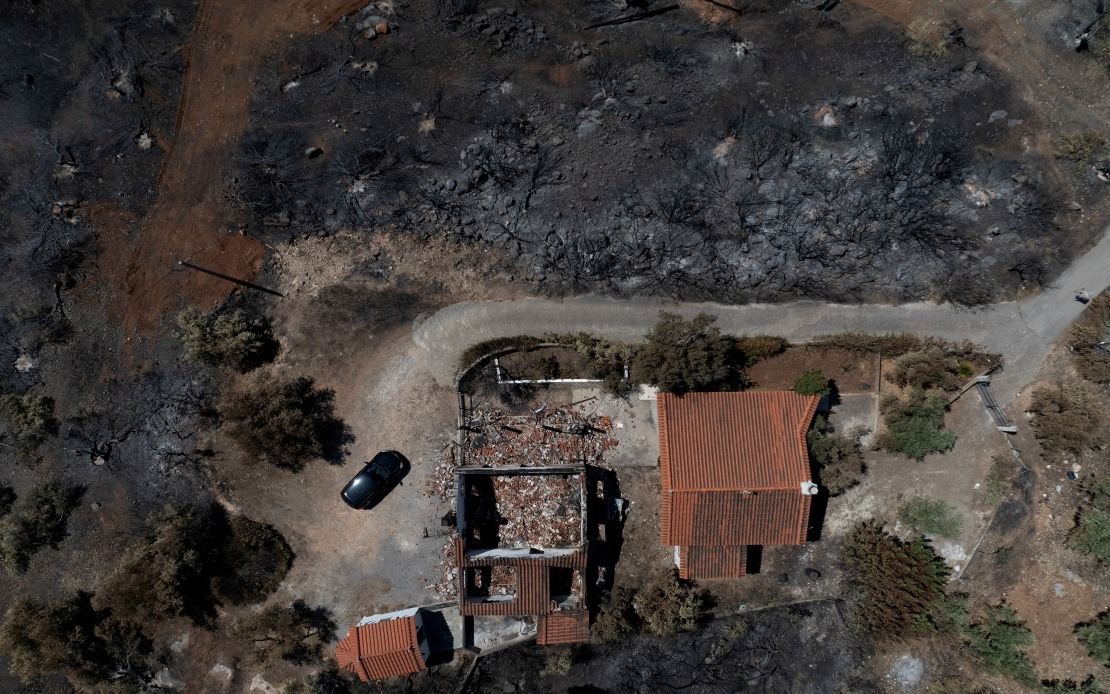
Greece's authorities escalated their wildfire response to the highest alert level on Wednesday, signalling an exceptionally dangerous day ahead for large portions of the country. The General Secretariat for Civil Protection, operating under the Climate Crisis and Civil Protection Ministry, designated Thursday as Category 4—the most severe rating on the wildfire risk scale—for the regions of Attica, Viotia, and Evia, which together encompass the capital city of Athens and surrounding vulnerable areas. This classification reflects meteorological conditions and fuel conditions that could allow fires to spread with exceptional speed and intensity, posing grave risks to communities and infrastructure across the densely populated regions.
The red alert declaration triggers the full mobilisation of Greece's National Civil Protection Mechanism, representing a comprehensive emergency posture involving coordination across multiple state agencies. Firefighting personnel, law enforcement, and military units have been positioned for immediate deployment, with both ground-based and aerial operations standing ready. The coordination structure ensures that resources can be deployed rapidly to any emerging fire, a critical capability given how quickly wildfires can escalate during extreme conditions. This level of institutional readiness underscores the severity that Greek authorities perceive in the coming weather and fire conditions.
Alongside heightened emergency readiness, authorities are implementing preventive restrictions designed to minimise human-caused ignition sources. Vehicle traffic into forested areas and natural reserves has been curtailed, and civilian access to vulnerable zones is being controlled through official checkpoint operations. These restrictions represent an attempt to reduce the universe of potential fire starts during the critical period, recognising that even small incidents can rapidly expand into major conflagrations when atmospheric and fuel conditions favour rapid spread. Residents have been explicitly urged by authorities to avoid outdoor activities that carry fire risk, including barbecuing, discarding smoking materials carelessly, or conducting any form of open burning.
The alert comes in the immediate aftermath of firefighting efforts against a significant blaze near Koropi, located southeast of Athens. This fire ignited in low vegetation within the Driggia area at approximately 1:45 pm local time on Wednesday and drew a substantial response involving 52 firefighters, including three specialised forest commando units equipped for terrain navigation and tactical suppression. The operation deployed 14 vehicles, four helicopters, and two water-dropping aircraft in coordinated efforts to contain the advancing flames. Local government authorities supplemented the state response by positioning water tankers, while sophisticated drone surveillance equipped with thermal and optical imaging systems tracked the fire's progression in real time. An arson investigation team was dispatched to determine whether the fire originated from deliberate incitement, accidental human activity, or natural causes such as lightning.
More concerning to Greek officials remains a substantially larger wildfire that ignited the previous week within Viotia and subsequently spread westward into Attica. According to satellite data from the European Union's Copernicus monitoring system, this major blaze has consumed approximately 14,424 hectares—an area exceeding 35,600 acres—making it a landscape-scale fire of significant proportions. Containment efforts have continued throughout the week as firefighting resources attempt to establish perimeter control and prevent further expansion of the burn zone. The sheer scale of this fire demonstrates the potential for wildfire activity in the region to overwhelm available suppression resources, a reality that contextualises the gravity of the red alert declaration.
The human toll of Greece's current wildfire season has already proven tragic. During aerial operations against the major Viotia-Attica blaze on Sunday, two firefighting helicopters collided in midair, resulting in the deaths of a Danish pilot and a Greek aerial coordinator. This incident represents not only a tragic loss but also a reminder of the extreme operational conditions under which firefighting personnel work during major incidents. The collision highlights the risks inherent in coordinating complex aerial operations in challenging terrain and atmospheric conditions, a hazard that becomes more pronounced when fire intensity and extent require maximum aircraft deployment. The incident may also raise questions about resource coordination and airspace management during large-scale firefighting operations.
For Southeast Asian observers, Greece's wildfire situation offers instructive parallels to regional fire challenges. Like parts of Malaysia and Indonesia, Greece experiences seasonal fire conditions that can rapidly escalate when weather patterns align with dry fuel conditions. The sophisticated monitoring systems, inter-agency coordination structures, and preventive alert mechanisms that Greece deploys represent institutional approaches that neighbouring Southeast Asian nations have progressively adopted in their own wildfire management frameworks. The integration of satellite monitoring, drone surveillance, and coordinated emergency response reflects evolving best practices in fire management that transcend geographic boundaries.
The red alert also underscores how climate-related extreme weather events are reshaping fire regimes in Mediterranean regions. The intensity and frequency of wildfire seasons have been increasing across southern Europe, a pattern consistent with climate change projections regarding shifting precipitation patterns and extended dry seasons. Greek authorities' escalation to maximum alert status reflects recognition that historical fire management protocols may prove insufficient for contemporary fire behaviour. This adaptation by government agencies—upgrading alert thresholds and pre-positioning resources more aggressively—represents an institutional response to changing environmental conditions that merit observation by regional governments facing similar pressures.
Operationally, the coordination mechanisms Greece has activated demonstrate the complexity of modern wildfire response. The integration of specialised forest commando units, aerial assets, drone surveillance, and ground-based firefighting units requires sophisticated command structures and real-time communication systems. The involvement of military forces alongside civilian fire services reflects the scale at which major wildfires can exceed traditional fire service capacity. This militarisation of civilian fire response, while operationally necessary during extreme events, also illustrates how wildfire management has evolved into a whole-of-government undertaking requiring coordination across institutional boundaries that typically remain separate during normal conditions.

