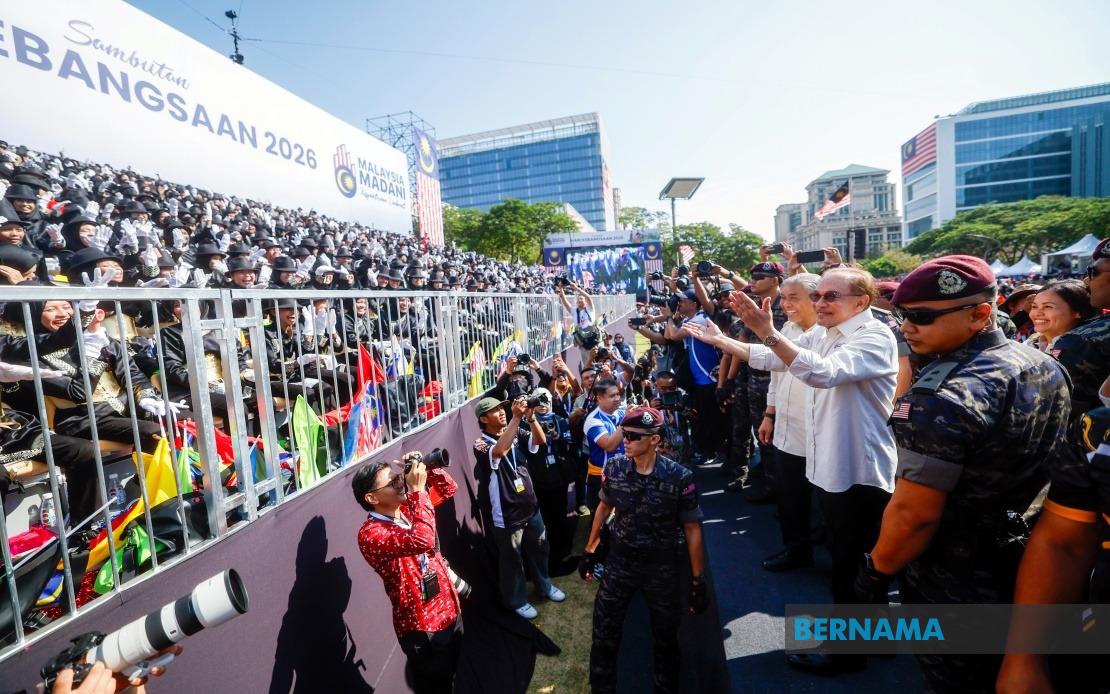
Prime Minister Datuk Seri Anwar Ibrahim expressed his heartfelt appreciation for the overwhelming public participation and execution of the 2026 National Day celebration held at Dataran Putrajaya on August 31. Describing the event as a "great show," Anwar commended everyone involved in organising the 69th National Day parade and those who turned out to celebrate Malaysia's independence, reflecting the nation's enduring commitment to unity and patriotism during uncertain regional times.
The festivities commenced at 8 am and were graced by the presence of His Majesty Sultan Ibrahim and Her Majesty Raja Zarith Sofiah, Malaysia's reigning monarchs. Anwar and his wife, Datuk Seri Dr Wan Azizah Wan Ismail, received Their Majesties alongside Communications Minister Datuk Seri Fahmi Fadzil, who chairs the 2026 National Day and Malaysia Day main committee. This high-level attendance underscored the event's significance as a showcase of governmental commitment to national cohesion and shared prosperity.
The parade itself demonstrated Malaysia's capacity for large-scale public spectacles centred on the Malaysia MADANI vision—a governance framework emphasising citizen well-being and respect for diversity. The procession featured 10,819 participants distributed across 76 contingents and 22 marching bands, supplemented by 11 decorated vehicles and 328 land, sea and air assets. Notably, the event incorporated modern sustainability messaging through the inclusion of 22 electric vehicles, signalling the government's environmental consciousness to younger audiences. Additionally, 112 service animals and human graphics performances on the terraces added visual dynamism to what observers described as a colourful, patriotic spectacle.
Public engagement exceeded organisational expectations, with attendance surpassing 100,000 individuals. Many Malaysians camped at Dataran Putrajaya from the evening before, while substantial crowds arrived early on celebration day, indicating genuine enthusiasm rather than mandated participation. After the formal proceedings concluded, Anwar walked more than 500 metres through the crowd, stopping for photographs and direct conversations with attendees—a deliberate strategy to project accessibility and demonstrate that leadership remains accountable to ordinary citizens even during ceremonial moments.
The public interaction yielded spontaneous expressions of gratitude regarding recently announced subsidies. One attendee specifically thanked the Prime Minister for restoring the monthly basic eligibility quota under the BUDI MADANI RON95 (BUDI95) programme from 200 litres to 300 litres, a benefit Anwar had announced during his National Day address the previous day. This exchange illustrated how economic policy decisions directly resonate with household finances, particularly affecting Malaysia's substantial lower-income and middle-income populations who depend on fuel subsidies for transportation and livelihoods.
The subsidies announced on August 30 represented significant government expenditure commitments addressing cost-of-living pressures facing ordinary Malaysians. The BUDI95 restoration benefits more than 16 million users of subsidised RON95 petrol, making it among the broadest social safety-net initiatives in recent years. Complementing this, the government committed to providing more than half a million eligible owners of diesel-powered pickup trucks and jeeps with up to 400 litres of BUDI Diesel monthly, effective September 1. These vehicles form the backbone of Malaysia's agricultural, fishing, and construction sectors, industries vital to provincial economies often overlooked in urban-centric policy discussions.
For Malaysian observers tracking government priorities, these announcements signal a recalibration toward addressing inflation and household purchasing power—concerns that dominated public sentiment following years of price increases. The timing of subsidy restoration announcements alongside National Day celebrations strategically positioned the government as responsive to citizens' economic anxieties while simultaneously celebrating national identity. This nexus between patriotic observance and tangible economic policy demonstrates how contemporary governance increasingly intertwines symbolic nationalism with material welfare provisions.
The parade's architectural narrative—centring on Malaysia MADANI—warrants examination for what it reveals about governmental self-presentation. The theme "Malaysia MADANI: Kesejahteraan Dinikmati" translates to emphasising well-being actively enjoyed rather than merely promised. This rhetorical positioning attempts to counter perceptions that development has remained unevenly distributed or that prosperity remains aspirational rather than actual for many Malaysians. The inclusion of diverse contingents, service animals, and electric vehicles within parade formations reinforced messaging about inclusivity and environmental responsibility, constituencies that have increasingly demanded political attention across Southeast Asia.
From a regional perspective, Malaysia's successful execution of large-scale public celebrations during a period of global political volatility and deepening geopolitical tensions carries implications beyond domestic symbolism. Countries throughout Southeast Asia have faced challenges organising major national commemorations amid polarisation, and Malaysia's ability to maintain National Day traditions attracting genuine mass participation demonstrates institutional resilience and sustained commitment to secular, unifying national narratives. This contrasts with some neighbouring nations where similar events have become flashpoints for communal tensions or governmental demonstrations of control rather than expressions of shared identity.
For Southeast Asian observers monitoring Malaysia's political stability and social cohesion, the 2026 National Day celebration offered reassuring evidence that despite contentious domestic political developments in preceding months, mechanisms for collective national expression remain functional and command public enthusiasm. The spontaneous expressions of appreciation from attendees regarding welfare policies suggest that Malaysian citizens remain receptive to government messaging when material benefits accompany patriotic appeals. This observation carries relevance for regional governance studies examining how democratic societies maintain legitimacy through combining symbolic nationalism with concrete economic delivery.
Looking forward, the apparent success of the 2026 National Day celebration and the positive public response to subsidy announcements will likely influence government strategy regarding future major national events and policy announcements. If attendance figures and media coverage translate into improved perceptions of governmental responsiveness, the Anwar administration may pursue similar strategies of coupling ceremonial occasions with significant welfare policy announcements. For ordinary Malaysians, particularly those dependent on fuel subsidies and residing in provincial areas distant from Putrajaya, the substantive commitments announced during National Day period carry greater consequence than the parade itself, determining whether patriotic enthusiasm translates into measurable improvements in household economics during coming months.

