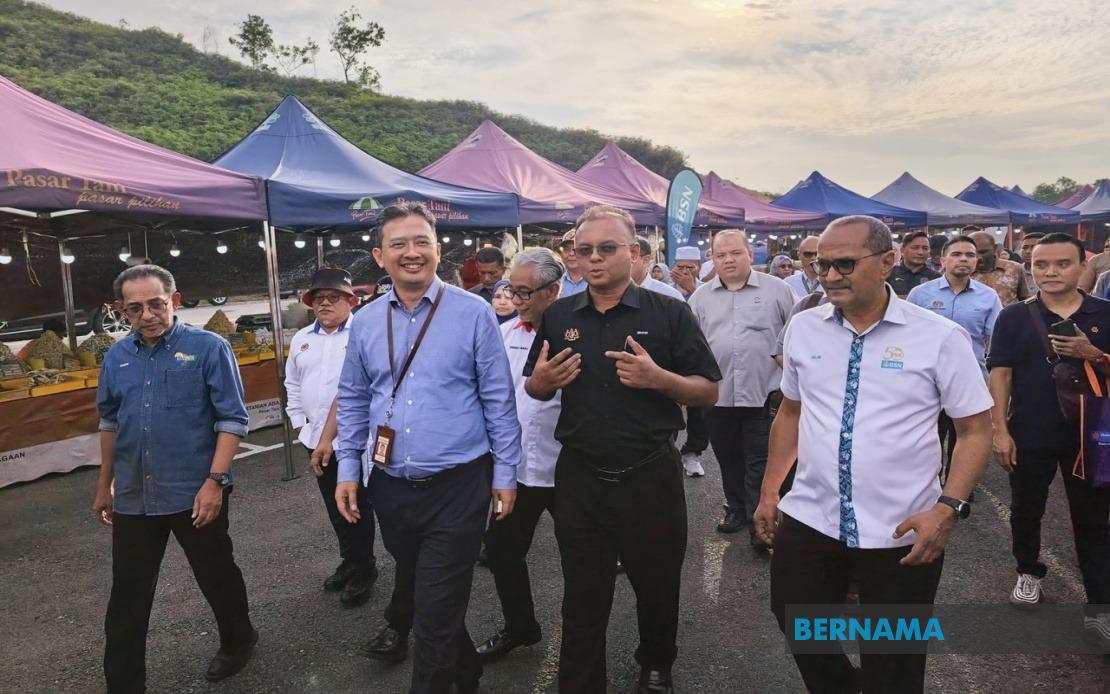
The Malaysian government is shifting into a more aggressive phase in its push to connect entrepreneurs and street traders with a substantial pool of micro-financing resources, acknowledging that awareness of existing facilities remains a significant barrier to uptake. Treasury Secretary-General Tan Sri Johan Mahmood Merican outlined the challenge plainly: despite RM5 billion in micro-credit commitments spread across six major financial institutions, many eligible business owners remain unaware of these opportunities and the specific mechanisms through which they can apply.
The coordinated effort represents a strategic pivot toward ground-level engagement rather than relying solely on traditional advertising channels. Speaking at the Putrajaya Pasar Tani Visit Programme, Johan indicated that all relevant agencies would be mobilised to operate at the grassroots level, with particular focus on small traders, hawkers, and market operators who often lack the bandwidth or digital connectivity to navigate formal financial applications. The initiative reflects Prime Minister Datuk Seri Anwar Ibrahim's broader agenda to support informal and semi-formal economic actors who constitute a significant portion of Malaysia's employment and entrepreneurial base.
The RM5 billion facility operates through six distinct channels: Agrobank, Bank Simpanan Nasional (BSN), Bank Rakyat, TEKUN Nasional, Amanah Ikhtiar Malaysia (AIM), and Majlis Amanah Rakyat (MARA). This multi-agency approach provides multiple pathways tailored to different borrower profiles, though the diversity of institutions has apparently created confusion among potential applicants. The government's realisation that fragmentation requires a unified communication strategy underscores a common administrative challenge in implementing large-scale financial inclusion programmes—even well-funded schemes can fail if beneficiaries cannot easily identify how to access them.
Feedback collected during the Putrajaya market visit revealed that most traders had previously benefited from government financing, with several having accessed funds on multiple occasions. This suggests that initial uptake among engaged segments is functioning reasonably well, but that passive awareness remains weak among those less connected to financial institutions or government outreach. The fact that traders with existing relationships could articulate positive experiences implies that the quality and appropriateness of available products are not inherently problematic; rather, the distribution of information and accessibility of application processes require enhancement.
Agrobank's engagement series at farmers' markets has already generated momentum, accumulating over 160 applications worth RM6.4 million since the programme began. Agrobank president and chief executive officer Datuk Tengku Ahmad Badli Shah Raja Hussin characterised the response as demonstrably positive, particularly among hawkers and micro-entrepreneurs who valued financing solutions designed specifically for their operational realities. The bank's observation that traders appreciate accessibility, physical proximity, and products aligned with daily business cycles offers crucial insight into why traditional banking channels often fail to serve this demographic effectively.
The expanded support ecosystem extending beyond pure financing reflects recognition that capital injection alone is insufficient for sustainable business development. Agrobank's integrated offering includes financial advisory services, takaful protection schemes, business digitalisation support, and financial literacy programmes. This comprehensive approach acknowledges that micro-enterprises often suffer from multiple constraints simultaneously—capital scarcity, limited management capabilities, and competitive pressures from larger competitors—requiring multifaceted intervention rather than narrow credit provision. The inclusion of digitalisation support particularly addresses the challenge of informal traders maintaining competitiveness as consumer behaviour and market dynamics shift toward digital transactions and online commerce.
For Malaysian entrepreneurs and traders, the practical implications of this intensified awareness campaign are significant. The government is explicitly committing resources to bring information and application support directly to markets and trading zones rather than requiring applicants to navigate banking channels independently. This structural shift reduces friction costs and recognises the time constraints faced by individuals operating business-as-usual while simultaneously managing financial applications. The ground-level approach also enables relationship building between financial institutions and traders, facilitating longer-term engagement and potentially establishing patterns of repeat borrowing and business development.
Regionally, Malaysia's emphasis on micro-financing accessibility within the informal and semi-formal economy reflects broader Southeast Asian policy trends recognizing that inclusive growth requires reaching beyond conventional banking relationships. The approach aligns with international development priorities emphasizing financial inclusion as a pathway to poverty reduction and entrepreneurial development. However, the challenge of coordinating across multiple agencies remains instructive for neighbouring countries wrestling with similar scale and fragmentation issues.
Monitoring price stability forms a complementary dimension to the government's micro-finance acceleration. The Agro-food Supply and Marketing Monitoring and Intervention (SISDA) portal operated by the Federal Agricultural Marketing Authority (FAMA) provides real-time price tracking across traders participating in farmers' markets, functioning as both a transparency mechanism for consumers and an early warning system for authorities. This integration of financing, business support, and market price monitoring suggests a more holistic approach to supporting agricultural and food trading sectors, recognising that credit access without attention to commodity pricing and market conditions provides incomplete economic support.
The success of this intensified awareness campaign will ultimately depend on execution consistency and measurement of actual loan disbursement, not merely applications received. Government agencies will need to sustain ground-level engagement beyond initial high-visibility visits, develop streamlined application processes cognisant of trader capabilities, and ensure that financing terms remain genuinely accessible rather than nominally available. The private sector's role, particularly banking partners like Agrobank and BSN, will be critical in translating awareness into functional access, requiring institutional commitment extending beyond participation in photo-opportunity market visits.

