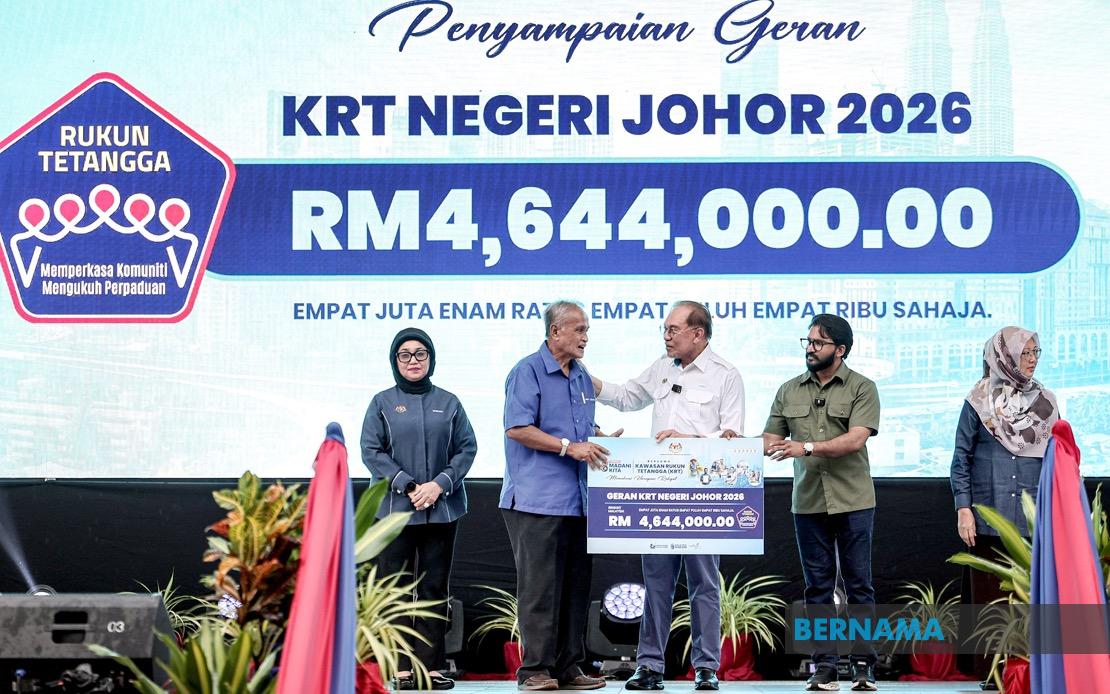
Prime Minister Datuk Seri Anwar Ibrahim has approved a significant enhancement to community funding nationwide, lifting the annual Neighbourhood Watch Area, or KRT, grant to RM10,000 from the previous RM6,000. The new funding level will commence distribution on January 1, 2027, marking the first meaningful increase to the programme in ten years. The decision was announced during the MADANI KITA Programme at Dataran Segamat, attended by Deputy Minister of National Unity R. Yuneswaran and Deputy Minister of Domestic Trade and Cost of Living Datuk Dr Fuziah Salleh.
The prolonged stagnation of KRT funding at RM6,000 prompted the government's reassessment of the neighbourhood security apparatus. According to the Prime Minister, the decision to boost allocations reflects recognition of the institution's pivotal contribution to grassroots governance and community resilience. Anwar indicated that all KRTs demonstrating transparent reporting of development initiatives and community activities would benefit from the raised grant, thereby incentivising accountability and sustained engagement across the country's neighbourhood networks.
Beyond the numerical increase lies a deeper strategic consideration regarding how local institutions function as intermediaries between central government and communities. KRTs have historically served as vital conduits for addressing security concerns, social cohesion, and welfare matters at the neighbourhood level. By strengthening their financial capacity after a decade of budgetary constraint, the government acknowledges that effective grassroots governance requires adequate resourcing. The timing of the increase also signals confidence in the KRT model as a mechanism for addressing contemporary challenges in an increasingly complex social environment.
The Prime Minister emphasised that KRT's institutional strength directly supports the broader national project of maintaining harmony across Malaysia's diverse demographic landscape. He articulated a vision in which the country's multicultural and multireligious composition represents a foundational asset rather than a liability. This framing positions community-level institutions like KRTs as essential guardians of that unity, tasked with nurturing consensus and democratic participation among neighbours across different backgrounds. Anwar cautioned against weaponising cultural and religious differences as sources of division, instead advocating their celebration as expressions of national character.
The grant increase announcement accompanied two additional allocations targeting institutional development in Johor. An immediate RM3.205 million fund was released for sixteen basic infrastructure repair and upgrading projects across Islamic educational facilities, including religious schools, madrasahs, study centres, and tahfiz institutions spanning multiple districts including Batu Pahat, Muar, and Segamat. This parallel investment underscores the government's broader commitment to enhancing facilities within the Islamic education sector, recognising that comfortable and conducive learning environments directly influence educational outcomes and community confidence in public institutions.
Separately, the Prime Minister approved RM1.0 million in immediate funding for critical and urgent repair work at Royal Malaysian Police quarters in Johor. This allocation addresses welfare considerations for security personnel, acknowledging that adequate housing and facility standards contribute to morale, retention, and operational effectiveness. The government positioned the investment as integral to honouring the commitment of law enforcement professionals to national peace and security, thereby treating personnel welfare as inseparable from institutional capacity.
For Malaysian readers and policymakers, the KRT grant increase carries several implications. Neighbourhood watch organisations form the backbone of community-based security and social cohesion efforts across the nation. Enhanced funding enables these groups to expand programmes, improve equipment, conduct training, and strengthen their engagement with residents. This proves particularly relevant in an era when social fragmentation and digital misinformation pose challenges to neighbourhood stability and interethnic understanding. Better-resourced KRTs can more effectively counter divisive narratives at the community level and foster the kind of everyday interaction that builds genuine relationships across difference.
The decision also reflects broader budgetary readjustment within the MADANI framework. Ten years without inflation-adjusted increases to grassroots allocations had effectively reduced real purchasing power and operational capacity. The jump to RM10,000 represents approximately a 67 percent increase, yet must be contextualised within inflationary pressures since 2017. This suggests the government recognises that neighbourhood institutions require periodic recalibration to remain functional and relevant. For other federal or state-level programmes languishing without recent adjustment, the KRT precedent may signal a willingness to revisit long-frozen allocations.
Regionally, Malaysia's emphasis on strengthening community-level governance mechanisms through targeted funding investment offers a template worth noting. Many Southeast Asian nations grapple with similar challenges of maintaining social cohesion amid rapid urbanisation, digital connectivity, and demographic pluralism. The KRT model, underpinned by adequate financial resources, represents a pragmatic investment in preventive security and social stability rather than reactive intervention. By treating neighbourhood watch organisations as integral to governance and allocating resources accordingly, Malaysia positions itself as forward-thinking in recognising that national resilience ultimately depends on strength at the hyperlocal level.
The announcement also carries implications for the government's broader MADANI agenda, which emphasises inclusivity, prosperity, and institutional strengthening. The parallel investments in Islamic education facilities and police personnel quarters demonstrate a multifaceted approach to governance capacity. Rather than viewing these investments as competing priorities, the government frames them as interconnected elements of a cohesive vision. Islamic educational institutions shape values and social understanding among younger generations, whilst adequately resourced police and neighbourhood networks ensure the security environment within which communities can thrive.
Implementation details regarding disbursement mechanisms, eligibility criteria for KRTs, and monitoring of fund utilisation remain to be clarified through subsequent government notices. The January 1, 2027 commencement date provides sufficient time for administrative preparation and advance communication to KRT leadership across the country. Organisations will need guidance on documentation requirements and reporting procedures to ensure transparent and efficient distribution. Given the decade-long dormancy of KRT grant increases, clear communication of the new arrangement and its rationale will be essential for maximising the credibility and effectiveness of the enhanced funding.
The Prime Minister's framing of the KRT grant increase as a statement of commitment to grassroots stability and communal harmony reveals a government conscious of bottom-up pressures on national unity. Rather than treating security and social cohesion as matters requiring top-down mandates alone, the MADANI framework invests in institutions and mechanisms that empower communities to themselves be custodians of these values. This distributional approach to governance, underpinned by adequate resourcing, may prove more durable and legitimate than centralised approaches that neglect neighbourhood-level agency and capacity.