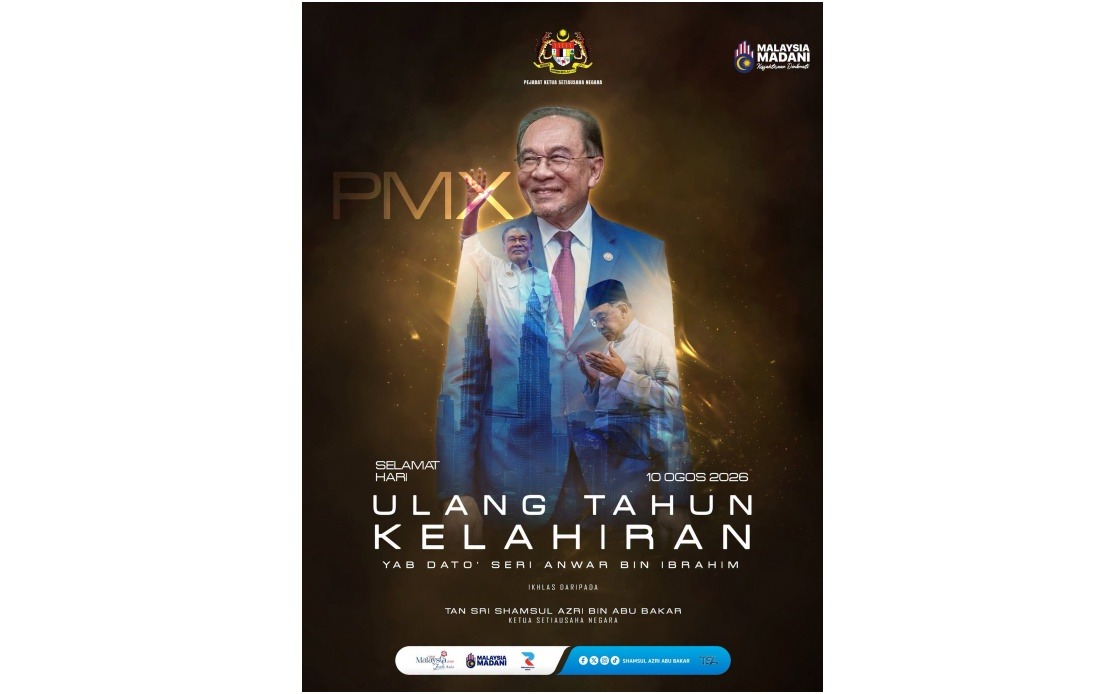
Senior government officials have extended warm birthday wishes to Prime Minister Datuk Seri Anwar Ibrahim as he turns 79, with expressions of support for his ongoing leadership and reform initiatives. Chief Secretary to the Government Tan Sri Shamsul Azri Abu Bakar conveyed the greetings on behalf of the civil service establishment, underscoring the institution's commitment to backing the Prime Minister's vision for public sector transformation.
The Chief Secretary's message carried particular significance given his pivotal role in overseeing the machinery of government across Malaysia. In his Facebook statement, Tan Sri Shamsul Azri expressed hopes that the Prime Minister would maintain robust health and mental acuity as he continues navigating the complex demands of leading Southeast Asia's third-largest economy. The gesture represents more than ceremonial protocol—it signals institutional alignment during a period when Malaysia's government has been pursuing substantial reforms across multiple sectors.
Beyond personal well-wishes, Tan Sri Shamsul Azri reaffirmed the civil service's determination to remain steadfast in supporting what he characterized as the Prime Minister's aspirations and the broader reform agenda for public administration. This commitment carries implications for how Malaysia's 1.6 million civil servants will approach their duties in coming months. The civil service remains crucial to implementing government policy, and explicit pledges of institutional support from its top administrator suggest continuity in pursuing the modernization initiatives that have defined the current administration's tenure.
The Prime Minister's Office reinforced these sentiments through a separate video message shared on social media, employing language that balanced acknowledgment of ongoing effort with spiritual conviction. The phrase "Efforts continue, the trust is fulfilled, and to Allah SWT we place our trust" suggests a framing of governance as a sacred responsibility, appealing to the predominantly Muslim electorate while emphasizing perseverance in addressing national challenges. This theological dimension reflects how Malaysian political discourse frequently interlaces spiritual values with governance narratives.
The Malaysia MADANI initiative, the government's flagship transformation framework, also issued birthday greetings through its official social media channels. The MADANI agenda—which encompasses prosperity, unity, integrity, and faith—has served as the conceptual backbone for much of the administration's policy direction since its inception. By extending wishes through this institutional account, the government reinforced the ongoing connection between the Prime Minister's leadership and this comprehensive development philosophy.
At 79 years old, Prime Minister Anwar Ibrahim ranks among the oldest serving heads of government in the Southeast Asian region. His tenure has been marked by efforts to rebuild institutional credibility following Malaysia's political turbulence in preceding years. The coordinated nature of these birthday wishes from multiple government institutions suggests a carefully curated message of institutional stability and unified direction, particularly important given Malaysia's history of political fragmentation and factional disputes within governing coalitions.
The timing of these public expressions of support also carries subtle political messaging. By having the Chief Secretary, the Prime Minister's Office, and the MADANI framework all issue birthday wishes, the administration demonstrates institutional coherence and suggests that various power centers within government remain aligned around the Prime Minister's leadership. Such coordination can matter considerably in Malaysian politics, where appearances of disunity have previously triggered market jitters and public concern about governance continuity.
For Malaysian civil servants, the Chief Secretary's explicit pledge of institutional support for the reform agenda signals expectations for continued implementation efforts. The public service in Malaysia has undergone considerable scrutiny regarding efficiency, accountability, and service quality. The reaffirmation of commitment to reform suggests that civil service modernization initiatives will likely remain a priority, potentially affecting workplace processes, training programs, and performance management systems across government agencies.
The birthday wishes also underscore the personal and institutional dimensions of Malaysian governance. While ceremonial expressions of support are common in most democracies, they assume particular significance in Malaysia's political context, where personal relationships and institutional loyalty have traditionally played outsized roles in determining political outcomes. The coordinated messaging from multiple official channels reflects sophisticated political communication strategy aimed at reinforcing the Prime Minister's authority and the legitimacy of his administration's direction.
Regionally, Malaysia continues to seek influence as a moderate Muslim-majority nation with significant economic importance and strategic geographic position. A Prime Minister perceived as healthy, capable, and supported by stable institutions enhances Malaysia's standing in regional discussions and international relations. The public expressions of institutional confidence therefore carry implications extending beyond domestic politics into Malaysia's regional engagement and its positioning within ASEAN and broader Asia-Pacific affairs.

