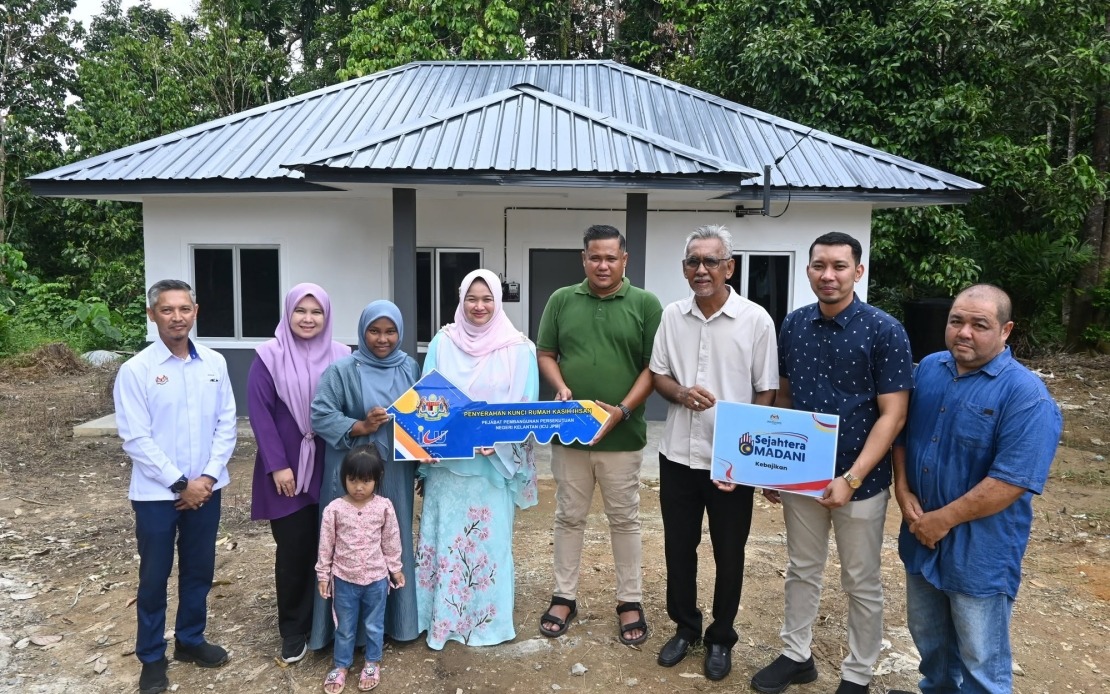
Prime Minister Datuk Seri Anwar Ibrahim's administration has accelerated its housing assistance programmes by distributing Rumah Kasih Ihsan residences to deserving families in Jeli, Kelantan, marking another step in the government's commitment to addressing housing insecurity across the nation. The initiative, coordinated through the Kelantan Implementation Coordination Unit (ICU) operating under the Prime Minister's Department (JPM), demonstrates how federal agencies are working to translate policy commitments into tangible improvements in citizens' lives at the district level.
The Rumah Kasih Ihsan programme represents a targeted approach to housing development that prioritises vulnerable populations often overlooked in conventional development schemes. Unlike large-scale construction projects that capture headlines, these individual home allocations address a fundamental human need—safe, dignified shelter—for families who otherwise lack the financial capacity to secure adequate housing. The programme underscores a philosophical shift in how development is measured and valued within the administration's governance framework.
Two families in Jeli received support through this initiative during the recent handover ceremony overseen by Dr Wan Nur Ibtisam Wan Ismail, the Kelantan ICU JPM director. For Yusof Mohamed Nawawi in Kampung Renyut, the programme provided a letter of acceptance for constructing an entirely new dwelling to replace his existing, substandard structure. This approach acknowledges that simply providing monetary assistance proves insufficient; direct involvement in the construction process ensures quality standards and protects beneficiaries from exploitation or inadequate outcomes. The second beneficiary, Shamsul Bahri Che Musa, received complete transfer of his newly constructed home, ready for immediate occupation.
Complementing the housing handovers, both families were presented with food baskets as a symbolic gesture extending beyond shelter provision. This multi-faceted approach recognises that housing security cannot exist in isolation from food security and overall welfare. The government's willingness to bundle complementary assistance reflects understanding that vulnerable households face interconnected challenges requiring holistic solutions rather than single-issue interventions.
Kelantan, Malaysia's poorest state by conventional economic metrics, has historically struggled with housing deficits affecting both rural and urban populations. The ICU's focus on implementation at the state level suggests the federal administration recognises that centralised policies require localised execution to achieve meaningful results. By embedding coordination units within state governance structures, the government creates accountability mechanisms that bridge federal intentions and ground-level realities, reducing bureaucratic distance between policymakers and affected communities.
The philosophical framing offered by the Kelantan ICU JPM—that housing extends beyond shelter to encompassing hope, dignity, and prosperity—reflects evolving development discourse in Malaysia. This perspective challenges purely quantitative measures of progress, questioning whether economic growth statistics reveal the actual quality of life experienced by ordinary citizens. For residents in districts like Jeli, where poverty rates exceed national averages and housing quality remains significantly below urban standards, this reorientation toward people-centred metrics carries practical importance.
The programme's emphasis on meaningful development being assessed through direct benefits reaching ordinary people rather than abstract infrastructure metrics addresses legitimate criticisms that Malaysia's development narrative often prioritises visible monuments over invisible suffering. Improved housing directly correlates with health outcomes, educational achievement among children, and psychological wellbeing—factors fundamental to long-term prosperity that conventional GDP measurements fail to capture adequately.
Kelantan's historical political dynamics have sometimes created perceptions of central government neglect, particularly during periods of opposition state governance. The visible presence of federal coordination units and active housing distribution programmes, regardless of political context, sends signals about the administration's commitment to equitable development across all states. This approach potentially neutralises narratives of federal-state tension by demonstrating tangible benefits flowing to communities regardless of electoral dynamics.
The Rumah Kasih Ihsan programme also reflects broader Southeast Asian trends toward targeted social housing initiatives replacing less effective indirect subsidies or charity-based approaches. Countries throughout the region have experimented with similar programmes, with varying success levels depending on implementation rigour, funding consistency, and freedom from political manipulation. Malaysia's structured approach through dedicated coordination units suggests institutional learning from previous initiatives and international best practices.
For families like those in Jeli receiving these homes, the practical implications extend far beyond shelter provision. Secure housing provides collateral for microfinance access, enabling income-generating activities. Children gain stable environments supporting educational progress. Reduced housing insecurity frees psychological and financial resources for other investments in human capital development. These multiplier effects, though difficult to quantify immediately, accumulate substantially over time, creating pathways toward upward mobility for participating families.
The sustainability of such programmes depends critically on continued funding allocation and political commitment transcending electoral cycles. Housing construction remains expensive, and Kelantan's vast number of inadequately housed families means current distribution rates, however impressive symbolically, reach only small fractions of those in need. Scaling operations significantly would require either substantially increased budgetary allocations or innovative financing mechanisms potentially incorporating private sector partnerships or community-based contributions.
Moving forward, questions about programme expansion criteria deserve attention. Geographic coverage, beneficiary selection processes, and mechanisms for preventing political patronage influence will determine whether Rumah Kasih Ihsan matures into a systematic approach to housing insecurity or remains primarily a symbolic initiative demonstrating government benevolence. The Kelantan ICU's performance in managing implementation will likely serve as a template for other state-level coordination units considering similar programmes.

