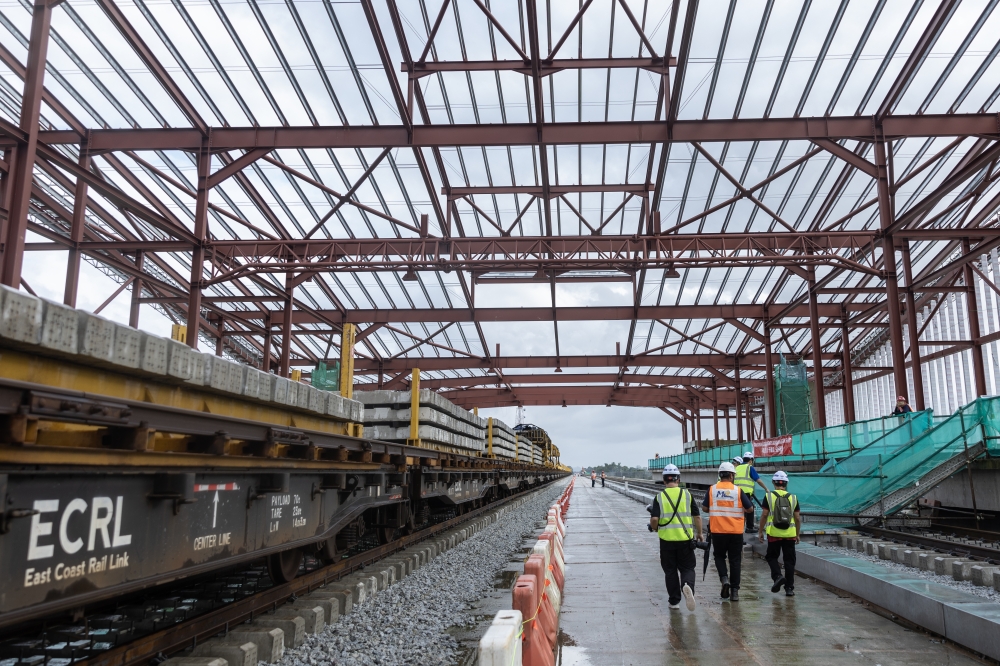
The Federal Government has earmarked RM207 million for a comprehensive cluster of 46 development projects targeting the Pasir Puteh parliamentary constituency, signalling a deliberate strategy to harness economic opportunities emerging from the East Coast Rail Link's expansion across the region. The portfolio of initiatives, which received formal approval from Putrajaya, reflects an integrated approach to infrastructure investment designed to unlock growth potential in this Terengganu-based electoral district.
Pasir Puteh's strategic positioning along the ECRL corridor has transformed the constituency into a focal point for regional economic planning. The East Coast Rail Link, once completed, will fundamentally reshape connectivity and commerce across Malaysia's east coast, potentially positioning constituencies adjacent to stations and interchange hubs as beneficiaries of enhanced accessibility. The RM207 million commitment demonstrates the government's recognition that proximity to major transport arteries requires deliberate supplementary investment to realise downstream economic gains for local communities.
The 46-project portfolio spans diverse sectors critical to sustainable constituency development. These initiatives encompass infrastructure modernisation, social facility upgrades, economic diversification programmes, and digital connectivity enhancements. Such breadth suggests the government approach moves beyond narrow infrastructure development toward holistic community advancement—addressing education, healthcare, commerce, and civic amenities simultaneously to create conditions for inclusive growth.
Infrastructure projects within the allocation likely include road improvements linking ECRL stations to peripheral communities, ensuring that enhanced rail connectivity translates into practical mobility advantages for residents and businesses. Last-mile connectivity challenges have historically constrained the developmental impact of major transport projects in regional Malaysia, and addressing these explicitly signals sophisticated planning that acknowledges previous implementation lessons.
The ECRL's relevance to Pasir Puteh's economic prospects extends beyond passenger transportation. Rail freight capabilities will lower logistics costs for businesses operating in or serving the constituency, potentially attracting manufacturing and distribution operations that depend on efficient freight movement. The RM207 million allocation may therefore function as an enabling investment, creating the institutional and physical infrastructure necessary for private sector response to improved connectivity.
Economic diversification components within the 46-project framework likely address agriculture modernisation, small and medium enterprise support programmes, and skills development initiatives. Pasir Puteh, like many east coast constituencies, maintains substantial agricultural heritage. Government-backed projects potentially facilitate transition toward higher-value agricultural production chains, digital marketing platforms, and supply chain integration with urban markets increasingly accessible via improved rail infrastructure.
Digital infrastructure investments deserve particular emphasis given Malaysia's broader digital economy objectives. Projects enhancing broadband coverage, digital payment systems, and e-commerce platforms would enable Pasir Puteh businesses to participate in nationwide digital commerce ecosystems. Rural digital divides have historically constrained economic participation, and deliberate government investment in this domain acknowledges connectivity as foundational to inclusive prosperity.
The announcement arrives within a broader pattern of government infrastructure spending designed to generate political goodwill and demonstrable development outcomes ahead of electoral cycles. However, the ECRL-linkage framing suggests the allocation responds to genuine geographic opportunity rather than pure political calculation. Effective corridor development requires coordinated public investment in complementary infrastructure, and Pasir Puteh's inclusion reflects rational planning extending beyond individual constituencies.
Regional implications warrant attention from business operators and policymakers across Southeast Asia. Malaysia's east coast development trajectory influences broader ASEAN logistics networks and supply chain configurations. Enhanced Pasir Puteh connectivity contributes incrementally to regional transport efficiency, potentially affecting cross-border commerce patterns and intra-ASEAN manufacturing competitiveness. The RM207 million represents Malaysia's specific contribution to this emerging regional landscape.
Implementation capacity will ultimately determine whether projected benefits materialise. Project delivery timelines, contractor quality, maintenance standards, and coordination between federal and state authorities all influence outcomes. The 46-project portfolio's size necessitates robust project management frameworks and transparent monitoring mechanisms to prevent implementation delays that commonly plague large-scale development schemes in Malaysia.
Stakeholder engagement represents a further critical success factor. Local residents, business associations, agricultural cooperatives, and educational institutions possess insights about actual development priorities. Government commitment to collaborative planning processes—rather than top-down project imposition—typically enhances project relevance and community support, improving long-term sustainability prospects.
The Pasir Puteh allocation also signals broader government confidence in ECRL's eventual completion and operational functionality. Public investment in complementary constituency-level infrastructure implicitly represents a bet that the rail link will deliver promised connectivity benefits. This confidence may influence private sector investment decisions, as businesses monitor public sector resource allocation as signals regarding government commitment and project viability.
Success metrics extending beyond project completion counts should guide implementation assessment. Economic growth rates, employment creation, income distribution, business formation rates, and quality-of-life indicators across Pasir Puteh's diverse communities will ultimately demonstrate whether the RM207 million allocation achieved its developmental objectives or represented merely infrastructure spending without enduring economic impact.

