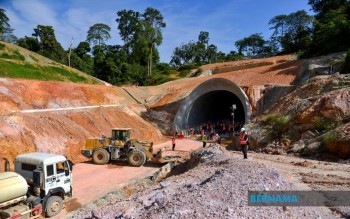
The Malaysian government has greenlit a substantial RM207.2 million development package comprising 46 projects for the Pasir Puteh parliamentary constituency in Kelantan, with implementation scheduled throughout 2026 and beyond. The initiative reflects Putrajaya's strategic vision to harness the East Coast Rail Link as an engine for regional economic transformation, positioning the constituency as a critical logistics and industrial node within the broader ECRL ecosystem.
Deputy Economy Minister Datuk Mohd Shahar Abdullah articulated the government's commitment during parliamentary proceedings, emphasising that the approved initiatives encompass substantial land preparation and infrastructure development targeting the Pasir Puteh downstream industrial zone. This coordinated approach aims to translate the ECRL's infrastructure advantage into tangible economic opportunities for local communities, addressing long-standing regional development disparities that have characterised Malaysia's economic geography.
Central to this strategy is the integration of the Pasir Puteh ECRL Station within a comprehensive land-use framework designed to optimise its dual functionality as both a passenger terminal and a cargo-logistics hub. The government has adopted the ECRL Integrated Land Use Master Plan, commonly referred to as PGTA-ECRL, as the guiding framework for coordinated development across the region. This systematic approach signals a departure from ad-hoc infrastructure spending towards strategic clustering that maximises synergies between transport facilities and downstream economic activities.
The geographical positioning of Pasir Puteh presents compelling advantages for regional logistics consolidation. Proximity to the Tok Bali Supply Base creates an unprecedented opportunity for the constituency to evolve into a comprehensive logistics and downstream industrial hub capable of attracting multinational investment and fostering employment generation at scale. This strategic location essentially positions Pasir Puteh as a natural convergence point where maritime, rail, and industrial operations can achieve operational efficiency through integrated planning and development.
Mohd Shahar stressed that the convergence of rail infrastructure with port facilities creates multiplicative economic benefits extending far beyond individual projects. Such synergy possesses the capacity to magnetise substantial corporate investment, generate employment across multiple skill tiers, and catalyse broader economic dynamism throughout the constituency and surrounding Kelantan region. The integration effectively transforms Pasir Puteh from a peripheral location into a strategically significant economic actor within Southeast Asia's emerging logistics networks.
The Deputy Economy Minister articulated a development philosophy underpinning the 13th Malaysia Plan that prioritises locality-specific strengths rather than imposing standardised interventions. Under this framework, constituencies identified as possessing logistics comparative advantages receive concentrated support for logistics infrastructure, whilst tourism-oriented areas receive corresponding tourism development investments. This contextualised approach acknowledges that sustainable regional development requires tailored strategies reflecting each area's unique endowments and market positioning.
Implementation of these approved projects will commence during 2026 and extend throughout 2030, providing a five-year execution window aligned with the 13th Malaysia Plan's overall timeframe. This extended implementation schedule allows for phased development enabling adaptive management and course corrections based on market conditions and private sector responsiveness. The protracted timeline also facilitates coordination with complementary state-level initiatives and private investment flows.
Program oversight mechanisms have been institutionalised through deployment of the MyRMK monitoring system, which tracks project advancement and ensures accountability to parliamentary stakeholders. Regular reporting cycles to the Dewan Rakyat establish transparency frameworks enabling legislative scrutiny of spending efficacy and timeline adherence. This accountability structure reflects contemporary governance standards emphasising evidence-based development management and public resource stewardship.
For Malaysian policymakers, this investment package represents a tangible demonstration of commitment to addressing historical development imbalances between Peninsular Malaysia's core regions and peripheral constituencies. Kelantan, which has historically lagged in per-capita income and infrastructure modernisation relative to more developed states, stands positioned to benefit substantially from ECRL-adjacent development clustering. The initiative acknowledges that transport infrastructure alone generates insufficient economic impact without complementary industrial ecosystem development.
Regionally, the Pasir Puteh development initiative contributes to Malaysia's broader positioning within emerging East Asian logistics corridors. The ECRL's capacity to move cargo efficiently between Thailand and Singapore, combined with enhanced downstream industrial capacity at Pasir Puteh, strengthens Malaysia's attractiveness for supply-chain-sensitive investments seeking locations balancing cost competitiveness with transport accessibility. This competitive positioning becomes increasingly consequential as global supply chains adjust to geopolitical tensions and nearshoring imperatives.
The emphasis on integrated planning reflects evolving understanding that infrastructure projects require synchronisation with industrial policy, labour force development, and regulatory frameworks to generate sustained economic benefits. Pasir Puteh's development thus extends beyond conventional construction spending into the realm of transformative regional restructuring. Success depends substantially on private sector responsiveness to improved logistics infrastructure and industrial site availability—government provision of enabling conditions rather than direct economic generation.
For investors and businesses monitoring opportunities within emerging Malaysia logistics hubs, Pasir Puteh warrants heightened attention. The RM207.2 million government commitment signals substantial confidence in the location's economic potential and substantially reduces private sector investment risk through co-investment in foundational infrastructure. As implementation progresses and physical development becomes visible, competitive pressures may accelerate private investment flows toward the constituency.

