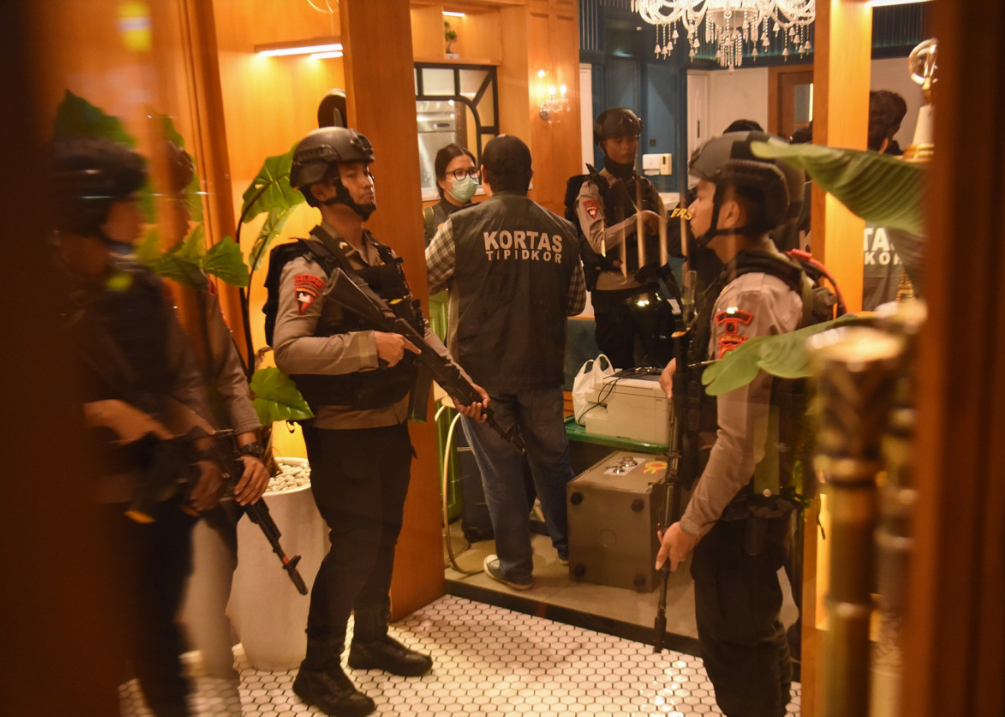
A coordinated police operation across Jakarta last week culminated in the discovery of US$26.3 million in gold and foreign currency, dramatising one of the most significant corruption allegations to shake Indonesia's law-enforcement hierarchy in recent years. The raids, which began at mid-afternoon and stretched into Thursday morning, targeted a network of properties and businesses allegedly connected to Febrie Adriansyah, who until his recent resignation had served as deputy attorney general for special crimes for more than four years. The seizure has become emblematic of deeper anxieties about institutional rot within Indonesia's justice system, raising uncomfortable questions for policymakers and the public alike about whether safeguards against corruption are genuinely effective or merely performative.
The dramatic nature of the search operations left little doubt about their significance. Armed personnel from Jakarta's police force, bolstered by the National Police's dedicated corruption crime investigation unit and Mobile Brigade officers dressed in full tactical gear, descended upon de'Clan Signature, an upscale restaurant in the Cipete neighbourhood of South Jakarta. In a scene that quickly drew media attention and astonished onlookers, officers located and breached a two-metre-high safe hidden behind cabinetry, extracting documents and substantial quantities of cash denominated in multiple currencies worth millions of dollars. The operation then shifted to an adjacent money-changing business called Koin Money Changer, where authorities unsealed another safe containing additional banknotes denominated in Indonesian rupiah, valued at hundreds of thousands of dollars alone.
Yet the true magnitude of the discovery emerged at a residential property in Sentul, an affluent hillside suburb approximately one hour's drive south of the capital. Police uncovered seven suitcases crammed with 74 kilograms of gold bullion alongside cash in various international denominations. The aggregate value of materials recovered across all raid locations reached the striking figure of US$26.3 million. This residence belongs to Febrie Adriansyah, whose four-year tenure overseeing investigations into extraordinary crimes positioned him as a critical institutional figure. The imagery of neatly stacked bullion and bundles of colourful banknotes, extensively documented and released by authorities, has become the dominant visual representation of the scandal, shaping public perception of the affair across Indonesian media platforms.
Febrie's response to the seizures revealed the complexity underlying the case. Though he acknowledged ownership of the Sentul residence, he contended that the confiscated assets did not belong to him personally, insisting their origins would surface through proper legal proceedings. His resignation came swiftly following the raids, though authorities subsequently designated him as a suspect in both corruption and money-laundering investigations. Notably, he has not been placed in police detention, a distinction that distinguishes his status from other suspects identified in connection with the case. Don Ritto, identified as a lawyer implicated in the proceedings, faced detention following his designation as a suspect. Corporate records reviewed by local journalists suggest Ritto maintained business interests in entities connected to both the raided restaurant and money-changing operation, potentially positioning him as a key intermediary in whatever arrangement or scheme generated the seized assets.
The scope of the investigation extended far beyond the initial three locations, with police conducting searches across at least thirteen separate premises throughout Jakarta and its environs. The Pacific Place residential towers, a prestigious development adjacent to the nation's stock exchange, housed one targeted address, while company offices scattered throughout the metropolitan area underwent examination. Properties in the Gandaria district of South Jakarta received particular scrutiny due to purported connections to Ritto's activities. The distributed nature of the raids—spanning residential, commercial, and financial sector locations—suggests authorities were executing a carefully planned operation designed to capture evidence and assets across multiple nodes of a suspected illicit network simultaneously.
The revelations triggered immediate discussion among Indonesia's political and legal elite regarding both the specific case and broader institutional implications. Constitutional law specialists and veteran observers of Indonesia's justice apparatus grappled with troubling questions about whether the impressive asset recovery demonstrated functioning anti-corruption mechanisms or whether the recurring pattern of high-level scandals indicated systemic institutional degradation accelerating rather than decelerating. Mahfud MD, a renowned constitutional scholar who previously served as chief justice of Indonesia's Constitutional Court and as coordinating minister responsible for political, legal and security affairs, emerged as a prominent critical voice. Appearing on his YouTube channel in a white, blue and black Batik blazer, Mahfud articulated specific legal concerns regarding the decision to transfer investigation authority from the police to the Attorney General's Office, arguing this procedural move lacked statutory foundation under Indonesia's criminal procedure code.
Mahfud's intervention introduced a procedural dimension that could substantially affect the trajectory of the investigation. His assertion that the prosecutorial authority transfer violated established criminal procedure law raised the prospect of pretrial challenges that might compromise evidentiary validity or procedural legitimacy. Rather than accepting the current investigative structure, Mahfud advocated for Indonesia's Corruption Eradication Commission—an institutionally independent state body specifically mandated to address corruption matters—to assume primary responsibility for the investigation. This recommendation implicitly suggested that neither the police nor the Attorney General's Office possessed sufficient institutional credibility to handle a matter involving such a senior official within the legal establishment itself. For Malaysian observers, the scenario underscores how even sophisticated anti-corruption architectures can face legitimacy crises when investigations target powerful insiders, paralleling concerns periodically articulated within Southeast Asia's anti-graft discourse.
The timing of the seizures carries particular significance within Indonesia's evolving governance context. The discovery emerged amid broader societal expectations that contemporary Indonesian administrations would demonstrate concrete commitment to combating systemic corruption, an issue that has persistently constrained institutional development and public confidence. The visual spectacle of seized gold and stacked currency provided compelling evidence that substantial illicit wealth had accumulated within the law-enforcement establishment itself, potentially through the very mechanisms supposedly designed to prevent such accumulation. This paradox—that those charged with investigating corruption had themselves become subjects of investigation—generated headlines extending throughout regional media and contributed to scepticism about institutional capacity for genuine self-correction.
For Malaysian and broader Southeast Asian policy audiences, the Jakarta case illuminates enduring tensions within institutional design across the region. Even countries with dedicated anti-corruption bodies and ostensibly rigorous investigative procedures face recurring challenges when allegations implicate senior officials embedded within the prosecutorial and investigative apparatus. The Malaysian context, with its own experience of high-level corruption cases involving formerly senior officials and its development of institutional anti-corruption mechanisms, offers comparative perspectives on how such investigations balance procedural propriety against public expectations for decisive action. The Indonesian situation demonstrates that structural institutional integrity—creating genuinely independent investigative bodies—remains a persistent challenge across Southeast Asia's maturing democracies.
Moving forward, the case will likely serve as a litmus test for Indonesian institutional resilience. Whether Febrie faces eventual prosecution, whether Don Ritto's detention yields productive investigative leads, and crucially whether the Corruption Eradication Commission assumes the role Mahfud advocated will collectively determine whether this scandal represents institutional capability for self-correction or merely another cyclical episode in an entrenched pattern of corruption exposure without meaningful institutional transformation. For Malaysian observers monitoring Southeast Asian governance trends, the unfolding investigation provides instructive evidence about how corruption cases involving law-enforcement insiders navigate the intersection of political pressure, institutional autonomy, and procedural legitimacy.

