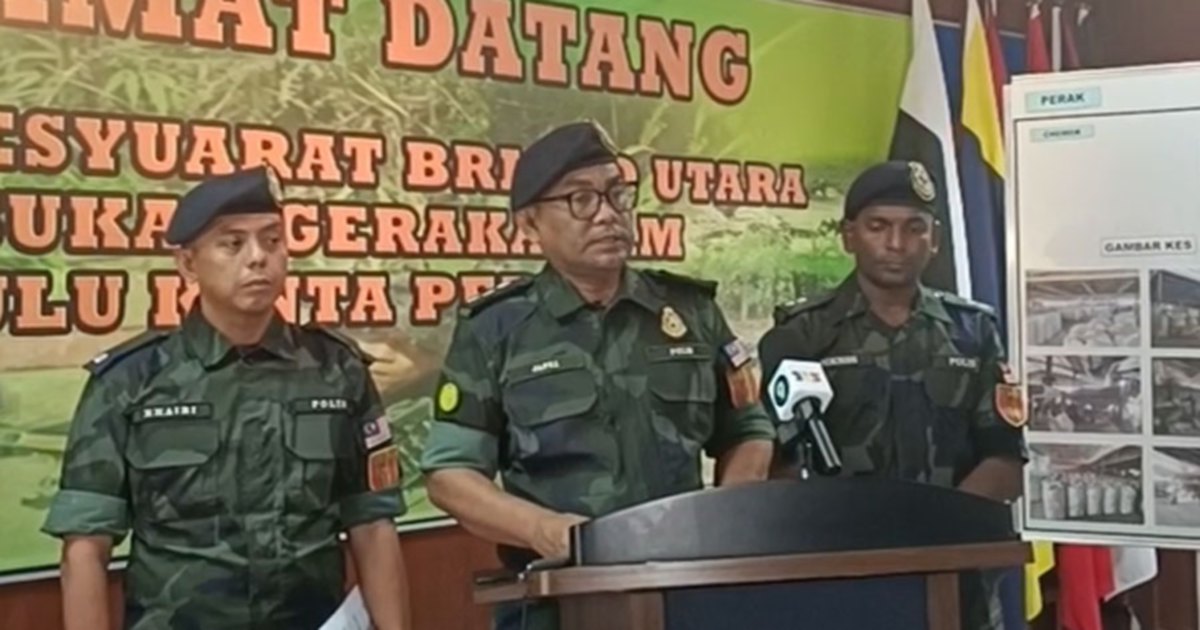
The General Operations Force Northern Brigade has delivered a decisive blow to organised illegal mining in Perak and Kedah, arresting 30 individuals and recovering minerals and machinery valued at RM31.7 million during an intensive enforcement operation. The sweeping crackdown represents a major escalation in efforts to combat the underground extraction of precious minerals that has plagued these resource-rich states and poses significant environmental and economic threats to the region.
The scale of the seizure underscores the sophisticated nature of illegal mining networks operating in northern Malaysia. These operations typically involve complex supply chains stretching from extraction sites through processing facilities to end-markets, often with involvement from both local syndicates and international criminal elements. The recovery of such substantial machinery and processed minerals indicates authorities targeted not merely small-scale artisanal operators but organised groups with substantial capital investment and infrastructure.
Illegal mining has become an increasingly endemic problem across the northern corridor, where mineral-rich geology attracts both licensed and unlicensed operators. The activities inflict considerable collateral damage on the environment, contaminating water sources, degrading agricultural land, and disrupting mining-dependent communities. Beyond environmental costs, unauthorised extraction drains state revenues that would otherwise fund development, while enriching criminal networks and fuelling corruption along the supply chain.
Perak and Kedah have historically served as focal points for mineral extraction, but the transition from regulated to clandestine operations has accelerated in recent years. Economic pressures and weak enforcement in certain jurisdictions create ideal conditions for underground mining syndicates to flourish. These groups often employ sophisticated techniques to evade detection, including nighttime operations, mobile processing units, and distributed extraction sites that complicate surveillance and interdiction efforts.
The GOF Northern Brigade's operation demonstrates enhanced capacity and coordination across state boundaries. Effectively combating organised illegal mining requires seamless cooperation between federal and state authorities, as criminal networks routinely shift operations across jurisdictions to exploit enforcement gaps. The multi-state nature of this operation signals improved intelligence sharing and joint tactical planning among security agencies tasked with resource protection.
The detained individuals now face processing under relevant federal and state statutes governing unlicensed mining and mineral processing. Depending on the evidence gathered, charges may encompass not only extraction violations but potentially environmental crimes, money laundering, and organised crime statutes. Successful prosecution of syndicate leaders—rather than merely foot soldiers—remains crucial to dismantling these networks, though Malaysian courts have sometimes handed down sentences critics view as insufficiently punitive for the scale of economic damage involved.
From a regional perspective, Malaysia's crackdown reflects broader Southeast Asian challenges with resource crime. Neighbouring Thailand, Indonesia, and Myanmar all grapple with illegal mining operations that degrade terrestrial and aquatic ecosystems while funding organised crime. Cross-border trafficking of illegally extracted minerals and smuggling of processed outputs complicates enforcement. Intelligence cooperation among ASEAN nations remains patchwork, creating opportunities for syndicates to operate across multiple jurisdictions with relative impunity.
The confiscated equipment and minerals retain considerable commercial value, creating opportunities for either rehabilitation into formal markets or destruction to prevent recycling through underground channels. Malaysian authorities typically auction recovered machinery through established disposal procedures, though valuables connected to serious crimes may be held as evidence or forfeited permanently. The fate of RM31.7 million in recovered assets will likely be determined through court proceedings and asset recovery mechanisms.
Longer-term solutions to illegal mining must address root causes driving both supply and demand. On the supply side, miners often turn to unlicensed extraction because formal sector employment has contracted or licensing barriers appear insurmountable. On the demand side, traders and processors profit handsomely from minerals obtained without compliance costs, while international buyers sometimes knowingly or unknowingly purchase materials of dubious provenance. Comprehensive approaches must therefore combine law enforcement with livelihood alternatives and supply chain transparency initiatives.
The GOF operation also highlights resource challenges facing Malaysia's security establishment. With limited personnel and budgets stretched across multiple enforcement priorities—from counter-terrorism to human trafficking—dedicated mineral crime units remain understaffed relative to the problem's scale. Sustained investment in surveillance technology, training, and personnel would amplify enforcement effectiveness, though political commitment to mining regulation sometimes wavers when licensed operators lobby for relaxed standards or when proceeds from illegal operations fund electoral networks.
Public awareness campaigns about the environmental consequences of illegal mining have gained traction in recent years, with communities increasingly vocal about water contamination and land degradation. Citizen reporting has occasionally facilitated enforcement actions, though rural communities dependent on mining-linked employment sometimes view crackdowns with ambivalence. Building community support for mining regulation therefore requires parallel investment in alternative livelihood development, particularly in states where mineral extraction has historically dominated local economies.
The GOF's Northern Brigade results should be contextualised within a broader enforcement landscape where arrests and seizures, while important, remain insufficient alone to arrest organised mining's expansion. Successful suppression requires sustained operations targeting not merely individual sites but the financial infrastructure, political patronage networks, and international trafficking routes that sustain these syndicates. The RM31.7 million seizure represents a substantial victory but one requiring systematic follow-up to prevent rapid reconstitution of dismantled operations.

