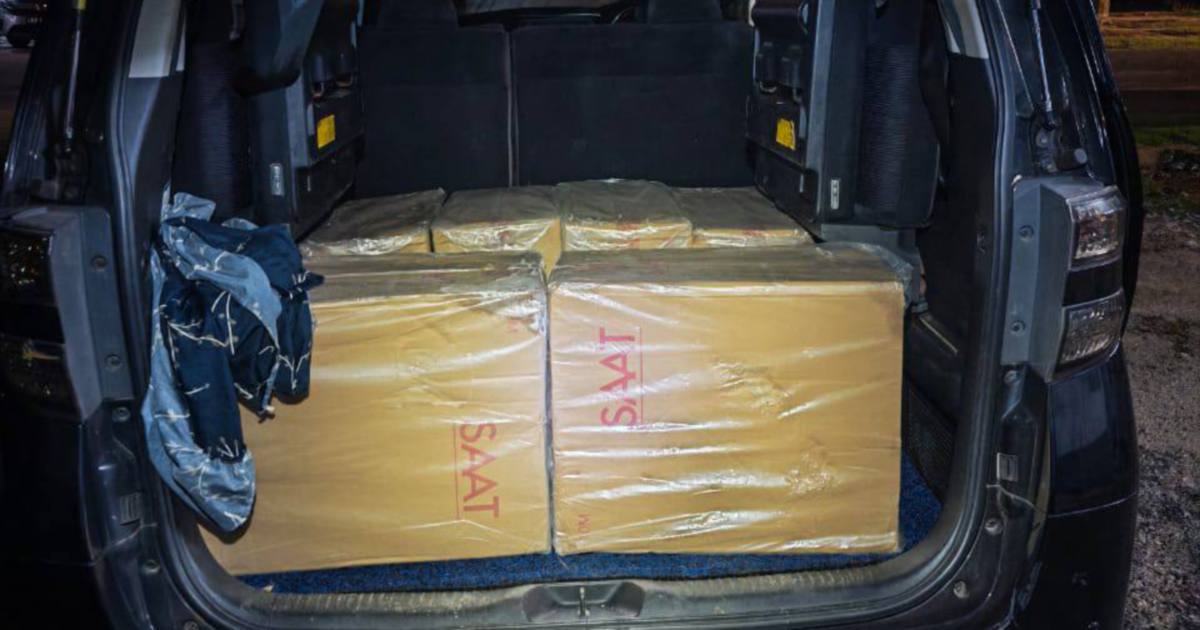
In a significant enforcement operation targeting the illicit tobacco trade, the General Operations Force (GOF) has apprehended a driver and recovered a substantial cache of contraband cigarettes in Kota Baru. The interception of a Toyota Vellfire at the shoulder of Pasir Tumboh Bridge during the early morning hours yielded 60,000 cigarettes believed to have evaded duty payment, with authorities valuing the haul at RM112,200. The arrested driver, a 37-year-old male, is now facing investigation under Malaysia's strict excise and taxation laws governing tobacco products.
The seizure underscores the persistent challenges Malaysian authorities face in combating the smuggling and distribution of duty-unpaid cigarettes, a problem that continues to drain government revenue and undermine legitimate tobacco retailers. The Kota Baru region, located in Kelantan in Malaysia's northeast, has historically been identified as a transit point for illicit goods moving between Thailand and Malaysian markets. The interception on the Pasir Tumboh Bridge—a strategic location in the state's transport network—suggests that enforcement agencies are maintaining heightened vigilance along key smuggling corridors.
The estimated value of RM112,200 reflects not merely the retail price of the contraband but also the substantial customs duties, excise taxes, and consumption charges that these cigarettes were intended to circumvent. When duties and taxes on tobacco products are factored in, the actual tax loss to the government considerably exceeds the bare product value, representing a meaningful impact on state and federal revenues that are earmarked for public health and infrastructure projects. The scale of this single seizure—60,000 units—illustrates how efficiently criminal networks operate in transporting bulk quantities through organized supply chains.
The GOF, a paramilitary force operating under the Ministry of Defense, has steadily increased its involvement in operations targeting illicit cigarette trafficking alongside the Royal Malaysian Customs Department. Their deployment in this interception reflects a coordinated approach to combating contraband along transport routes where commercial vehicles like the Toyota Vellfire—a popular multipurpose vehicle—are commonly used by smugglers. The choice of vehicle is deliberate; these models offer ample storage capacity while maintaining the appearance of legitimate commercial or personal transport, making them favored by trafficking networks.
The timing of the operation during early morning hours is consistent with law enforcement tactics designed to catch smugglers during low-traffic periods when illegal convoys can move more discretely along highways. Authorities in Kelantan and other border-adjacent states have increasingly adopted such timing strategies to intercept contraband before it enters distribution networks in major population centers or is broken down into smaller consignments for retail sale. The driver's immediate capture suggests that checkpoints were established with sufficient intelligence or random enforcement protocols to intercept the vehicle effectively.
For Malaysian consumers and legitimate retailers, the recovery of such quantities carries indirect benefits. The illicit cigarette trade creates market distortions by offering duty-free products at artificially depressed prices, undercutting authorized sellers and eroding market share for legitimate businesses operating within the tax framework. This forms a vicious cycle where tax revenue declines, legitimate retailers struggle, and enforcement pressure increases—yet smuggling networks continue adapting their strategies. The arrest of the driver may disrupt one particular smuggling operation but signals the broader persistence of the problem.
The investigation into the arrested driver will likely explore connections to wider trafficking networks, including points of origin, distribution routes, and end-market buyers. Authorities typically examine financial records, communication devices, and network relationships to dismantle organized smuggling groups rather than treating individual arrests as isolated incidents. In many cases involving contraband cigarettes, the driver is a relatively low-level operative, with higher-level organizers and financiers remaining insulated from detection through compartmentalized operations.
The seizure also reflects ongoing tensions between Malaysia and neighboring Thailand regarding cross-border trade in illicit goods. Thailand's lower tobacco taxation creates incentives for smuggling into Malaysia, where cigarette duty rates remain among Southeast Asia's highest. This tariff differential has sustained a profitable grey market for decades, with smuggling networks continuously innovating to evade detection. Regional cooperation between customs agencies has improved, yet the geographical and economic incentives driving the trade persist.
For policymakers considering tobacco control and tax policy, this operation demonstrates the tangible enforcement costs associated with high excise duties that create profitable smuggling opportunities. While higher taxation serves public health objectives by reducing affordability and consumption—particularly among price-sensitive youth—it simultaneously incentivizes illicit supply chains. Balancing these competing priorities remains a central challenge in tobacco regulation across Malaysia and the broader Southeast Asian region.
The GOF's continued vigilance in this sector indicates that enforcement against illicit cigarette trafficking remains a prioritized government function. The RM112,200 seizure, while significant, represents merely one transaction in what experts estimate as a multi-billion-ringgit underground tobacco market operating across Malaysia. As long as substantial duty differentials exist between legal and smuggled products, and as long as organized networks possess the resources to exploit weak points in monitoring systems, such interdictions will remain necessary but insufficient to fully resolve the illicit trade challenge.

