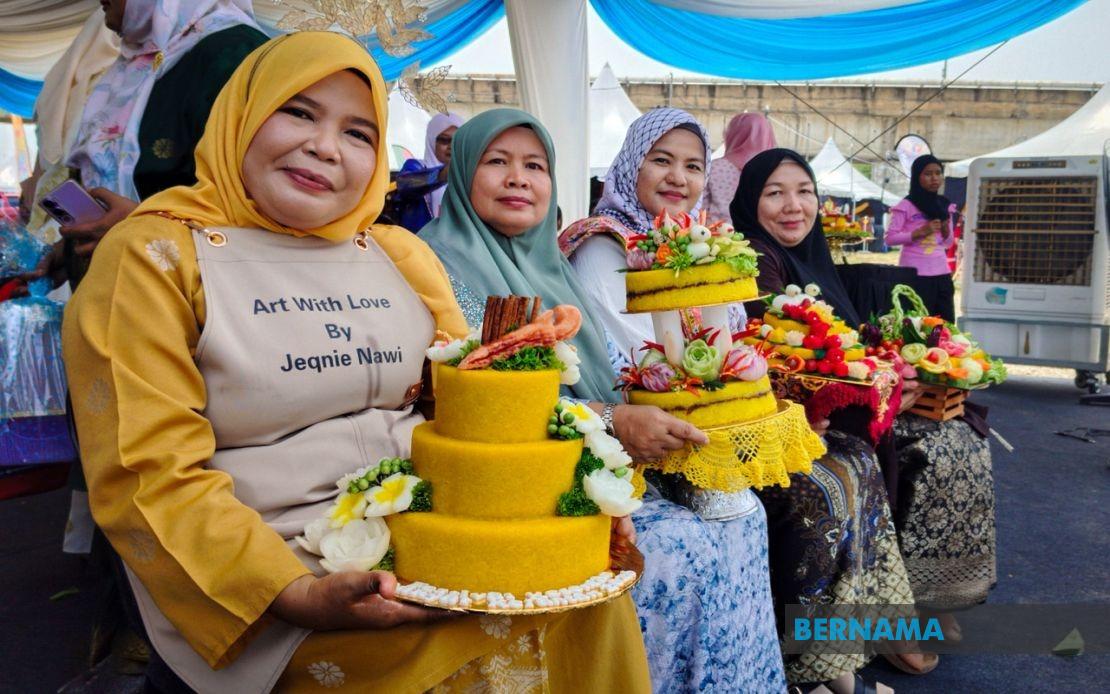
Nortiny Nawi's career pivot four years ago—stepping away from a stable position as a resort marketing officer to pursue her culinary passion—represents a growing trend among Malaysian professionals seeking meaningful work aligned with their interests. Today, the 46-year-old entrepreneur operates a thriving business from her home in Kampung Gong Cokoh, Pasir Puteh, crafting exquisite pulut kuning arrangements that have garnered recognition at the state level and generated consistent demand across Kelantan.
Pulut kuning, the golden-hued glutinous rice infused with turmeric, holds cultural significance across Malaysia as a staple feature in celebrations ranging from thanksgiving ceremonies to wedding receptions. What distinguishes Nortiny's work is her elevation of this traditional comfort food into decorative centrepieces, transforming basic ingredients into visually striking arrangements that command prices from RM100 to RM280 depending on complexity and portion size. This value-addition strategy illustrates how entrepreneurs in Southeast Asia can leverage cultural culinary practices to create premium market niches.
The journey toward her current success began during teenage years when cooking first captured her imagination, though serious pursuit came only after leaving her resort career. Her professional background proved instrumental; while managing marketing operations at the resort, Nortiny spent spare moments in the kitchen observing chefs' techniques and developing her understanding of food preparation and presentation. This self-directed apprenticeship demonstrates how career transitions need not represent wasted experience—her prior role in hospitality, though unrelated on the surface, provided crucial exposure to guest preferences, service standards, and presentation aesthetics that now underpin her business operations.
The recognition she received at the Kelantan Folk Arts Festival, winning top honours with an eight-kilogramme pulut kuning arrangement adorned with intricate white radish floral carvings, validates both her technical skill and artistic vision. Such competitive validation carries commercial significance beyond prestige; it signals quality assurance to potential customers and differentiates her offerings in an increasingly crowded homemade food marketplace. For small-scale food entrepreneurs across Malaysia, participating in state-level festivals and competitions provides low-cost marketing exposure and third-party credibility endorsement.
Nortiny's client base has expanded considerably beyond individual households to encompass schools and government departments throughout Kelantan, a diversification that stabilises revenue and suggests the product's broad institutional appeal. The capacity to handle up to six orders daily—constrained not by demand but by the labour-intensive nature of her craft—indicates her business has achieved a critical juncture where expansion becomes viable. For similar home-based food entrepreneurs, this growth threshold often determines whether their operation remains a supplementary income stream or evolves into a substantial commercial enterprise.
The production schedule reveals the demanding reality behind artisanal food preparation. Beginning work at 3 am to steam glutinous rice before kneading, cooling, and sculpting each arrangement reflects the temporal inflexibility inherent in perishable food products. Unlike baked goods that permit batch preparation and refrigeration, pulut kuning deteriorates without timely consumption, necessitating just-in-time production aligned precisely with delivery schedules. This operational constraint, while physically exhausting, creates a competitive moat—only entrepreneurs capable of absorbing irregular sleep patterns and intense labour bursts can sustain such a business model.
Maintaining motivation through daily physical demands represents a psychological dimension often overlooked in business narratives focused on profit margins. Nortiny explicitly credits her passion for the craft as the sustaining force, alongside positive customer feedback that validates her creative efforts. This observation carries implications for Malaysian policymakers considering support schemes for micro-entrepreneurs; sustainability metrics should encompass psychological well-being and intrinsic motivation alongside financial performance, as burnout threatens the viability of intensive home-based operations.
The geographic focus on Kelantan positions this business within a state renowned for preserving traditional Malay crafts and culinary heritage. This cultural ecosystem provides both competitive context and market advantage—customers in Kelantan inherently value authenticity and traditional food practices, supporting premium pricing for culturally authentic offerings. The state's emphasis on heritage arts, evidenced by events like the Kelantan Folk Arts Festival, creates institutional recognition structures that amplify individual entrepreneurs' visibility.
Looking forward, Nortiny's intention to expand into larger commercial premises reflects rational growth strategy. Current home-based operations impose natural capacity ceilings and may face regulatory scrutiny regarding food safety certifications and production standards. Moving to dedicated commercial space would enable compliance with food handling regulations, permit hiring of additional staff, and facilitate scaling production to meet growing demand. For aspiring food entrepreneurs across the region, this progression pathway—from passion project to home-based business to commercial facility—represents the conventional and achievable trajectory.
The broader narrative of Nortiny's entrepreneurial journey illustrates how Malaysian professionals can successfully transition from conventional employment to self-determined work by building upon genuine skills and cultural knowledge. Her success demonstrates that profitable business opportunities exist within traditional food practices when entrepreneurs apply presentation innovation and market positioning strategy. As Southeast Asian economies increasingly emphasise creative industries and cultural entrepreneurship, examples like Nortiny's pulut kuning business offer practical templates for others seeking sustainable livelihoods grounded in heritage crafts and culinary traditions.

