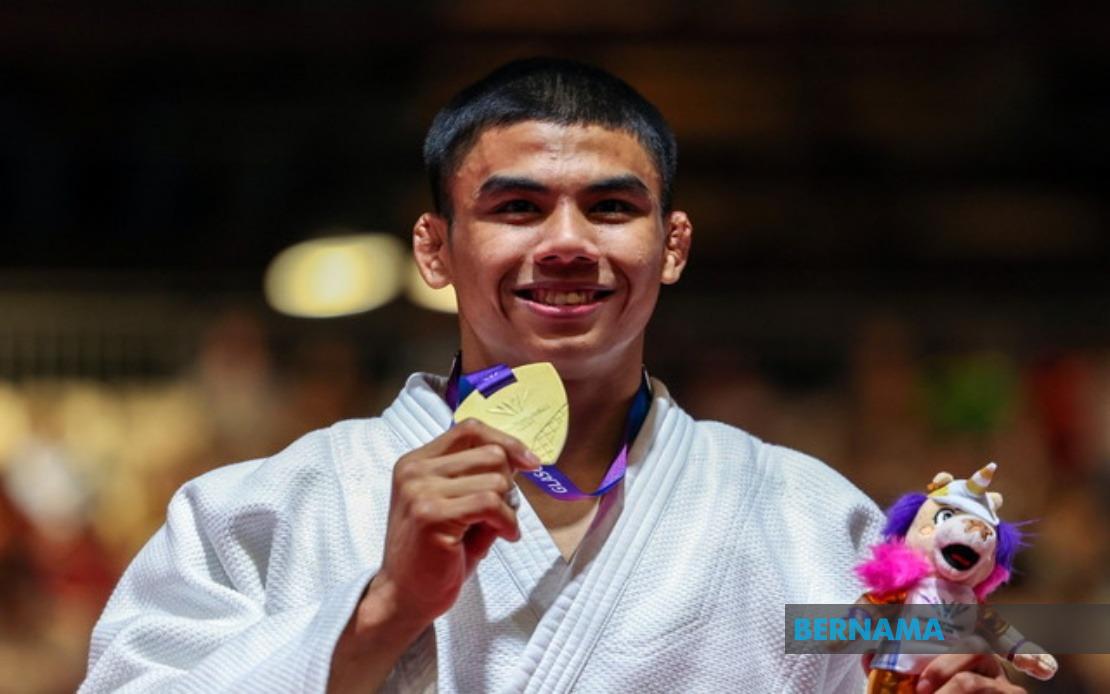
The transition from elite athlete to coach represents a fundamental shift in how one experiences competitive pressure, a reality now confronting 21-year-old judo champion Amir Daniel Abdul Majeed. Having secured gold at the Commonwealth Games, the Penang judoka has recently stepped into the unfamiliar role of assistant coach for his state's judo contingent at SUKMA Selangor 2026, an experience he describes as paradoxically more nerve-wracking than his years spent competing on the mat. While the roar of spectators and the adrenaline of direct competition create their own intensity, the responsibility of guiding others introduces a psychological burden that Amir acknowledges he is still learning to manage.
The mental dimensions of coaching, Amir explains, arise from a deeper investment in the athletes under his guidance. Having observed many of his charges develop from their formative years in the sport, he carries emotional weight that extends beyond mere technical instruction. The shift from peer competitor to mentor creates a peculiar dynamic, particularly when he previously shared the training environment with those he now directs. This personal connection amplifies the stakes whenever one of his athletes steps onto the mat, transforming what might otherwise be routine matches into moments laden with accumulated responsibility and expectation.
Managing a team of 13 athletes represents a scaling up of accountability that Amir had never previously experienced. During his own competitive career, the variables within his control were confined to his own preparation, strategy, and mental fortitude. As coach, however, he must synthesize and coordinate the needs, progress, and performance of multiple individuals, each with distinct strengths, weaknesses, and psychological profiles. This expansion of scope carries considerable weight, though Amir has begun recognizing the profound rewards embedded within the coaching process. Witnessing the development arcs of his athletes, observing incremental improvements in technique and confidence, and celebrating their successes provides a satisfaction that differs markedly from personal achievement.
The Penang judo team's performance at SUKMA Selangor 2026 offered validation of Amir's emerging coaching contributions. Over three days of competition, the contingent accumulated three gold medals, one silver, and five bronze medals, a haul that positioned Penang as joint-top medal winners alongside Johor. While Amir remains characteristically humble about his specific influence, the team's success suggests that his transition into this supporting role has been productive. The results demonstrate not only the quality of Penang's judo talent but also the effectiveness of the coaching framework within which these athletes operate.
Beyond his immediate responsibilities at SUKMA, Amir's attention is now focused toward a potential appearance at the Aichi-Nagoya 2026 Asian Games in Japan. The selection process remains incomplete, with an official confirmation meeting scheduled for this week. For Amir, the Asian Games represent more than another competition; they constitute a crucial waypoint on his longer trajectory toward Olympic participation. The caliber of judokas competing in Asia's premier multi-sport event significantly exceeds that of most regional tournaments, a reality that Amir views not as intimidating but as educational.
The competitive environment in Japan carries particular significance for athletes with Olympics aspirations. The exposure to higher-level opponents, the technical refinement demanded by world-class practitioners, and the pressure of international competition all serve as preparation mechanisms for the ultimate prize. Amir's willingness to embrace this elevated challenge reflects a maturity often found in athletes determined to progress beyond their current ceiling. Where some might shy away from the difficulty, preferring to dominate lower-level competitions, Amir actively seeks the stress and struggle inherent in facing superior opponents.
Integrally connected to his Asian Games objectives are the SEA Games Malaysia 2027, which will be held on home soil. This home Games provides an additional motivation layer for Malaysian judokas, as domestic audiences and national expectations converge. By competing at the Asian Games in 2026, Amir will have completed a significant portion of his preparation work, refining both technical elements and the mental resilience required to perform under intense scrutiny. The progression from Asia-wide competition to regional championships within one's own country follows a logical development pathway for athletes aiming to excel internationally.
Amir's Olympic ambitions remain the gravitational center around which his current decisions orbit. Judo, as an Olympic sport, has historically produced Malaysian medals at the Games, though consistency has been elusive. The sport demands not only physical prowess but exceptional mental discipline, strategic intelligence, and the ability to execute under conditions of maximum stress. Amir's current phase, combining coaching responsibility with competitive participation, may actually serve his long-term development by forcing him to think more deeply about the technical and psychological dimensions of the sport.
The parallel paths Amir is now walking—as both coach and athlete—create interesting dynamics within the Malaysian judo ecosystem. As a coach, he contributes to the pipeline of talent that feeds into national senior squads. As a competitor, he remains a contender for limited positions in major international competitions. This dual role, while demanding, positions him at the nexus of Malaysian judo's present and future, influencing not only individual athletes but potentially the broader trajectory of the sport within the country.
For Malaysian sports audiences following judo's development, Amir Daniel represents an encouraging model of how athletes can extend their influence beyond their individual careers. The challenge he now faces—balancing the pressures of coaching with the demands of competing at elite levels—will test his adaptability and mental strength. The results of this week's Asian Games selection meeting will provide the next chapter in his evolving story, one that carries implications not only for his personal trajectory but for Malaysia's judo program more broadly.

