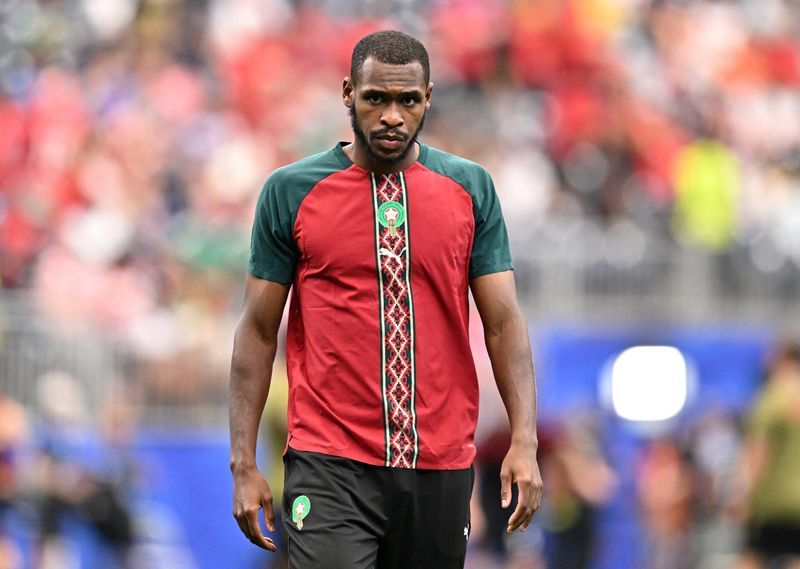
The path that brought Moroccan centre-back Issa Diop to Thursday's World Cup quarter-final against France reads like an unlikely redemption arc in international football. Once a fierce advocate for French representation, the 29-year-old defender now finds himself tasked with neutralising Kylian Mbappé and containing France's attacking threat—a scenario that appeared virtually unthinkable just months earlier when Diop remained adamant about his footballing allegiance to the country of his birth.
Diop's journey to Morocco encapsulates the complex identity questions that define modern international sports. Born in Toulouse to a Senegalese father and Moroccan mother, he carried impeccable credentials for either nation. His grandfather stood among Senegal's pioneering national team coaches, offering a direct lineage to African football tradition. Yet Diop consistently rebuffed Morocco's advances and Senegal's courtship, insisting his future lay exclusively with France. When speaking to Canal Plus seven years ago during his spell with France's Under-21 programme, his words crystallised an unwavering conviction: "I am French. I was born in France. France has given me everything. Joining another national team simply because I didn't make the French squad would be a bit hypocritical of me. It would be something of a default choice." Those words proved prescient—they accurately captured his mindset at that moment, yet they also exposed the fragility of such certainties when circumstances shift.
The announcement of his March commitment to Morocco ignited considerable controversy on social media platforms, with critics viewing his reversal as precisely the kind of "default choice" he had once disdained. Eight years spent in England's Premier League with West Ham United and Fulham had cultivated a profile that made this decision unexpectedly consequential, drawing scrutiny beyond typical club-to-country transitions. Coach Mohamed Ouahbi's decision to recruit Diop reflected pressing defensive needs rather than sentimental considerations. Following captain Romain Saiss's departure after the Africa Cup of Nations in January and Nayef Aguerd's March injury setback, Morocco required experienced reinforcement at the heart of their defence.
Ouahbi characterised Diop as someone displaying genuine commitment to Moroccan football, noting his integration into the country's lifestyle and his regular visits when not fulfilling club obligations. The coach deliberately sidestepped dwelling on historical controversies, preferring to emphasise immediate contributions and pitch performance. This pragmatic framing helped shift narrative focus from divided loyalties toward present utility. Diop's debut materialised in a March friendly against Ecuador, followed by consistent selection alongside Crystal Palace's Chadi Riad in Morocco's central defence. The arrangement proved fortuitous, with Diop demonstrating the defensive solidity Ouahbi had anticipated.
Diop's most memorable contribution arrived during the round-of-32 encounter against the Netherlands, when Morocco teetered on the precipice of elimination. As full-time approached, the Dutch appeared positioned to advance. Yet in the ninety-first minute, with the clock running down, Diop attacked a Chemsdine Talbi cross with a powerful header that found the net. The stoppage-time equaliser transformed the match's trajectory, forcing extra time and ultimately leading to Morocco's penalty-shootout victory. Describing his unlikely contribution, Diop offered characteristic modesty: "I went forward, I don't know what I was doing there, it was the end of the match. I tried to find some space and scored." The understated reflection belied the goal's significance, which supplied both immediate salvation and psychological momentum heading toward the knockout stages.
Morocco's progress to the quarter-finals represented their strongest World Cup performance in decades, building toward a rematch with their former coloniser that carried unavoidable historical and cultural dimensions beyond standard sporting competition. The encounter also marked a significant moment for African football on the international stage. Yet for Diop personally, Thursday's quarter-final represented the ultimate test of his new allegiance. Unlike his earlier assertion that rejecting Morocco would constitute betrayal of France's investment in him, this fixture demands he prioritise the national team that belatedly welcomed him.
The prospective defensive assignment against Mbappé requires Diop to operate at peak performance levels. France's emerging superstar has demonstrated extraordinary technical ability and acceleration throughout the tournament, posing acute challenges for centre-backs regardless of their experience or Premier League exposure. Diop's eight seasons in England have exposed him to elite attacking talent, yet Mbappé represents a different calibre of threat—possessed of pace, intelligent movement, and the composure to exploit even marginal defensive lapses. The quarter-final setting eliminates any margin for error, raising defensive stakes dramatically.
From a broader Southeast Asian perspective, Morocco's unexpected progression carries particular resonance. The North African nation's success validates the competitive potential of nations operating outside Europe's traditional power structure, providing inspiration for regional footballing ambitions. Furthermore, Diop's narrative—bridging Europe and Africa, ultimately choosing an African allegiance—reflects broader patterns of identity and belonging increasingly familiar to multinational audiences across Southeast Asia. His decision to commit to Morocco despite earlier declarations mirrors conversations about national identity that resonate across diverse communities throughout the region.
Speaking to Diop's selection, Ouahbi attempted to reframe the narrative surrounding the defender's previous ambivalence toward Moroccan representation. The coach's message emphasised forward momentum and on-field contribution over historical context. Yet the symbolic dimensions of Thursday's match inevitably persist beneath the surface. Diop now represents not merely a defensive asset but embodiment of Morocco's capacity to unite fractured constituencies and repurpose conflicting loyalties toward unified national purpose. Against Mbappé and France, he must prove that his conversion extends beyond bureaucratic transfer paperwork to genuine commitment and sustained athletic excellence under pressure.

