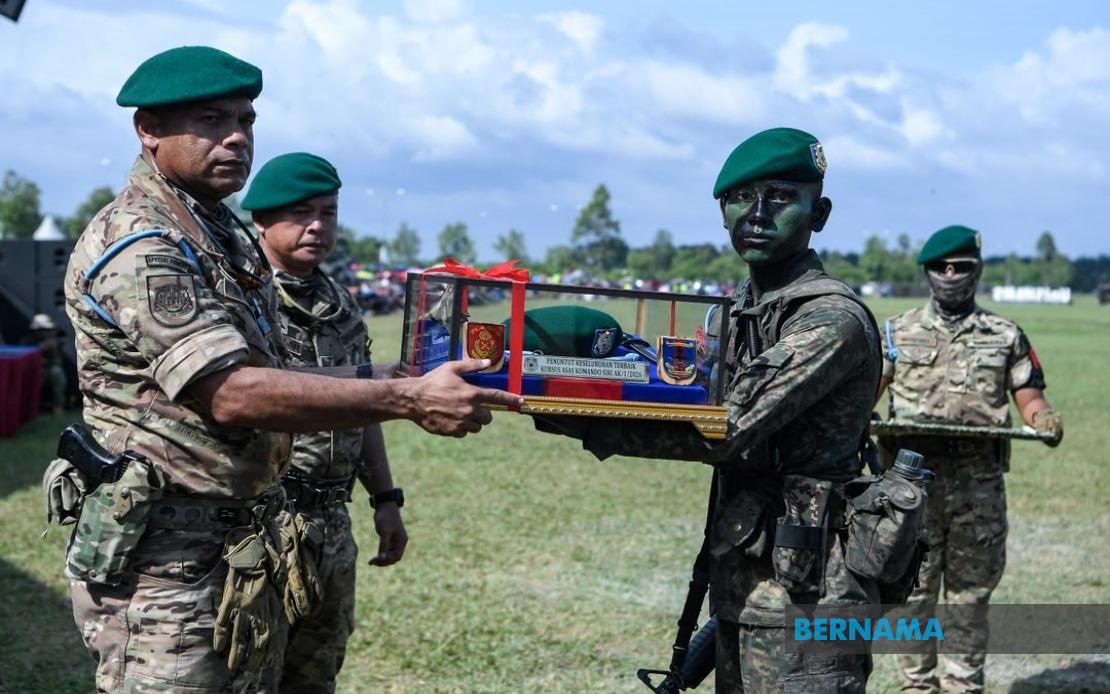
Second Lieutenant Muhammad Fadli Jamalluddin's journey to earning Malaysia's coveted green beret was far from straightforward. The 24-year-old officer from Ampang, Kuala Lumpur, initially stumbled on his path to becoming a commando, failing the Basic Commando Course in 2024 before returning to complete Series AK/1/26 with distinction, ultimately securing the Best Overall Trainee honour at the closing ceremony held at Universiti Sultan Abdul Halim Mu'adzam Shah (UniSHAMS) in Kuala Ketil.
Muhammad Fadli's military aspirations took root during his secondary school years, a calling that eventually led him to the National Defence University of Malaysia (UPNM) where he earned a Bachelor's degree in Global Policing and Intelligence with Honours. Upon graduation, he joined the Royal Malay Regiment in 2024 before volunteering for the 21st Special Service Group (21 GGK), one of Malaysia's most demanding military postings. His family played a crucial motivational role throughout his journey; as the third of five siblings, he cited a desire to make his father proud as a driving force, particularly poignant given that his father suffered a stroke more than a year ago and was unable to attend the recent ceremony.
The path through commando training proved brutally demanding. During the three-month intensive course, trainees endure rigorous land and sea operations that push both physical capacity and psychological fortitude to their limits. Muhammad Fadli encountered a critical moment during the eighth week when he failed one of the training exercises, a setback that could have forced him to restart the entire gruelling programme from the beginning. The emotional weight of this near-failure was considerable; having already completed more than 100 kilometres of endurance marching, falling short at such an advanced stage tested his resolve profoundly.
What distinguishes Muhammad Fadli's experience is not merely overcoming a single obstacle but demonstrating the mental resilience that separates elite military personnel from ordinary soldiers. When he wept over his eighth-week failure, multiple people counselled him to accept defeat and abandon the course. The psychological barrier of repeating such demanding training loomed large, yet he refused to accept the outcome as final. Instead, he reframed the failure as an opportunity for transformation rather than an endpoint, a perspective that ultimately proved transformative for his performance.
Commando training in Malaysia represents one of the military's highest professional achievements, demanding far more than physical prowess. Officers pursuing commando qualification face elevated standards compared to enlisted personnel; they must combine physical strength with sharp tactical thinking and strategic problem-solving abilities. Special operations inherently require meticulous planning and sound decision-making under extreme stress, capabilities that cannot be developed through physical conditioning alone. Muhammad Fadli's articulate reflection on these demands demonstrates the calibre of officer Malaysia's special forces are cultivating.
The successful completion of Series AK/1/26 involved five officers and 33 other ranks who met the stringent requirements. Among this cohort, Muhammad Fadli emerged as the standout performer, earning recognition from the Commandant of the Special Warfare Training Centre (PULPAK), Colonel Nordin Abu. This recognition carries particular significance within Malaysia's military hierarchy, as it identifies not just a qualified commando but an exemplary one capable of leading within the special operations community.
For Malaysian readers and defence observers, Muhammad Fadli's achievement illuminates the institutional standards and personnel quality within the Malaysian Armed Forces' most elite units. The military's investment in identifying young officers with both aptitude and determination, then subjecting them to refinement through extreme training, reflects a professional approach to developing special operations capability. In an era when regional security considerations increasingly demand sophisticated, specialised military responses, having a cadre of well-trained commando officers becomes strategically significant.
The broader context of Malaysian military development shows consistent effort to strengthen special operations capacity. The existence of structured progression through courses such as Series AK/1/26, with formal recognition protocols and senior leadership oversight, demonstrates institutional maturity in force development. Muhammad Fadli's trajectory from initial failure through renewed determination to ultimate success exemplifies the human dimension of military capability building that statistics and equipment inventories cannot capture.
Muhammad Fadli's personal motivation—particularly his desire to honour his family and provide encouragement to his ill father through this achievement—represents the human story underpinning military service. His stated belief that failure constitutes opportunity rather than terminus offers valuable perspective extending beyond military contexts, relevant to Malaysian society broadly as the nation navigates development challenges requiring sustained perseverance.
Looking forward, Muhammad Fadli's placement within the 21st Special Service Group positions him to contribute meaningfully to Malaysia's special operations capabilities. His demonstrated capacity to overcome setbacks while maintaining mental clarity under extreme pressure indicates he possesses qualities essential for leadership in high-stakes operational contexts. The recognition he receives at this ceremony marks not a conclusion but a beginning in what promises to be a distinguished military career characterised by the same determination that carried him through the commando course.

