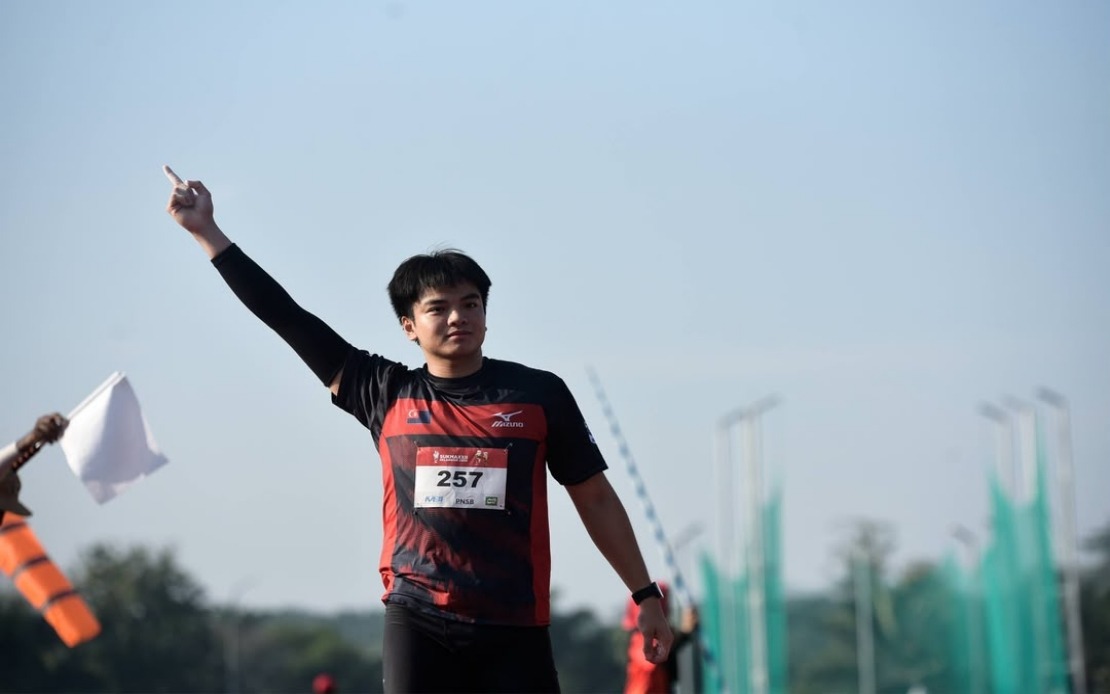
Johor's javelin sensation Chai Kai Le arrived at the Selangor 2026 Malaysia Games carrying the weight of expectation but also the lightness of youthful ambition. On his second attempt at the Universiti Putra Malaysia Sports Centre, the 18-year-old unleashed a throw that would rewrite the record books, sending the javelin 64.44 metres through the Serdang air to eclipse a mark that had stood untouched for more than a quarter-century. The previous Games record of 62.33 metres, set by Sarawak's Kho Mei Kuan at the 2000 Penang edition, had seemed immovable until Kai Le's moment of triumph.
Yet the path to this record-breaking performance began not on the javelin field but in the badminton hall. As a primary school student in Standard Six, Kai Le was a shuttlecock enthusiast whose early passion lay in a different sport entirely. It was during those badminton sessions that a perceptive teacher observed something beyond typical athletic ability—a distinctive snap and speed in the young athlete's arm when releasing the shuttle. That single observation would prove pivotal, as the educator suggested that Kai Le's natural kinetic gifts might find greater expression in track and field, specifically in the explosive discipline of javelin throwing.
The transition from badminton to javelin was neither immediate nor guaranteed to succeed, but Kai Le embraced the suggestion with the openness characteristic of adolescent athletes still discovering their sporting identity. Once committed to the new discipline, he pursued it with growing seriousness, entering local competitions and absorbing knowledge from more experienced throwers. Witnessing the senior athletes achieve distances that seemed almost superhuman at the time, Kai Le began to harbour a vision of his own future. The dream was not merely to participate but to join the ranks of these accomplished competitors, to match their performances and perhaps, eventually, to surpass them.
Behind every athlete's ascent stands a support network, and Kai Le has been fortunate in this regard. His father, Chai Yin Huan, has provided unwavering backing throughout the athlete's development, making the financial and logistical commitments necessary to sustain a competitive javelin career. When injuries struck, requiring medical intervention and rehabilitation, his father covered treatment costs without hesitation. When equipment wore out—shoes abraded by countless training sessions—replacements materialised swiftly. This parental commitment extended beyond the material realm; Chai Yin Huan's expectations were notably modest by the standards of competitive sport, focusing instead on effort, improvement, and crucially, maintaining health amidst the grinding demands of elite athletics.
The past twelve months have tested both athlete and family resolve considerably. While balancing pre-university studies at Bukit Jalil Sports School, Kai Le has contended with a troublesome trio of injuries affecting his back, right shoulder, and elbow. These injuries have refused to heal completely, creating an ongoing vulnerability that threatens to undermine performance at critical moments. Despite this physical fragility, Kai Le has maintained his training regimen and continued competing, demonstrating a resilience that separates ambitious athletes from truly committed ones. Earlier this year, at the Indonesia Open, he channelled this determination into a personal breakthrough, establishing both a personal best and a national under-20 record with a throw of 65.65 metres.
The significance of Kai Le's SUKMA breakthrough extends beyond the immediate satisfaction of breaking a 26-year-old record. At just eighteen years old, he has positioned himself among Malaysia's most promising field athletes at a moment when the nation's javelin programme requires fresh talent and vitality. The record achievement validates the early intervention by his teacher and the sustained investment by his family, suggesting that the pathway from recreational badminton to elite javelin competition, though unconventional, can yield remarkable results. For Malaysian athletics more broadly, Kai Le represents the kind of raw potential that emerges when coaching intuition, family support, and personal determination align.
Looking forward, Kai Le's ambitions have already expanded beyond SUKMA glory. His next target is a 70-metre throw, a threshold that would substantially strengthen his credentials for selection to the 2027 SEA Games team. To pursue this objective, he has arranged a month-long training expedition to Japan in early 2027, where exposure to international coaching methods and high-level competition should accelerate his development. Such overseas training blocks have become increasingly common among serious Malaysian field athletes seeking to bridge the gap between national and regional performance standards.
The challenges ahead are formidable. Injuries remain a persistent concern, and the trajectory from 64.44 to 70 metres represents not merely a 5.56-metre increase but a qualitative leap in athletic achievement. International competition typically demands not only greater strength and technique but also improved consistency and the mental resilience to perform under pressure. Nevertheless, Kai Le's track record suggests he possesses the mental fortitude to pursue such ambitious targets. His commentary that "if you really want it, it will come" reflects a philosophical maturity beyond his years, grounded in the lived experience of overcoming obstacles and capitalising on opportunity.
The story of Chai Kai Le ultimately illustrates principles that extend far beyond athletics. It demonstrates the cascading impact of early identification and encouragement, the transformative power of parental commitment, and the capacity of young Malaysians to achieve excellence when given appropriate guidance and support. As he trains towards the SEA Games and contemplates throws beyond 70 metres, Kai Le carries forward not only his own aspirations but also the hopes of a nation increasingly seeking success in field events on the regional and international stage.

