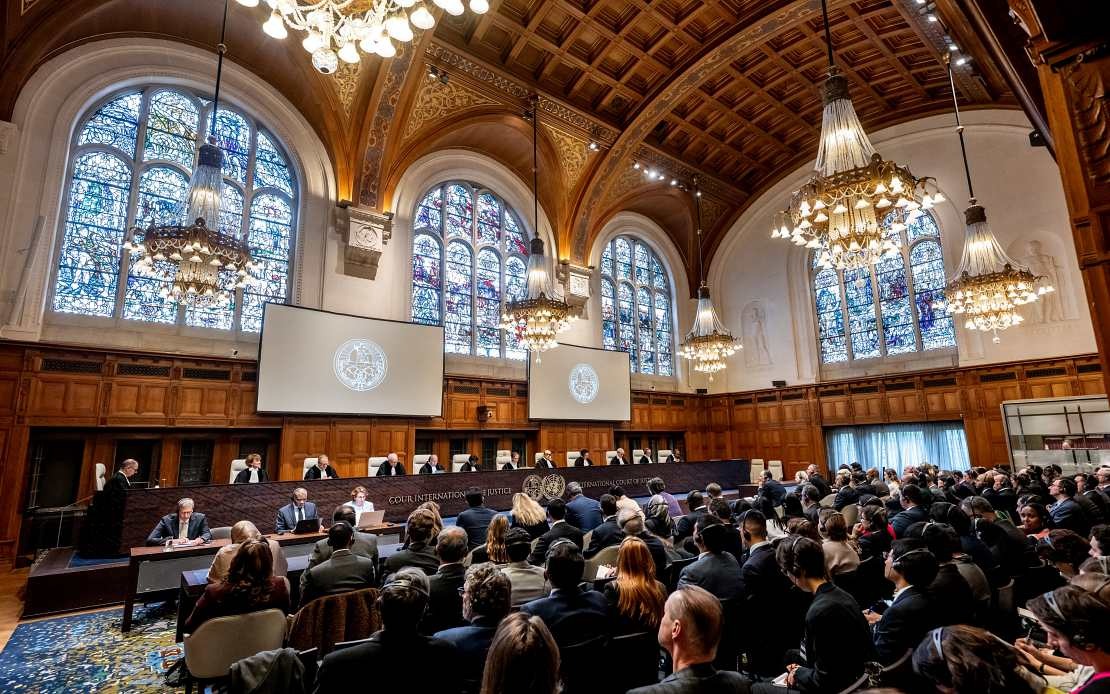
France has thrown its weight behind the International Criminal Court in a forceful rebuttal to mounting American criticism of the institution. Speaking through Foreign Ministry spokesman Pascal Confavreux on Thursday, Paris made clear that it sees no contradiction between supporting the ICC and protecting state interests, positioning itself as a steadfast defender of multilateral justice mechanisms even as Washington threatens to isolate the court.
The timing of France's statement reflects escalating tensions between Washington and the global legal system it largely opposes. US Secretary of State Marco Rubio has begun a coordinated campaign against the ICC, publicly questioning its legitimacy and announcing that the State Department intends to persuade other nations to exit the institution. This represents a hardening of American hostility towards the court, which has intensified in recent years as the tribunal has expanded its investigations into matters that touch on US interests.
At the heart of the dispute lies a fundamental disagreement over institutional authority and accountability. The American argument—that the ICC poses a threat to sovereign decision-making—reflects longstanding scepticism about international bodies that could theoretically constrain American military and political operations. Rubio's initiative explicitly targets what Washington describes as the court's ability to challenge American sovereignty, signalling an administration willing to actively pressure allied nations to abandon the multilateral framework.
Confavreux's response reframes the sovereignty question entirely. By emphasising that the ICC prosecutes individuals rather than governments, the French spokesman identifies a crucial distinction that underpins the court's legitimacy across democratic nations. This legal architecture means the tribunal investigates and tries persons accused of genocide, war crimes, crimes against humanity, and aggression—the world's gravest offences—without displacing domestic judicial systems or claiming authority over state institutions themselves. For France and other member nations, this distinction renders American sovereignty concerns misplaced or disingenuous.
The ICC's institutional history lends weight to the French position. Established in 2002 and headquartered in The Hague, the court emerged from international consensus that certain atrocities demand prosecution beyond national borders, particularly where domestic systems lack capacity or willingness to act. Its creation reflected post-Cold War optimism about global governance and shared values among democracies and developing nations alike. France, as a founding supporter, has invested diplomatic capital in the institution's legitimacy and independence.
Washington's refusal to join the court—the US remains a non-signatory to the Rome Statute—has historically insulated America from direct jurisdiction, yet the ICC's expansion of investigative scope has begun to complicate this protective position. American concerns have sharpened as the court has opened preliminary examinations into situations involving NATO allies and American personnel, prompting the current campaign to undermine the institution rather than engage with it constructively.
The State Department's initiative to limit the ICC's mandate, as described in diplomatic channels, represents an escalation beyond rhetorical criticism. Such pressure campaigns typically involve conditioning aid, trade benefits, or diplomatic recognition on whether nations maintain or withdraw their membership. For smaller countries or those dependent on American support, such incentives can outweigh commitment to international justice. The risk is that American pressure fractures the coalition of nations that has sustained the court's authority and legitimacy.
France's explicit mention of attacks and threats against ICC staff underscores another dimension of the dispute. Personnel working for the tribunal have faced intimidation and security challenges, particularly from states investigating or hostile to the court's work. By condemning such harassment as unacceptable, Confavreux positioned France as defending not just an institution but individuals exercising judicial functions in service of humanity's highest legal principles. This rhetorical move elevates the stakes beyond institutional positioning to questions of personal safety and professional independence.
For Southeast Asian observers, this transatlantic clash carries particular significance. Several countries in the region have engaged with ICC mechanisms or faced pressures regarding their own international legal obligations. The court's independence and credibility affect how smaller nations navigate between great-power interests and commitments to global legal standards. Should American pressure succeed in fracturing the ICC's membership or constraining its mandate, it would reinforce patterns where powerful states dictate the scope and reach of international accountability—a precedent that could reshape how Asia-Pacific nations approach multilateral institutions broadly.
France's stance also reflects deeper European strategic interests. The European Union, of which France is a leading member, has positioned itself as guardian of multilateral institutions and rules-based international order, positioning these commitments as essential to global stability and European influence. Defending the ICC, therefore, becomes part of a larger competition for influence in shaping global governance, where Europe asserts values and institutional frameworks against American unilateralism or Chinese alternatives.
The coming weeks will reveal whether France's endorsement attracts similar statements from other European nations or whether American pressure begins fragmenting the court's coalition. Germany, as another major European power and ICC supporter, will likely face similar decisions about how visibly to back the institution. Meanwhile, the broader question of whether international accountability mechanisms can survive superpower opposition remains unsettled, with implications far beyond criminal justice itself.

