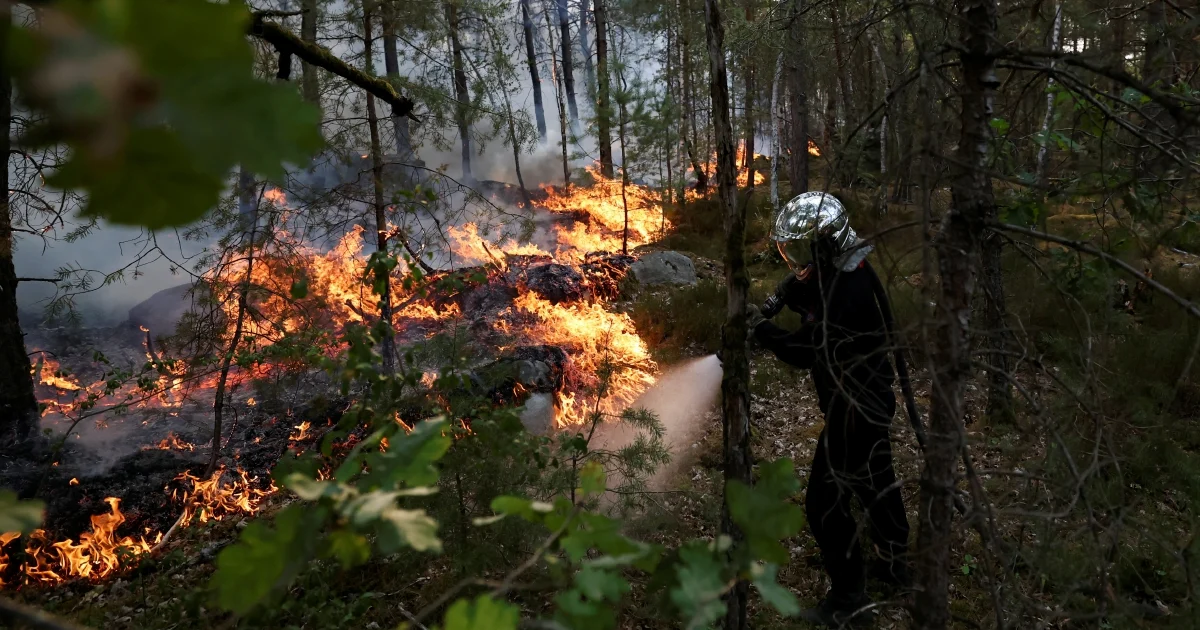
France mobilised emergency firefighting crews on Monday to contain two blazes that consumed over 1,300 hectares of forest in the Arbonne-la-Foret region south of Paris, while police investigations turned toward an apparent deliberate cause. The discovery of suspected arson adds a criminal dimension to what has become one of France's significant wildfire incidents this year, raising fresh concerns about intentional fire-setting during the warmer months when conditions favour rapid spread.
The two individuals arrested by authorities are currently under investigation for their alleged role in igniting the flames, though detailed circumstances surrounding the suspected arson remain unclear. This development underscores a troubling trend across Europe, where deliberate acts of fire-setting create additional strain on already-stretched emergency services during peak fire seasons. In France specifically, the summer months have historically witnessed both accidental and intentional wildfire incidents, though the scale of destruction in this case marks it as particularly serious.
The Arbonne-la-Foret incident demonstrates how quickly forest fires can spiral beyond initial containment efforts when conditions align unfavourably. The region's wooded terrain, combined with weather patterns and the rapid propagation potential of flames, created an environment where firefighters faced considerable operational challenges. Regional authorities coordinated response efforts across multiple departments, deploying aerial resources, ground crews, and support personnel to battle the expanding perimeter.
For Malaysian observers, this European wildfire situation carries relevant parallels to Southeast Asia's own fire management challenges. While the geographical and climatic contexts differ substantially, the underlying principle remains constant: large-scale forest destruction inflicts environmental damage with ripple effects extending far beyond the immediate burn zone. Transboundary smoke, ecosystem disruption, and long-term forest recovery all mirror concerns that have affected Malaysia during regional haze episodes triggered by fires in Indonesia and neighbouring countries.
The environmental footprint of consuming 1,300 hectares extends beyond immediate landscape transformation. Such fires release substantial carbon emissions, disrupt wildlife habitats critical for endangered species, and degrade air quality across a wider geographic area than the fire zone itself. The recovery trajectory for French forests following such incidents typically spans years or decades, depending on species composition and the severity of soil damage sustained. This underscores why prevention strategies, particularly enforcement against deliberate fire-setting, form a cornerstone of modern forest management policy.
The arrest of two suspects signals that French law enforcement is taking a prioritised investigative approach to determining causation. Arson prosecutions in forest environments carry significant legal consequences across European jurisdictions, reflecting the gravity with which authorities treat intentional destruction of natural resources. Understanding motivation behind such acts—whether criminal negligence, insurance fraud, land dispute resolution, or other factors—helps authorities refine prevention and security strategies in vulnerable forest regions.
France's experience managing this incident also underscores infrastructure and resource dependencies. Effective wildfire response requires sustained funding for specialised equipment, trained personnel, and inter-agency coordination protocols. Southeast Asian countries, particularly those in the ASEAN region that struggle with recurrent fire crises, often grapple with comparable resource constraints that hamper rapid response capabilities. Investment in firefighting infrastructure and cross-border cooperation mechanisms has become increasingly urgent as climate patterns shift and fire seasons potentially lengthen.
The international dimension of forest fire management has grown increasingly prominent in policy discussions. The European Union and member states like France have strengthened protocols for mutual aid during major fire incidents, recognising that regional cooperation enhances overall resilience. This model has relevance for ASEAN nations considering deepened coordination mechanisms for transboundary haze and fire management, particularly given how smoke from one country rapidly affects air quality and public health across the region.
Public health implications of the Arbonne-la-Foret fires extend beyond immediate firefighting operations. Communities downwind from the burn zone face air quality degradation, which triggers respiratory health impacts particularly among vulnerable populations including children, elderly residents, and those with pre-existing pulmonary conditions. Air quality monitoring systems deployed across affected regions provide real-time data to residents and health authorities, enabling appropriate public health advisories. Malaysian cities have repeatedly experienced similar challenges during regional haze episodes, making this dimension of wildfire impact immediately recognisable to Southeast Asian audiences.
The investigation into suspected arson will likely shape future security measures in French forest regions. Enhanced surveillance, community awareness campaigns, and targeted enforcement in identified high-risk zones represent common policy responses following deliberate fire incidents. Authorities must balance environmental protection with privacy considerations and resource allocation, determining whether heightened monitoring delivers commensurate safety benefits. Similar policy tensions emerge in Southeast Asia as governments weigh surveillance and enforcement strategies against development pressures and land-use competing interests.
Looking forward, the Arbonne-la-Foret incident reinforces that modern wildfire crises increasingly blend natural environmental factors with human agency. Climate change, vegetation density, seasonal weather patterns, and deliberately-set fires collectively shape fire risk profiles. Comprehensive forest management strategies must therefore integrate climate adaptation, landscape planning, and law enforcement elements into coherent policy frameworks. For regional observers in Southeast Asia, the French experience provides instructive lessons about maintaining preparedness while building institutional capacity for investigation and prevention.

