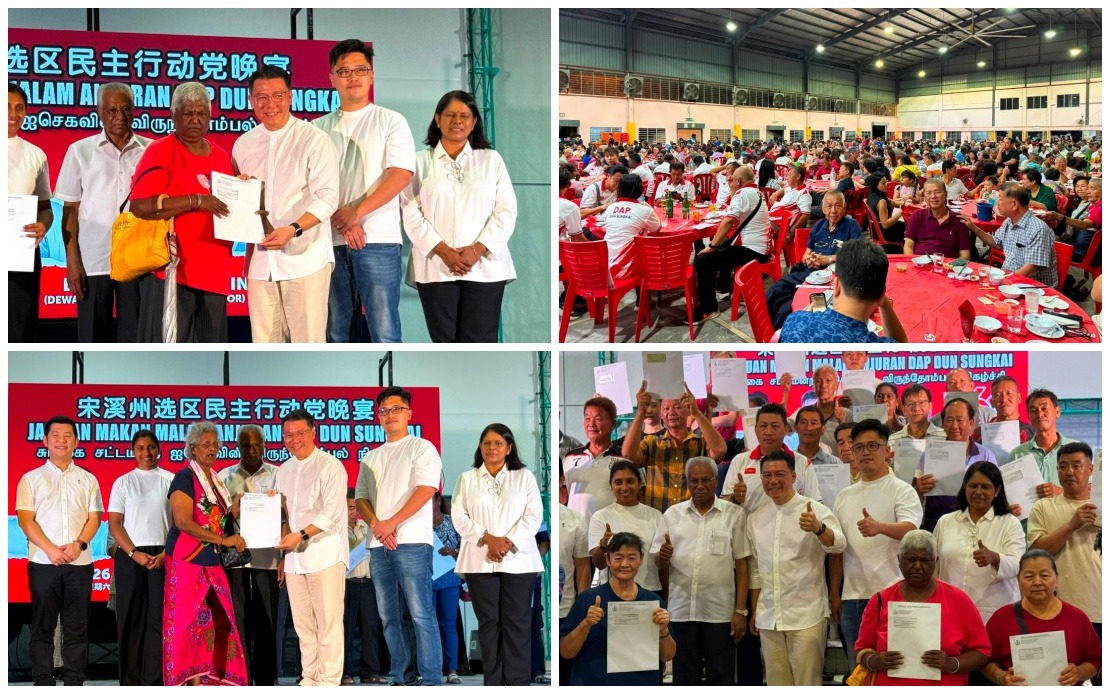
A settlement dispute that has shadowed the lives of 120 squatter families in Perak's Sungkai and Kuala Bikam constituencies for more than four decades has reached resolution, with Housing and Local Government Minister Nga Kor Ming presenting formal land grants to the beneficiaries. The distribution took place during a dinner celebration organised by the DAP Sungkai state constituency division on August 8, drawing an audience of more than 1,200 community members from diverse backgrounds across the region.
The allocation of these land grants represents a watershed moment for households that have endured decades of housing insecurity and legal limbo. Many families have built lives on informal settlements without secure tenure, exposing themselves to the constant threat of eviction and preventing them from accessing formal credit, infrastructure improvements, or passing secured assets to their children. The resolution carries particular weight in Perak, a state where informal settlements remain a visible reminder of the gap between rapid urbanisation and inclusive development planning across Malaysia's regions.
Nga framed the resolution within the MADANI Government's broader policy framework, emphasising that the initiative reflects the administration's commitment to inclusive development that transcends racial, religious, and socioeconomic divides. He positioned the land grant distribution as evidence that the government prioritises the wellbeing of all Malaysians, regardless of background or social standing. This messaging carries significance given longstanding perceptions among certain communities that development programmes have historically favoured particular demographic groups over others.
The resolution also highlights the role of Sungkai assemblyman Datuk A. Sivanesan, who chairs the state's Human Resources, Health, Indian Community Affairs and National Integration Committee. Sivanesan's portfolio suggests that the settlement predominantly comprises Indian families, reflecting broader patterns of informal housing in Malaysia where certain ethnic communities face disproportionate housing insecurity. The assemblyman's involvement underscores how state-level legislative representatives can facilitate resolution of decades-old infrastructure gaps when political will and bureaucratic coordination align.
Beyond the immediate land distribution, Nga referenced complementary government programmes targeting Indian community development and welfare. The government has allocated RM20 million specifically for Indian settlements, RM50 million for Tamil vernacular schools, and increased funding for the Malaysian Indian Transformation Unit to RM150 million. These concurrent initiatives suggest a coordinated approach to addressing multiple dimensions of community development rather than treating housing security in isolation. For Malaysian policymakers grappling with similar settlement issues elsewhere, the integration of education, economic transformation, and housing support offers a template for multifaceted intervention.
The dinner's scale—attracting more than 1,200 attendees—reflects how housing security issues resonate beyond affected families to broader community constituencies. Local representatives including Ipoh Timur MP Howard Lee Chuan How and state assemblypersons from surrounding constituencies participated in the event, indicating that settlement resolution commands cross-party acknowledgment of its importance. This political engagement suggests that housing informality, despite its persistence in Malaysian discourse, enjoys sufficient priority among elected representatives to warrant high-profile ceremonial recognition.
Nga's exhortation to voters to evaluate government performance against measurable achievements rather than perception represents an implicit acknowledgment of trust deficits that persist in Malaysian politics. His call for citizens to resist racial sentiment-driven messaging and embrace "constructive politics" rooted in performance and development outcomes suggests government awareness that policy implementation alone cannot overcome accumulated perceptions shaped by historical inequities. For Malaysian readers assessing governmental effectiveness, Nga's framing invites scrutiny of tangible outcomes—whether these 120 families can indeed secure mortgages, obtain title deeds, and build permanent structures on newly granted land.
The four-decade duration of the settlement dispute raises important questions about institutional responsiveness and the mechanisms that allow housing insecurity to persist so long before political intervention. Understanding why resolution required this particular political configuration—the DAP Sungkai division, a sympathetic state assemblyman, ministerial attention, and a public ceremony—offers insights into how informal settlement issues gain traction in Malaysian governance. Settlement problems affecting lower-income communities often languish without resolution precisely because affected populations lack the political voice or constituency prominence to force the hand of authorities.
For Perak specifically, the resolution addresses a chronic issue that has affected housing security across multiple constituencies and demographic communities. The state has historically grappled with informal settlements in various municipalities, and this distribution suggests that targeted intervention with political backing can achieve resolution even when disputes span generations. However, the underlying question remains whether resolution of these 120 cases signals systematic changes to prevent future settlement proliferation or represents an isolated success in a persistently fragmented landscape of informal housing across the region.
The ceremony itself exemplifies how Malaysian politics increasingly stages policy delivery as public spectacle, transforming administrative resolution into community celebration. The attendance of numerous political figures and community leaders transformed what could have been a bureaucratic land registry transaction into a symbolic affirmation of governmental commitment to inclusive development. This approach carries both strengths—it elevates recognition of affected communities and their struggles—and potential weaknesses, namely that public theatricality may substitute for deeper systemic changes addressing root causes of housing insecurity.
Moving forward, the practical implications of these land grants depend substantially on complementary support mechanisms. Beneficiary families will require assistance navigating property registration, potential taxes, infrastructure development on granted land, and possibly access to financing for housing construction. The government's broader allocation of RM20 million for Indian settlements suggests recognition that land grants alone represent an incomplete solution. Whether beneficiaries receive coordinated support in accessing these resources and translating land ownership into secure housing remains crucial to determining whether this initiative fulfils its symbolic promise of generational security.
The resolution ultimately reflects convergence of multiple factors—sympathetic local representation, ministerial championing, and political circumstances favouring high-profile resolution of long-standing grievances. Perak residents and policymakers elsewhere should assess whether comparable mechanisms exist to address similar settlement issues in other areas and constituencies, particularly those lacking equivalent political prominence or representation.

