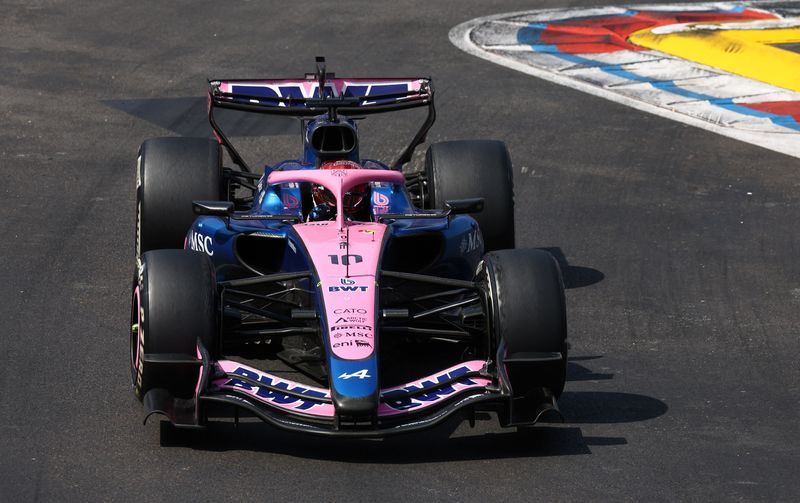
The final results of June's Monaco Grand Prix remain unresolved following a closed-door hearing before Formula One's appeal court on Tuesday, with judges signalling they will require two to three weeks to deliver their verdict. The case centres on a complex dispute involving penalty application and timekeeping accuracy that has created significant uncertainty across the championship standings heading into the second half of the season.
The FIA's international court of appeal convened in Paris to address a situation with far-reaching consequences for multiple drivers and teams. At its heart lies the question of whether Alpine's Pierre Gasly should retain the third-place position he was originally awarded on the circuit, or whether Red Bull's Isack Hadjar deserves the trophy and points he briefly celebrated before the decision unravelled. The outcome will ripple through the finishing order, affecting drivers like McLaren's Oscar Piastri and other competitors whose final classifications remain contingent on how the stewards' original decision is ultimately validated or reversed.
Gasly appeared to have completed his race work on June 7 in solid fashion, crossing the line in third position. However, stewards subsequently handed down two five-second penalties for exceeding pit-lane speed limits, a decision that demoted the Alpine driver to seventh place and elevated Hadjar into the podium positions. The Red Bull driver marked the achievement in traditional fashion, dousing himself with champagne as third-place finisher. This version of events proved short-lived.
Just five days later, on June 12, stewards reopened the matter following an appeal by Alpine, which presented evidence demonstrating that a timekeeping error had occurred. The stewards agreed with this technical evidence and overturned Gasly's penalties, restoring him to third place and bumping Hadjar back down the order. This reversal prompted Hadjar to return the trophy to Gasly in a somewhat awkward exchange. However, the matter remained far from settled when Red Bull and McLaren jointly lodged an appeal on June 16, arguing that the original decision should stand or questioning the fairness of how the situation had been handled.
The broader context of the dispute reveals uncomfortable questions about consistency and fairness in penalty administration. Oscar Piastri, Gasly's fellow driver penalised for the identical speeding infraction, served his five-second penalties during the race itself rather than having them applied post-race. Because Piastri completed his punishment in real-time, the rules governing post-race reviews do not permit that decision to be revisited, meaning the Australian suffered the consequences without any possibility of remedy. Meanwhile, George Russell of Mercedes, another driver penalised for pit-lane speeding that day, attempted to negotiate having his penalty applied after the race to preserve a theoretical opportunity for later review, though stewards did not grant this request.
This asymmetry in how identical offences were handled and ultimately adjudicated has formed the basis for the opposing teams' concerns. McLaren team principal Andrea Stella articulated his organisation's position during the Dutch Grand Prix weekend, emphasising that reversing Gasly's penalties raised fundamental fairness questions for the sport. Stella acknowledged that McLaren's appeal reflected both a principled concern about sporting integrity and material self-interest, given that Piastri's penalty cost his team championship points that could prove decisive in the tight constructors' competition.
Stewards themselves acknowledged the inequitable nature of the situation when they overturned Gasly's penalties. In their June 12 decision, they noted explicitly that while a timekeeping error justified reviewing the original penalty decision, the outcome created unfairness for drivers like Piastri who had already served their penalties. The stewards further observed that motor racing regulations do not contemplate reversing penalties that have already been served during a race, making it conceptually impossible to create parity after the fact for drivers who complied with the original instructions.
Mercedes' championship aspirations have also been affected by the fallout from Monaco's penalty decisions. Russell finished outside the points-scoring positions after serving his drive-through penalty for the pit-lane infraction, placing additional pressure on the team's season campaign. The driver had explicitly requested that stewards apply his penalty post-race rather than as a drive-through, hoping for the same review opportunity that ultimately benefited Gasly, but this request was denied.
The championship implications of the Monaco decision extend well beyond the immediate podium positions. With teams and drivers fighting for supremacy across both drivers' and constructors' championships, the allocation of points and the precedent established by the appeal court's ruling will influence how stewards approach similar situations for the remainder of the season. The decision may also prompt discussions about clarifying regulations to prevent such ambiguities from arising in future races.
Formula One continues its season without final clarity on Monaco's standings, with the Italian Grand Prix scheduled for Monza on September 6, just days after the appeal judges are expected to issue their ruling. Following Monza, the calendar will feature the inaugural Madrid Grand Prix on September 13, introducing another new venue to the sport. The delayed resolution of the Monaco dispute, meanwhile, has left teams in a state of uncertainty as they calculate championship mathematics and resource allocation for the remainder of the campaign.
The confidential nature of Tuesday's Paris hearing meant no substantive details emerged regarding the arguments presented or the direction judges appeared inclined to take. This opacity, while standard procedure for Formula One's appeal processes, has only amplified speculation within the sport about the likely outcome. Observers have noted that the fundamental tension between upholding stewards' authority and ensuring fairness across all competitors will heavily influence how the judges ultimately resolve this extraordinarily complicated situation.

