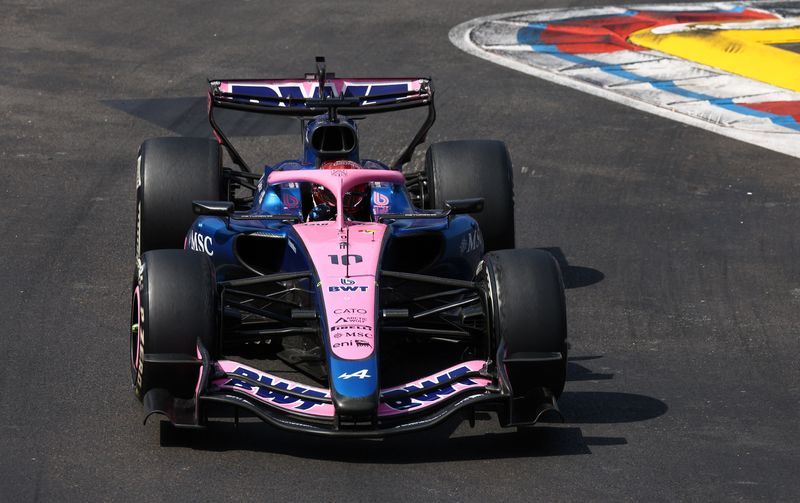
The motorsport world's attention returns to the contentious Monaco Grand Prix podium finish as Formula 1's international court of appeal prepares for a decisive hearing in Paris on Tuesday, resolving a dispute that has festered since June and exposed potential vulnerabilities in the sport's penalty system. Pierre Gasly's third-place result from the June 7 race in the Mediterranean principality remains uncertain, with the Alpine driver's position contested by two of the grid's most powerful teams in what has become a test case for how Formula 1 handles post-race corrections.
The saga began conventionally enough when stewards imposed two five-second penalties on Gasly for excessive pit-lane speed, dropping him from the podium to seventh position and elevating Red Bull's Isack Hadjar to third place. However, within five days, the decision unravelled dramatically when Alpine presented evidence demonstrating a timekeeping error had occurred, prompting stewards to rescind the penalties entirely and restore Gasly to the rostrum. Hadjar reluctantly returned his trophy, a reversal that appeared to settle matters until the appeals began flowing in.
McLaren's subsequent objection to the FIA reflected genuine frustration with asymmetrical treatment of identical infractions. Oscar Piastri, the team's fourth-placed driver, had incurred penalties during the race for the same pit-lane speeding violation, operating under the reasonable assumption that such infractions were unavoidable given the circuit layout and pit procedures. Unlike Gasly, who faced penalties that could theoretically be erased through post-race adjustments, Piastri served his penalty during active racing, consuming valuable time that placed him behind competitors and fundamentally altered his subsequent performance. The disparity troubled team principal Andrea Stella, who articulated during the Dutch Grand Prix weekend that the situation raised profound questions about sporting equity.
Stella's position extended beyond McLaren's immediate championship interests, though those were hardly incidental to the team's appeal filing on June 16. He emphasized that the reversal of Gasly's penalties created concerning precedent, suggesting that procedural decisions made by race stewards could be undermined if sufficient evidence materialization warranted reconsideration. This opened what some paddock observers characterized as a troubling can of worms—the possibility that established penalties might be routinely challenged or reversed, undermining the finality necessary for competitive certainty. Red Bull joined the appeal, aligning with McLaren's institutional interests despite their traditional rivalry.
The timing of the appeal underscored McLaren's championship aspirations. Every point gained or lost carries exponential weight in a tight title battle, and the decision to pursue the matter through to the international court suggested the team calculated that vindication remained within reach. Stella's candid acknowledgment that McLaren faced both systemic and material harm demonstrated how this single race's administrative chaos threatened to ripple through the entire season's competitive standings.
The FIA's approach to the hearing reflects the governance structure of modern Formula 1, with the international court operating as the sport's final judicial authority on competitive disputes. The organization confirmed that the proceedings would occur at FIA headquarters in Paris, conducted confidentially to protect the integrity of deliberations and the parties involved. This closed-door arrangement, while standard procedure, ensures that judgment will not be influenced by public opinion or media commentary, though it also limits transparency for the global fan base invested in the outcome.
What makes this case particularly significant for Malaysian and Southeast Asian followers is how it exposes the tension between technological precision and human judgment that increasingly characterizes Formula 1. The timekeeping error that prompted Gasly's reinstatement raises questions about whether modern sport remains adequately equipped to handle the exponential data and monitoring systems now embedded in racing. If such errors can occur at Monaco, widely regarded as the sport's most prestigious venue with correspondingly rigorous technical oversight, the implications extend to every circuit on the calendar.
The decision's ramifications will extend beyond the three drivers immediately affected. A ruling supporting Gasly's podium position essentially validates the correction mechanism and suggests that discovering post-race errors justifies penalty reversal. Conversely, an outcome favouring McLaren's position would establish that drivers cannot benefit from administrative oversights, even when those oversights demonstrably occurred. Either determination will inform how stewards approach penalty management throughout the remainder of the season and establish precedent for future disputes.
For regional enthusiasts following McLaren's title challenge through the remainder of the campaign, the hearing's outcome carries concrete implications. Should Piastri's points be restored, McLaren's constructor's championship position strengthens materially. The team's momentum heading toward upcoming races could shift depending on whether they receive institutional validation for their grievances or face disappointment from the sport's highest court.
The FIA has committed to publishing its decision as expeditiously as possible following Tuesday's proceedings, ending a limbo that has persisted for over two months. This extended uncertainty itself represents a weakness in Formula 1's governance framework, as teams operate under provisional standings while awaiting definitive rulings. The court's eventual pronouncement will carry weight extending far beyond Monaco 2024, establishing principles that will govern how the sport adjudicates complex technical and procedural disputes for seasons to come, making this hearing consequential for the entire competitive ecosystem.

