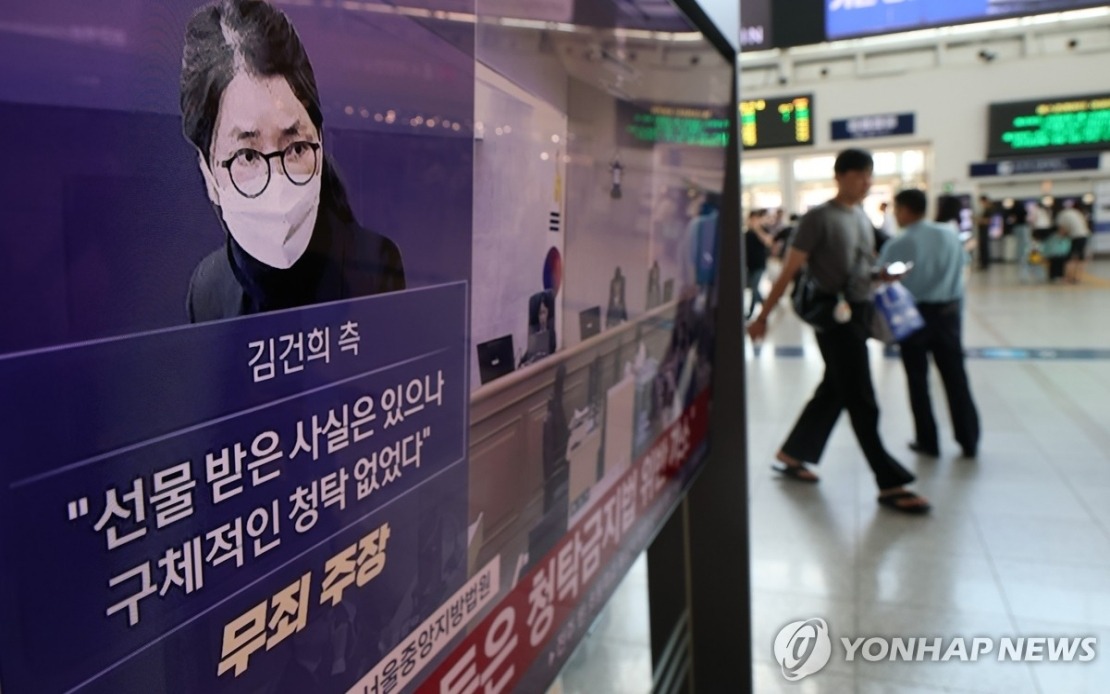
A Seoul court has delivered a decisive verdict in one of South Korea's most prominent political corruption cases, sentencing former first lady Kim Keon Hee to seven years in prison for accepting expensive gifts in exchange for leveraging her position to secure government appointments and business advantages. The Seoul Central District Court's ruling, handed down on Friday, represents a stark reminder of how high-ranking political figures can become entangled in bribery scandals that erode public trust in governance across the region.
Kim, the wife of ousted former President Yoon Suk Yeol, faced an array of specific charges involving the acceptance of luxury items worth approximately 300 million won cumulatively. The gifts accepted ranged from designer jewellery to artwork, including a Van Cleef & Arpels necklace valued at over 100 million won alone, which she obtained from a construction company chairman in exchange for facilitating a government job placement for the businessman's son-in-law. The court found her guilty on every count, validating the prosecution's case that she had systematically exploited her privileged position.
The evidence presented during the televised proceedings painted a picture of deliberate abuse of her role. Between March and May 2022, Kim received luxury items including jewellery pieces from the construction company chairman. In April of the same year, she obtained a golden turtle ornament from Lee Bae-yong, the former head of the National Education Commission, whose appointment she had facilitated. A Dior bag valued at 5.4 million won was gifted to her by a pastor in 2022, while a Vacheron Constantin watch arrived from a separate businessperson in September 2022. Additionally, in February 2023, she was found to have received a painting by celebrated artist Lee Ufan from a former prosecutor whose election nomination she had helped secure.
Presiding Judge Cho Sun-pyo's remarks during sentencing underscored the gravity of the offences and the betrayal of public expectation. The judge stated that Kim had fundamentally disregarded the dignified responsibilities inherent in serving as first lady, instead weaponising the position to pursue narrow personal interests. This characterisation reflects a broader frustration evident in South Korean society regarding the instrumental use of political office for private gain, a concern that resonates throughout East Asia where corruption scandals have repeatedly undermined governance credibility.
The prosecution's original recommendation had been for a sentence of seven and a half years, so the court's decision to impose exactly seven years represents a slight moderation from the demand while still reflecting the seriousness of the transgressions. The special counsel Min Joong-ki's team, which led the investigation, welcomed the outcome as a vindication of their work. However, the legal proceedings are far from concluded, as Kim's defence team has already signalled their intention to appeal the conviction, likely prolonging uncertainty around the case.
Crucially, the timeline of these offences reveals that most occurred during Yoon Suk Yeol's presidency, from May 2022 through his dismissal in April 2025. This temporal concentration emphasises how the first lady exploited her proximity to power during her husband's tenure in office, when her influence over appointments and business matters would have been at its maximum. The fact that these transgressions persisted for nearly three years without formal intervention raises questions about institutional oversight and the checks available to constrain the behaviour of presidential family members.
The sentencing of co-conspirators alongside Kim further illustrates the systemic nature of the corruption. The construction company chairman who gifted the diamond necklace received a one-year prison sentence suspended for two years, while the businessman who presented the Vacheron Constantin watch was given a ten-month suspended sentence spanning two years. The pastor faced a fine of 8 million won, a notably lighter penalty reflecting perhaps his more peripheral involvement. These differentiated sentences suggest the court recognised Kim's position as the primary beneficiary and driver of the corrupt exchanges.
Kim's legal troubles, however, extend considerably beyond this single conviction. An appellate court had previously sentenced her to four years in prison in a separate corruption case, meaning she now faces accumulated prison time from multiple proceedings. The stacking of convictions underscores the breadth of her allegedly corrupt activities and the sustained nature of her misconduct spanning different schemes and timeframes. For Malaysian and Southeast Asian observers, this demonstrates how political corruption often encompasses multiple overlapping schemes rather than isolated incidents.
Additionally, the former first lady faces forthcoming trial regarding her alleged involvement in directing members of the Unification Church to join the main opposition People Power Party ahead of the 2022 presidential election. Prosecutors allege that this manoeuvre was designed to influence the outcome of the party's primary contest to select its presidential candidate, which her husband eventually won. Should she be convicted in this proceeding, it would add another layer of political manipulation to her portfolio of offences, suggesting that her exploitation of her position extended beyond personal economic gain to encompassing efforts to shape electoral outcomes in favour of her husband's political ambitions.
The court found that Kim had attempted to evade accountability through various stratagems after investigations commenced. She returned certain gifts once authorities began their inquiry and claimed that some items were personal purchases rather than gifts received for favours. Judge Cho explicitly rejected these defences, stating that such behaviour demonstrated her full awareness of the illegality of her conduct and her deliberate efforts to obstruct justice. This finding is particularly significant as it indicates premeditation and consciousness of guilt rather than inadvertent or naive involvement in questionable transactions.
For the broader East Asian region, including Malaysia where governance and anti-corruption efforts remain critical policy concerns, the Kim case serves as an instructive example of how even the highest positions carry legal accountability when wielded for personal enrichment. South Korea's judiciary demonstrated willingness to prosecute and convict a former first lady without apparent political interference, suggesting institutional resilience. However, the conviction's ultimate finality remains uncertain pending appellate review, and questions will persist regarding how such extensive wrongdoing evaded institutional detection during the years it occurred. The case underscores both the potential for legal systems to address elite corruption and the ongoing challenges in preventing such misconduct from taking root within privileged circles in the first instance.

