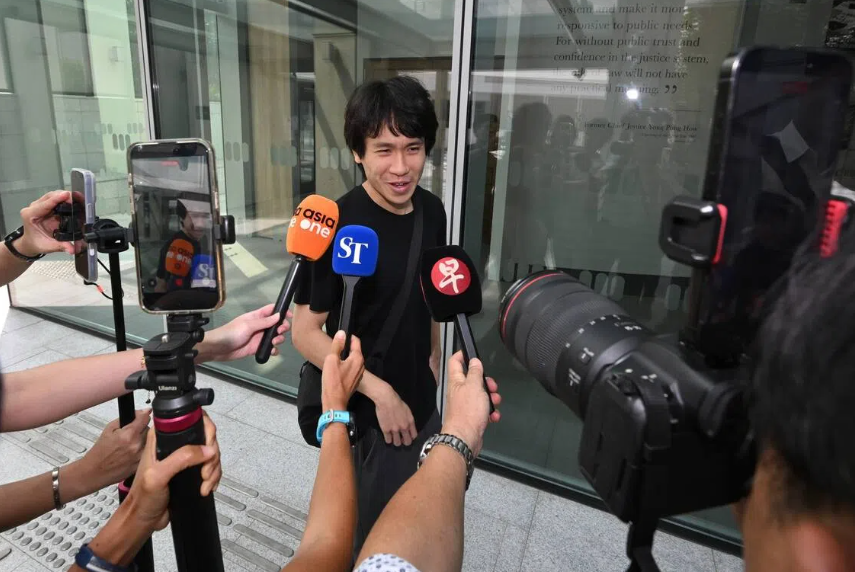
Amos Yee, the 27-year-old former child actor, appeared before Singapore's District Court on Aug 26 to face four fresh charges, bringing his total liability to seven separate offences. The series of allegations paints a picture of escalating legal troubles for the controversial online personality, who has already gained notoriety for inflammatory social media posts and public statements that authorities claim violate multiple Singapore laws.
Central to the new charges is an accusation that Yee deliberately sought to incite racial tension through his online writings. Between April 7 and April 11, he allegedly published blog posts asserting that the Chinese-majority population in Singapore systematically disadvantaged Malays and Indians, and he purportedly encouraged members of these communities to stage protests against the Government. This conduct has triggered a charge of knowingly attempting to promote racial disharmony, a serious offence in Singapore's multicultural context where communal harmony is treated as foundational to social stability. The legal system takes such allegations with considerable gravity, given the nation's historical experience with communal tensions and its emphasis on maintaining religious and ethnic coexistence.
A second charge relates to a video Yee uploaded on May 27, in which he allegedly made similar claims about discrimination faced by the Malay and Muslim communities at the hands of the Chinese population. The repeated nature of these accusations—appearing across multiple platforms and spanning several weeks—suggests a pattern of conduct rather than isolated incidents. For Malaysian observers, these charges are particularly significant because they highlight how Singapore's approach to managing racial discourse differs markedly from Malaysia's own constitutional protections and laws against sedition and racial provocation. Both nations grapple with managing plural societies, but their regulatory frameworks reflect different historical trajectories and political priorities.
Perhaps most disturbing among the allegations are two charges under Singapore's Protection from Harassment Act relating to content created in 2021. Yee allegedly produced three videos in which he advocated for legalising free speech protections for paedophiles, with the deeply troubling claim that infants and children could consent to sexual activity. He reportedly went further by calling for the abolition of laws criminalising the production and distribution of child sexual abuse material. These statements represent not merely offensive expression but advocacy for the decriminalisation of child exploitation, a position that societies across Southeast Asia universally reject. An additional post on June 30 allegedly reiterated these contentions, suggesting deliberate persistence rather than momentary lapse in judgment.
The bail conditions imposed by the court on Aug 26 reflect the seriousness with which authorities view the charges. Released on S$15,000 bail, Yee faces significant restrictions: he is prohibited from posting anything online that discusses his views on paedophilia or content that could inflame communal feelings between racial groups. These conditions acknowledge the particular potency of digital platforms in amplifying divisive messaging and the urgent need to prevent further distribution of his alleged statements. The restrictions essentially confine his online expression to non-controversial terrain, a remarkable constraint that underscores judicial concern about his repeat conduct.
The Singapore Police Force received multiple complaints spanning April through July regarding Yee's blog posts, triggering the investigation that culminated in these charges. Platform X (formerly Twitter) removed one of his videos after police issued a disabling direction under Singapore's Online Criminal Harms Act on Aug 18, demonstrating how authorities coordinate with technology companies to restrict harmful content circulation. Yee also received stop communication directions requiring removal of the disputed posts from his blog, giving him explicit legal instruction to cease distribution. These enforcement mechanisms reveal a sophisticated regulatory approach to managing online speech that many regional governments are studying as they craft their own digital governance frameworks.
The potential penalties for conviction on the racial disharmony charge alone are severe: up to three years imprisonment, a fine, or both. Each harassment charge under the Protection from Harassment Act carries a maximum fine of S$5,000. These sentencing ranges reflect parliament's judgment about the gravity of advocating racial division and harassment in Singapore's densely multiethnic city-state, where public order depends substantially on communal restraint. For Malaysian readers accustomed to their own sedition laws and constitutional provisions protecting Islam and the Malay-Muslim majority, these penalties illustrate how Singapore addresses comparable social tensions through different statutory mechanisms.
Compounding Yee's legal jeopardy are three charges under Singapore's Enlistment Act, connected to his national service obligations. He allegedly failed to report for pre-enlistment medical screening and departed Singapore without valid exit permits on multiple occasions: from December 13, 2015, to April 19, 2016, and again from December 15, 2016, to March 19, 2026. These absences, which span years, suggest either deliberate evasion or profound indifference to compulsory military service requirements. Yee allegedly failed to complete his medical screening across an extended period from April 26, 2016, to March 19, 2026. National service violations in Singapore can result in fines reaching S$10,000, imprisonment up to three years, or both—penalties that rival those for the political speech charges.
The cumulative effect of these seven charges places Yee at risk of substantial prison time should courts find him guilty. His case highlights the tension between protecting free expression and maintaining public order in diverse societies—a challenge that resonates across the region. For Malaysia, Singapore, and other Southeast Asian nations navigating rapid digital change and communal sensitivities, the Yee prosecution offers a real-world demonstration of how courts apply existing legal frameworks to online conduct. Whether such robust intervention protects social stability or unduly constrains legitimate expression remains contested among legal scholars and civil libertarians.
Yee is scheduled to return to court on September 18 for a pre-trial conference, where prosecutors and defence representatives will narrow the issues for eventual trial. The intervening weeks will likely see intense legal preparation and possibly negotiations regarding the charges. His case has already attracted international attention from free speech advocates and child protection organisations, reflecting the polarised responses his statements have generated. The proceedings may also influence how other Southeast Asian jurisdictions approach comparable cases involving online speech that allegedly threatens communal harmony while simultaneously advocating harmful positions on child protection.
The charges against Yee underscore broader questions about balancing individual expression rights with community safety in digitally connected societies where a single post can rapidly reach thousands. Singapore's response—criminal charges, platform removal, court restrictions, and potentially lengthy imprisonment—represents one end of the regulatory spectrum. As Malaysia and other nations observe Yee's prosecution, they will evaluate whether similar approaches suit their own legal traditions and social circumstances. The case also serves as a cautionary tale for online personalities whose provocative statements may trigger criminal investigation, regardless of their intentions or claimed commitment to free speech principles.

