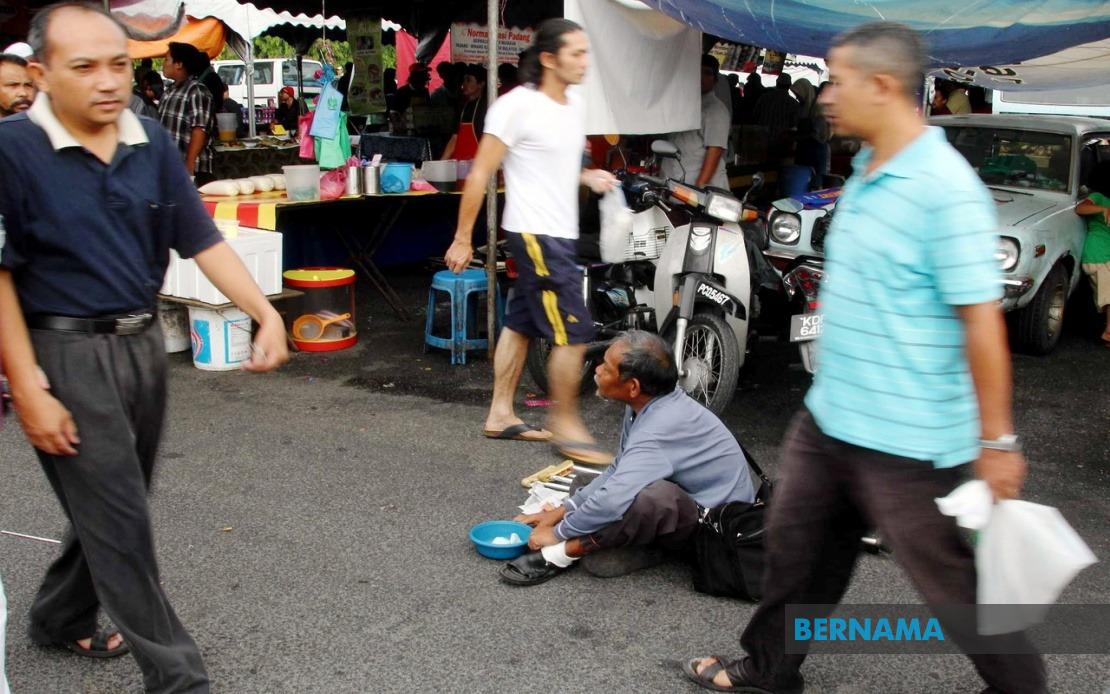
The Malaysian government is treating the prevalence of foreign beggars on Kuala Lumpur's streets as a serious organised crime matter, with officials now convinced that many such activities are coordinated by criminal networks rather than isolated instances of hardship. The Ministry of Home Affairs has disclosed that enforcement agencies suspect local accomplices are actively involved in protecting, organising, and profiting from these operations, raising concerns about the systematic exploitation of vulnerable migrant populations.
Data released in Parliament reveals the scope of the problem facing authorities. Between early 2025 and the end of May, immigration officers executed 836 separate enforcement sweeps across Kuala Lumpur and its surrounding districts, screening a cumulative total of 10,609 individuals. These operations yielded the detention of 5,411 foreign nationals on immigration-related charges, though only 42 detainees were specifically identified as being involved in begging. The relatively modest number of begging-related arrests compared to total detentions suggests that many of those swept up may be undocumented workers in other sectors, though the ministry's framing emphasises the synicate element in begging specifically.
The question that prompted this disclosure came from Fong Kui Lun, a Bukit Bintang representative in Parliament, who sought clarity on enforcement effectiveness in some of Kuala Lumpur's most visited locations. Bukit Bintang, Jalan Alor, and Changkat Bukit Bintang have become focal points for the begging problem, likely because their concentration of shopping malls, restaurants, and nightlife venues ensures high foot traffic and generous tourist spending. The ministry acknowledged that these areas require sustained attention and that identifying and dismantling the networks behind such activities demands more than standard immigration patrols.
To address the challenge, the Home Affairs Ministry has adopted a multi-agency framework that draws on the expertise and enforcement capacity of several government bodies. The Immigration Department now conducts coordinated operations jointly with the Royal Malaysia Police and Kuala Lumpur City Hall, pooling their intelligence and tactical resources. This collaborative structure has been enhanced through improved data-sharing protocols designed to map out syndicate networks, identify common operational patterns, and pinpoint locations where begging is most prevalent. The approach reflects a recognition that immigration enforcement alone cannot solve a problem rooted in criminal organisation and local complicity.
A key institutional mechanism driving this integrated response is the KL Strike Force, a multi-agency task force that includes representation from the Department of Social Welfare alongside the police and city authorities. The strike force operates as both a preventive and reactive mechanism: it systematically identifies and monitors locations where begging and vagrancy concentrate, conducts unannounced operations to disrupt activities, rapidly processes intelligence tips from the public and field officers, and maintains pressure on identified hotspots to prevent the re-establishment of networks. By bringing social welfare expertise into the mix, the framework also theoretically allows for victim identification and support, though public disclosure of such efforts remains limited.
The ministry's investigation extends beyond apprehended beggars to implicate locals who may be orchestrating operations from behind the scenes. Officials are pursuing inquiries against Malaysian citizens suspected of serving as protectors—individuals who may pay off local enforcement or provide safe houses—organisers who recruit and direct begging teams, and financial beneficiaries who extract a portion of daily takings. This investigation strand is crucial because dismantling syndicates requires proving the conspiracy and removing the economic incentive structures that make begging operations profitable for those running them.
The stated commitment to preserve Malaysia's international image and reputation reflects the particular sensitivity surrounding begging in tourist zones. Visitors' first and lasting impressions of Kuala Lumpur are shaped by their experience on the street, and visible poverty amplified by organised exploitation carries diplomatic implications. A city associated with street begging, child labour, and human trafficking suffers reputational damage that extends beyond public order concerns to affect investment confidence and tourism revenue. The ministry's insistence that it will not compromise on legal breaches or exploitation must be understood against this backdrop.
Parallel to the begging crackdown, the ministry disclosed information about its management of foreign worker quotas, responding to a separate parliamentary question from Datuk Ngeh Koo Ham. A special application window running from mid-January to the end of March this year, designed to assist employers who missed a December 2025 deadline, received 1,919 quota applications. Of these, 314 employers received positive recommendations, a 16 percent approval rate that suggests either substantial rejection of applications or a process designed to constrain the overall supply of foreign workers. Those successful employers are now awaiting final deliberation by the Department of Labour Peninsular Malaysia before receiving formal authorisation to hire overseas staff under the relevant employment legislation.
The timing and framing of these disclosures together illustrate the tension in Malaysia's approach to foreign labour and migration. On one hand, the government facilitates the recruitment of documented foreign workers through formal quota mechanisms, responding to employer demand for labour that cannot be filled domestically. On the other hand, it aggressively pursues undocumented migrants and those engaged in irregular livelihoods like organised begging. The apparent gap between quota approvals and detention numbers raises questions about whether enforcement pressure is adequately channelled toward incentivising documented employment or whether it primarily targets the most visible and vulnerable migrants.
For Malaysian readers and businesses, these developments carry practical implications. The intensified crackdown may reduce visible street begging in KL's premium districts, improving the aesthetic and safety environment for residents and tourists. However, the success of integrated enforcement ultimately depends on sustained funding, inter-agency coordination, and the willingness of frontline officers to implement policy consistently. Historically, such multi-agency task forces sometimes struggle with competing priorities and resource constraints. Additionally, the focus on organising domestic accomplices suggests that disrupting syndicates requires not only immigration enforcement but also criminal investigation and prosecution capabilities that demand significant police resources.
The broader regional context matters too. Foreign begging in Malaysia reflects larger patterns of economic migration, labour trafficking, and informal economy participation across Southeast Asia. Nations across the region struggle with similar phenomena, and Malaysia's emphasis on the syndicate dimension reflects a growing international recognition that most irregular migration and street-based exploitation involve some level of organised activity rather than purely individual desperation. How effectively Malaysia's multi-agency model operates will likely influence approaches adopted by neighbouring countries managing comparable challenges.

