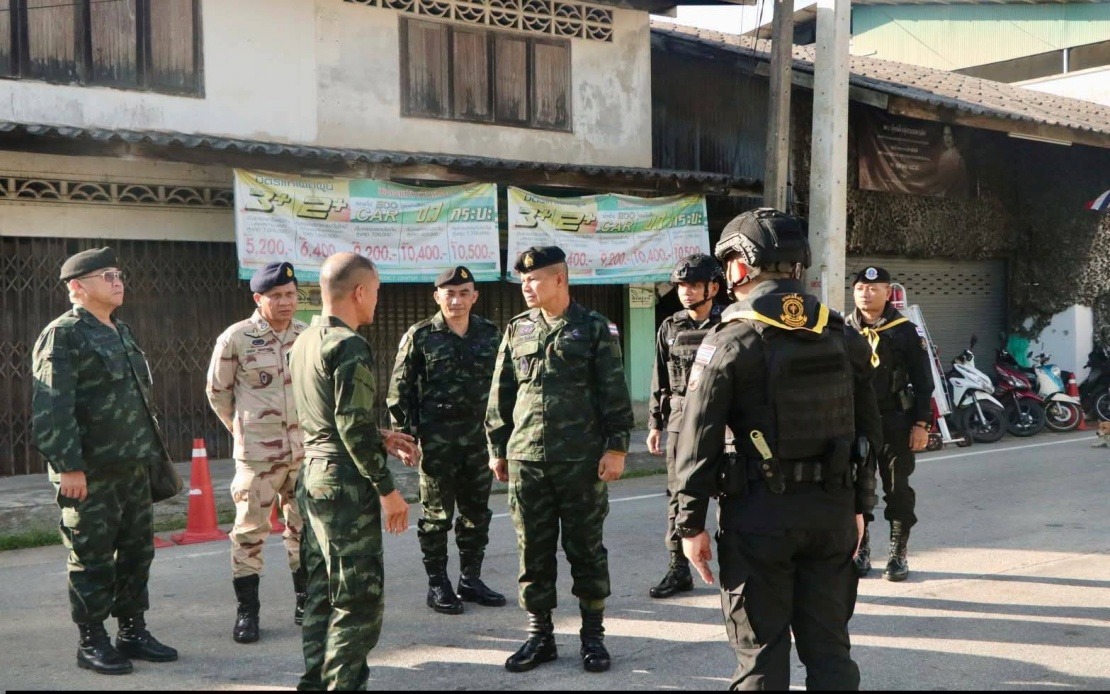
A coordinated assault on a military checkpoint in Thailand's southern province of Narathiwat has claimed the lives of five rangers and left multiple civilians wounded, marking another escalation in violence along one of Southeast Asia's most volatile border regions. The attack unfolded around 6:45 pm local time at the 4509 Ranger Company checkpoint situated on Sami Hill in Rangae District, where security personnel faced a barrage of gunfire and explosive devices from masked assailants who vanished into the darkness.
According to Lieutenant General Norathip Phoyanok, commander of the Fourth Army Region and director of the Internal Security Operations Command Region 4, the assault was carefully orchestrated and executed with tactical precision. More than six suspects, their faces concealed and bodies shrouded in dark attire, descended on the checkpoint with firearms and pipe bombs, overwhelming the guards positioned there. The commander's statement during his Thursday visit to the scene provided the first official assessment of what witnesses described as an unusually intense and coordinated operation compared to typical incidents in the troubled border area.
The human toll extended beyond the military personnel who died at the scene. Six civilians sustained injuries in the crossfire, among them a three-year-old girl whose presence at or near the checkpoint underscores the reality of civilian vulnerability in active conflict zones. An elderly person was also among those hurt, pointing to the indiscriminate nature of such attacks in areas where military installations exist alongside ordinary civilian settlements and transportation routes. The presence of young children in the vicinity highlights the challenging task Thai authorities face in protecting non-combatants while maintaining security infrastructure in densely populated regions.
The assailants' apparent use of a black four-wheel-drive vehicle for escape suggests a degree of planning and resource availability that distinguishes this incident from spontaneous or opportunistic violence. The choice of vehicle, the coordinated timing, and the volume of firepower deployed all indicate an operation carried out by individuals with access to logistics support and advance intelligence about checkpoint operations. Investigators have been tasked with tracing the vehicle and identifying connections to wider militant networks operating in the southern border provinces.
Narathiwat Governor Boonchuai Hormyamyen responded swiftly to the incident by issuing directives to heighten security across multiple fronts. Security forces—combining resources from the police, military, and local administrative bodies—have received orders to increase vigilance throughout twelve districts across Narathiwat province, with particular emphasis on the Malaysia-Thailand border where porous crossing points and extensive smuggling routes have long complicated counter-insurgency efforts. This multi-agency approach reflects recognition that no single security organization possesses sufficient capacity to address the persistent threat environment alone.
The intensification of violent incidents in recent months has prompted authorities to reassess their defensive posture throughout the province. What had appeared to be a period of relative calm has given way to renewed activity by militant groups, suggesting either organizational regrouping or the emergence of splinter factions seeking to reassert presence and capability. The timing and scale of this particular attack may signal strategic intentions beyond simple harassment of security forces, potentially aimed at demonstrating operational capacity and sowing fear among both military personnel and civilians.
Forensic teams have secured the checkpoint and surrounding areas to preserve evidence that might illuminate the attackers' identity and organizational affiliations. The collection and analysis of ballistic evidence, explosive residue, and witness statements will provide crucial investigative leads. Such technical analysis, combined with intelligence gathering on militant group movements and communications, represents the primary avenue for Thai security agencies to identify the masterminds directing operations from behind the scenes.
For Malaysian observers, this incident carries particular significance given the cross-border dimensions of insurgency in the region. The southern Thai provinces have long served as transit zones and operational bases for various militant groups, some with connections to Malaysian networks. The porous border and the presence of refugee populations and smuggling operations create conditions enabling militant movement and resource transfer across national boundaries. Malaysian security agencies maintain monitoring protocols and coordinate with Thai counterparts to prevent spillover effects into Malaysian territory.
The broader context of southern Thai insurgency involves multiple dimensions—religious, ethnic, and economic grievances—that have proven remarkably resistant to conventional counter-insurgency approaches over decades. While mainstream separatist movements have engaged in political dialogue, armed splinter groups continue deadly operations despite government efforts at both conflict resolution and security force deployment. The recurring cycle of attacks and security responses suggests that military measures alone may be insufficient without simultaneous addressing of underlying grievances.
Thailand's approach to the southern challenge has oscillated between hard security operations and attempts at reconciliation and development programs. The latest surge in violence may prompt reassessment of these strategies and potential realignment of military and civilian resources. For the broader Southeast Asian region, continued instability in southern Thailand carries implications for border security, refugee flows, and the transnational criminal networks that exploit conflict environments for trafficking and other illicit activities.
The investigation into this particular attack will likely reveal details about command structures, funding sources, and tactical planning that intelligence agencies will scrutinize for insights into wider militant capabilities and intentions. Security officials from Thailand and neighboring countries will be closely monitoring developments to discern whether this represents isolated opportunistic action or signals a broader strategic campaign by organized militant factions.

