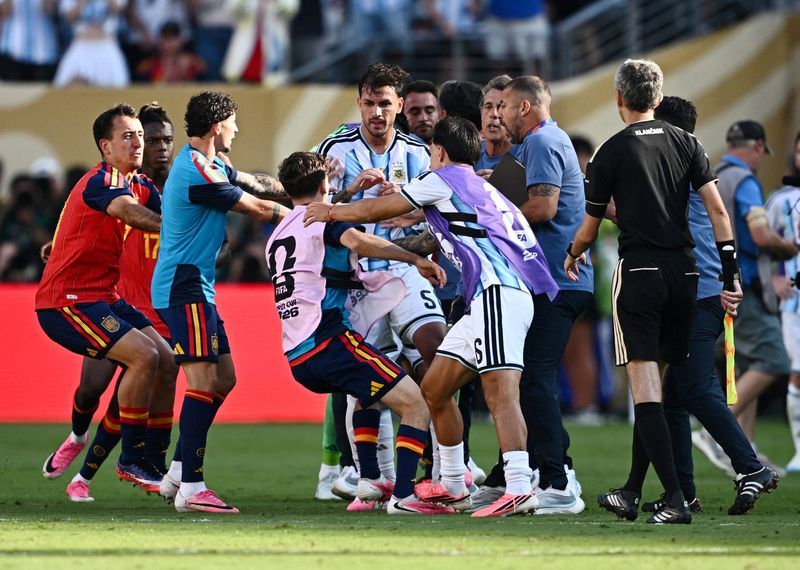
FIFA, world football's governing authority, has formally initiated a disciplinary inquiry into the violent confrontation that marred the conclusion of the World Cup final between Spain and Argentina. The governing body has engaged a dedicated prosecutor to examine the circumstances surrounding the post-match brawl, signalling the seriousness with which the sport's leadership views the incident. The clash represents a significant departure from the expected decorum of football's most prestigious tournament, drawing international scrutiny to competitive tensions that boiled over on the grandest stage.
Spain secured their second World Cup triumph through a goal by winger Ferran Torres in the extra-time period, ultimately prevailing 1-0 against a determined Argentine side. The match itself had already been marked by contentious moments before the final whistle, with Argentina suffering a critical numerical disadvantage after midfielder Enzo Fernandez received a second yellow card in the 93rd minute of regular play. This reduction in player numbers substantially altered the match's dynamics and contributed to mounting frustration within the Argentine team as they sought an equaliser.
The violent outbreak commenced immediately as the final whistle sounded, with Argentine midfielder Leandro Paredes initiating physical contact with multiple Spanish players. The confrontation specifically involved Spanish defender Eric Garcia and midfielder Gavi, but rapidly escalated into a broader melee encompassing both squads. What began as isolated confrontations quickly developed into chaotic scenes with players from both teams exchanging aggressive physical contact, including sustained shoving and threatening posturing.
The intensity of the altercation necessitated intervention from coaching staff and match officials, who worked to physically separate the antagonistic players and restore order at the conclusion of the encounter. Argentina's head coach Lionel Scaloni made visible efforts to pacify his own players and de-escalate the volatile situation, demonstrating the considerable emotion and tension that had accumulated throughout the fixture. The scenes represented a troubling moment for international football, occurring in full view of millions of viewers and highlighting the challenges officials face in managing heightened competitive intensity at elite levels.
For Malaysian and Southeast Asian football enthusiasts, the incident underscores recurring concerns about player conduct and disciplinary standards in international competitions. The World Cup represents not merely a sporting competition but a global cultural event that millions across the region follow with passionate investment. When violence erupts at such moments, it sends concerning messages about sportsmanship and respect that resonate throughout the football community in developing nations, where young players and supporters look to international events as exemplars of proper athletic conduct.
FIFA's investigative process will likely examine video evidence, player statements, and match official reports to determine appropriate sanctions. The body's decision to appoint a dedicated disciplinary prosecutor indicates that potential violations extend beyond simple unsporting conduct, possibly encompassing more serious charges that could warrant substantial penalties. Previous comparable incidents have resulted in fines, suspension of players from future matches, and damage to national team reputations during qualification campaigns and tournament play.
The investigation's scope will determine whether individual players face personal disciplinary consequences or whether both federations might incur organisational penalties. Spanish football authorities and the Argentine Football Association may themselves face questions regarding player preparation and emotional management protocols heading into such high-stakes encounters. The broader implications extend to tournament hosting and security procedures, as violent scenes create reputational concerns for future World Cup organisers considering stadium safety and crowd control measures.
For regional football administrators and clubs monitoring international standards, this investigation serves as a reference point for establishing expectations around player behaviour. The ramifications of FIFA's findings will likely influence how Southeast Asian national teams approach competitive intensity during qualifying campaigns and continental tournaments. Training programmes increasingly emphasise psychological preparation and conflict management, recognising that emotional regulation directly impacts team success and international standing.
The apparent timeline for concluding this investigation remains undefined, with FIFA officials declining to specify when determinations might be announced. Such investigations typically require several weeks or months to complete comprehensively, allowing time for evidence gathering and due process procedures. The delayed resolution extends the period of uncertainty regarding potential consequences for involved players and teams, prolonging the incident's prominence in international football discourse and media coverage throughout the region and globally.

