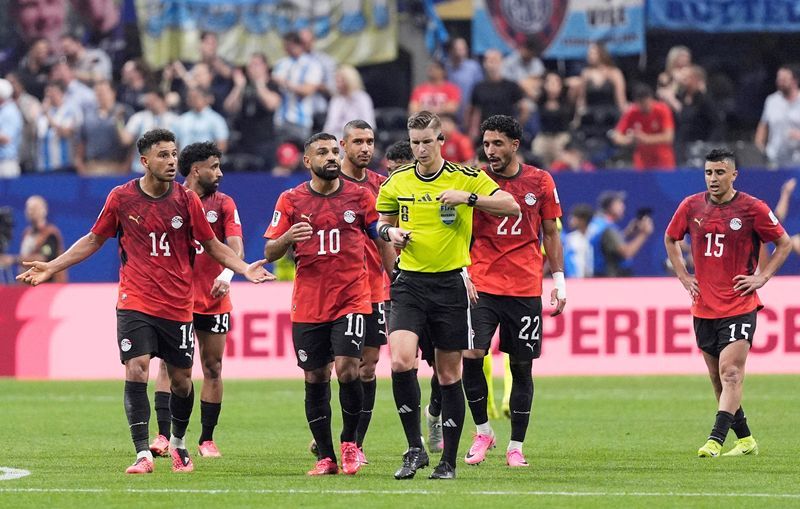
FIFA's head of refereeing, Pierluigi Collina, has moved to defend the controversial officiating in Argentina's dramatic 3-2 comeback victory against Egypt during the World Cup knockout phase, rejecting outright the Egyptian Football Association's allegations of unfair treatment and systemic bias. Speaking through an official FIFA platform, Collina underscored that match officials operated with complete autonomy and dismissed suggestions that external pressure or national interests had influenced decision-making on the field.
The controversial nature of the fixture stems from a sequence of pivotal moments in the second half that ultimately determined the tournament's progression. Egypt had built a commanding two-goal advantage but Argentina mounted an extraordinary comeback, clinching victory through a stoppage-time strike from Enzo Fernandez. The result proved decisive in ending Egypt's World Cup campaign, triggering swift criticism from the Cairo-based coaching staff and football authorities who argued that several critical incidents had been mishandled by the officiating team.
Egyptian Football Association officials lodged a formal complaint highlighting what they considered to be inconsistent and inequitable application of the rules. The primary grievance centred on a disallowed goal by midfielder Mostafa Zico in the second half, which referees had ruled out for an infraction during the attacking build-up. Egypt's governing body characterized this decision as particularly problematic, contending that no genuine foul had occurred in the lead-up to the goal-scoring opportunity. Additionally, Egyptian officials expressed acute frustration over what they viewed as a failure to penalize a physical challenge involving star player Mohamed Salah moments before Argentina engineered the move that produced their winning goal.
Collina, whose appointment as refereeing supremo carries considerable weight throughout world football, addressed these grievances with measured language that nonetheless conveyed FIFA's unwavering confidence in its officials. He acknowledged that criticism of refereeing decisions represents an inevitable aspect of competitive sport but drew a firm distinction between legitimate tactical debate and what he characterized as unsubstantiated attacks on officials' professional integrity. The FIFA official warned that baseless allegations questioning the impartiality of referees could generate harassment and threats directed at match officials and their families, a consideration that underscores broader concerns about referee safety in international sport.
Regarding the disallowed Zico goal, Collina explained that video assistant referee technology had correctly identified a foul by Egyptian defender Marwan Attia against Argentina's Lisandro Martinez during the possession phase that culminated in the scoring attempt. Under established VAR protocols, Collina emphasized, any infraction detected during the attacking sequence warrants intervention and cancellation of a subsequent goal, regardless of whether the initial foul appeared obviously egregious or borderline to observers. This principle, he insisted, maintains consistent application of the sport's fundamental rules across all match circumstances.
The question of whether contact between Salah and Argentina's Julian Alvarez constituted a penalty offense proved equally contentious. Collina defended the collective judgment of both the on-field referee and the VAR team, characterizing the physical interaction as routine defensive contact rather than a culpable foul deserving penalty sanction. He outlined the technical distinction that VAR officials apply when assessing such situations: a defender who establishes contact with the ball before subsequently making incidental contact with an opponent has not committed an infraction, whereas deliberately stepping on an opponent's foot or engaging in excessive physical challenge would constitute punishable conduct.
Collina's public defense reflects broader FIFA efforts to reinforce confidence in refereeing standards as the tournament progressed through its knockout stages. The officiating chief conceded that certain decisions inevitably contain subjective elements open to interpretation and that reasonable observers might reach different conclusions based on identical visual evidence. Nevertheless, FIFA maintained comprehensive satisfaction with how VAR principles had been operationalized throughout the competition, suggesting that the system had functioned according to design and that officials had applied its frameworks appropriately.
The incident assumes particular significance for regional football audiences across Southeast Asia and beyond, where confidence in competition integrity directly influences public engagement with major tournaments. The Argentina-Egypt dispute exemplified broader tensions that emerge when high-stakes knockout football produces dramatic reversals, particularly when technological interventions feature prominently in determining outcomes. For Malaysian and regional sports followers, the controversy highlighted how global sporting institutions navigate complex questions of officiating fairness, video review application, and the delicate balance between subjective judgment and objective rule enforcement.
Collina's assertion that no external force—not even FIFA leadership—could influence refereeing decisions speaks to institutional safeguards theoretically designed to insulate match officials from organizational pressure. However, his need to make such emphatic denials underscores lingering skepticism among some national federations regarding the absolute independence of international referees. The Egyptian complaints, despite their ultimate dismissal by FIFA, nevertheless entered the historical record as testimony to persistent concerns about whether refereeing structures possess sufficient insulation from geopolitical or commercial considerations.
Moving forward, the episode illustrates the ongoing evolution of football's relationship with technological arbitration and human judgment. While VAR has introduced new mechanisms for error correction, it simultaneously generates fresh controversies when its application produces outcomes perceived as disadvantageous to particular teams. For Southeast Asian football stakeholders observing these global developments, Collina's defense of current refereeing standards carries implications for how technology might eventually be deployed within regional competitions and whether international protocols can accommodate varying expectations regarding fairness and consistency across different football cultures and traditions.

