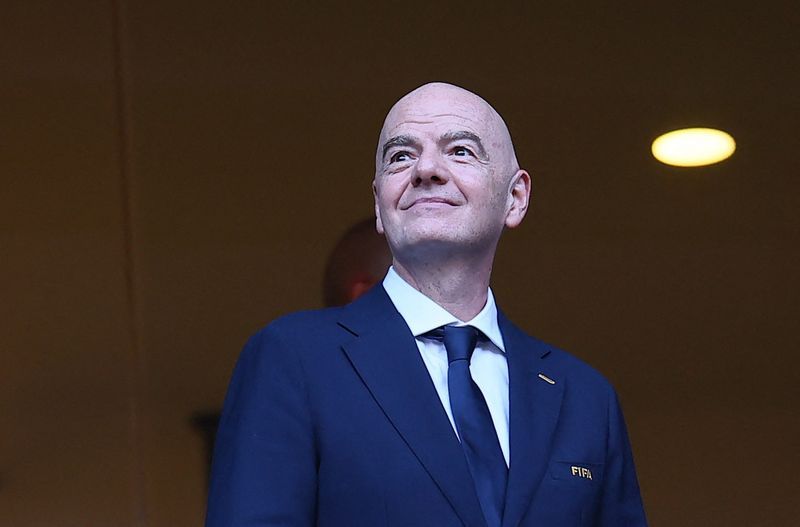
FIFA President Gianni Infantino's grip on power has been dramatically weakened following his last-minute withdrawal of a contentious proposal to sell equity stakes in World Cup commercial rights, a plan that would have injected $4.2 billion into the sport through private investment. The Swiss-Italian leader, who has helmed world football's governing body since 2016 and seeks to extend his tenure until 2031, announced the retreat late on Friday after three days of unprecedented turmoil within FIFA's administrative structure. His apology for how the initiative fractured consensus among football's stakeholders appears insufficient to repair the damage inflicted on what was once considered his unassailable position.
The fallout from the abandoned scheme has crystallised into formal withdrawals of electoral support from five major European national associations, including the Football Association of England, ahead of the FIFA Congress scheduled for Morocco in March. Denmark has additionally made clear it would never back Infantino's reelection regardless of circumstances. Offsetting these losses, Morocco, Qatar, Kuwait, Lebanon, and Sri Lanka have publicly committed to supporting the incumbent, yet these declarations underscore the precarious arithmetic facing the 56-year-old administrator. With 211 national federations entitled to vote at Congress, the publicly declared positions represent merely a fraction of potential support, suggesting significant uncertainty across much of the football world.
The regional confederations—the true power brokers in FIFA's political ecosystem—have responded with remarkable unanimity to what they perceive as authoritarian decision-making. The European confederation UEFA and CONCACAF, which governs football across North America, Central America, and the Caribbean, issued forcefully worded statements on Saturday expressing lost confidence in Infantino's leadership style and strategic direction. The Asian Confederation (AFC), traditionally more diplomatic in its institutional relationships, stopped short of outright condemnation but characterised the absence of consultation over the proposal as entirely unacceptable and called for comprehensive structural reforms within FIFA's operations and governance frameworks.
According to reporting from the Times of London, these three confederations—UEFA, CONCACAF, and the AFC—have reportedly coordinated to pursue Infantino's removal from office through deliberately obstructive tactics, potentially including the establishment of alternative competitive structures should the FIFA president refuse to voluntarily step aside. Such coordination among these powerful bodies represents a genuinely unprecedented mobilisation against a sitting FIFA president, signalling that the damage extends far beyond hurt feelings or procedural complaints. The apparent willingness of confederations to contemplate fracturing world football's traditional institutional architecture reflects the depth of anger provoked by what many perceive as contemptuous disregard for collaborative governance.
The strategic vulnerability of Infantino's position becomes most acute when considering the mechanics of FIFA's internal politics. An Extraordinary Congress can be convened if 43 or more member associations formally request one, potentially forcing a confrontation before the March elections. The threshold of 43 affiliates represents a meaningful but surmountable barrier, suggesting that orchestrating such a request remains well within the capacity of aligned confederations. Beyond this immediate threat, Infantino faces a seven-month window during which he must undertake substantial relationship rebuilding with key constituencies and neutralise potential challengers to his reelection bid.
Infantino's previous success in consolidating power derived substantially from his cultivation of support among less prosperous football associations, particularly across Africa, Asia, and the Caribbean regions where federations depend critically on FIFA's financial allocations to maintain operations. His now-abandoned World Cup stake sale proposal was specifically designed to appeal to these associations through promises of $20 million to $40 million dividends for each federation endorsing the scheme—a sum representing genuinely transformative resources for smaller national bodies. This approach mirrored the relationship-building strategies employed by his predecessors Joao Havelange and Sepp Blatter, who similarly constructed durable power bases outside Europe's relatively self-sufficient football structures.
The irony underlying Infantino's current predicament involves his apparent miscalculation regarding which constituencies would tolerate the proposition. Rather than generating enthusiasm among poorer associations through financial incentives, the plan provoked unified resistance from the confederations representing wealthier football markets—precisely the institutions wielding disproportionate influence over FIFA's regulatory direction and internal politics. UEFA's decision to issue a document preservation letter regarding all materials connected to the proposal signals that European confederations are preparing potential legal actions, a tactic that escalates the conflict beyond conventional administrative disputes into formal institutional challenge.
Facing such organised opposition, Infantino's survival strategy must simultaneously address multiple audiences and constituencies. He requires reconciliation with European federations aggrieved by the consultation failure, reassurance to Asian and other confederation leaders that reform commitments will materialise, and continued maintenance of support from African and Caribbean associations whose financial dependence on FIFA funding makes them potentially more forgiving of leadership transgressions. The balance between these competing demands becomes significantly more complex when confederation leadership has publicly declared loss of confidence, as such statements constrain the flexibility available to member associations wishing to support Infantino despite their confederation's official position.
Crucially, Infantino's opponents must identify a viable challenger before the November 18 nomination deadline who can credibly articulate concern for the interests of financially vulnerable associations while simultaneously addressing the governance reform demands of European and other developed football markets. No obvious successor candidate has yet materialised, suggesting that potential rivals remain cautious about contesting an incumbent FIFA president, despite his substantially weakened position. This candidate recruitment challenge may ultimately prove decisive in determining whether the confederation opposition can translate political opposition into electoral defeat.
The attempted World Cup stake sale fiasco thus represents a genuine inflection point in FIFA's recent institutional history, marking the first moment when major confederations have united against a sitting president with apparent determination to pursue his removal rather than merely register protest. Whether Infantino can navigate this crisis through skilful political manoeuvre, substantive governance reforms, or electoral coalition-building over the coming months remains profoundly uncertain. What appears clear is that his once-dominant position has been fundamentally altered, and the regional confederations—historically the true repositories of power within world football's governing structure—have demonstrated their capacity to mobilise collectively when sufficiently provoked by perceived administrative overreach.

