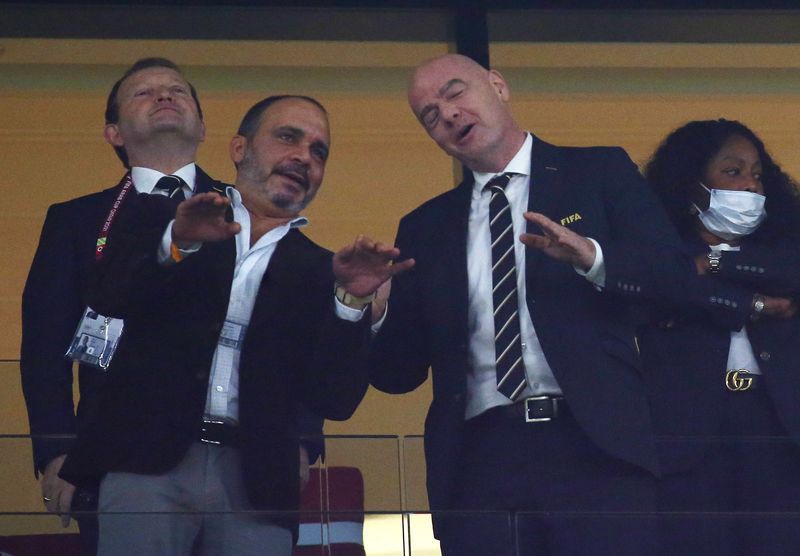
Jordan's national football team and coaching staff have finally received eight months of outstanding prize money for their run to the 2025 Arab Cup final, according to Jordan Football Association President Prince Ali bin Hussein on Thursday. The delayed payment came just two days after Prince Ali levelled explosive allegations against FIFA, claiming the world football governing body had effectively held the funds hostage in exchange for his political support of FIFA President Gianni Infantino. The sudden release of the money has reignited questions about FIFA's governance practices and the murky relationship between football's international administrator and its member nations.
Prince Ali's criticism emerged against a backdrop of mounting pressure on Infantino, who recently abandoned a controversial proposal to sell a minority stake in World Cup commercial rights after facing resistance from confederations and national associations worldwide. The Jordanian official alleged that FIFA officials had verbally communicated during the World Cup period that backing Infantino "would go a long way to helping our FA out." This insinuation of quid pro quo arrangements strikes at the heart of persistent concerns about how FIFA conducts its internal politics, particularly during presidential election cycles when member votes become leverage points.
The prize money in question had been owed since December, when Jordan reached the Arab Cup final in Qatar. For an association in a country with limited financial resources relative to European football powers, an eight-month delay in receiving legitimately earned tournament revenue represents a genuine hardship that affects player compensation, coaching staff salaries, and programme development. The fact that FIFA could allow such a delay while simultaneously asking for political favours demonstrates the asymmetrical power dynamics embedded within international football governance, where smaller nations often find themselves dependent on FIFA's goodwill for basic operational funding.
Prince Ali's public acknowledgement of the payment carried a pointed tone. He thanked "the FIFA administration for suddenly this morning delivering what was owed," using language that emphasised both the unexpectedness of the action and its timing relative to his public criticism. His emphasis that the money "should have been received eight months ago" underscored that this was not a discretionary gesture but rather the settlement of an obligation that FIFA had apparently been willing to stretch indefinitely. The strategic deployment of the word "suddenly" suggests the payment was motivated not by bureaucratic resolution but by reputational damage control following his allegations.
While acknowledging receipt of the funds, Prince Ali made clear that the payment would not alter his position on FIFA's leadership. He stated unequivocally that Jordan's FA would neither endorse Infantino nor vote for him in upcoming elections. This public defiance is significant because it demonstrates that even after receiving the money, Prince Ali has chosen to maintain his critical stance rather than accept the implicit deal that FIFA appeared to be offering. His refusal to be bought off suggests either genuine conviction about FIFA's need for reform or a calculation that his independence carries more long-term value than short-term accommodation with the current administration.
Prince Ali framed the delayed payment within a broader systemic critique of FIFA. He noted that the episode is "symptomatic of those exact difficulties that we all face and that are usually linked to the FIFA presidential elections," suggesting that such dynamics represent a recurring pattern rather than an isolated incident. This observation points to a structural problem: FIFA's presidential cycles appear to create opportunities for the administration to use financial leverage over member associations as a tool for securing internal political support. The delays and conditional approvals that smaller nations experience may be coordinated, if not explicitly mandated, strategies rather than mere administrative oversights.
FIFA's response to the allegations has been notably restrained. The organisation declined to respond directly to Prince Ali's accusations of blackmail-like conduct, instead issuing a broader apology to member states for mistakes made regarding the abandoned World Cup commercial rights proposal. This silence on the specific allegations is itself telling, suggesting either that FIFA has no credible response or that its leadership has decided the best strategy is to avoid further commentary that might draw additional scrutiny. The lack of denial or explanation leaves Prince Ali's claims effectively unchallenged in the public record.
Despite the rocky episode, FIFA's leadership reaffirmed its support for Infantino following a crisis meeting in Morocco on Wednesday. This display of institutional solidarity suggests that the organisation's power structures remain aligned behind the current president, at least among the confederation leadership that attended the gathering. However, the willingness of figures like Prince Ali to publicly challenge FIFA's conduct indicates cracks in that solidarity, particularly among representatives of smaller associations who may feel most vulnerable to the use of financial leverage as a political tool.
For Malaysian and Southeast Asian football stakeholders, this episode carries cautionary implications. Smaller football nations in the region that depend on FIFA funding, prize money, and tournament participation face similar structural vulnerabilities to those evident in Jordan's experience. If financial flows from FIFA can be delayed or accelerated based on political alignment with the administration, then associations across Asia may find themselves navigating similar pressures during presidential elections. The episode also raises questions about whether regional confederations have adequately protected member interests through collective bargaining or transparency requirements regarding prize money distribution and payment timelines.
The broader implications for global football governance are significant. The incident illustrates how FIFA's internal political system can create perverse incentives that distort the relationship between the governing body and its members. When an international sports administration can apparently withhold legitimately earned funds as a negotiating tactic, it suggests that the organisation operates more as a political entity than as a neutral administrator of sport. Prince Ali's willingness to go public with these allegations, rather than quietly accepting the financial arrangement in exchange for political accommodation, may signal a turning point in member state willingness to tolerate such practices.
Moving forward, FIFA faces pressure to demonstrate that it has reformed its approach to member relations and financial distributions. The reopening of discussions about World Cup commercial arrangements and Infantino's political fortunes will likely see further scrutiny of FIFA's governance practices. Whether the organisation responds with genuine systemic reform or merely tightens its public relations strategy remains unclear. What is evident, however, is that the model of FIFA as an unquestioned authority maintaining harmonious relationships with compliant member states is increasingly fragile.

