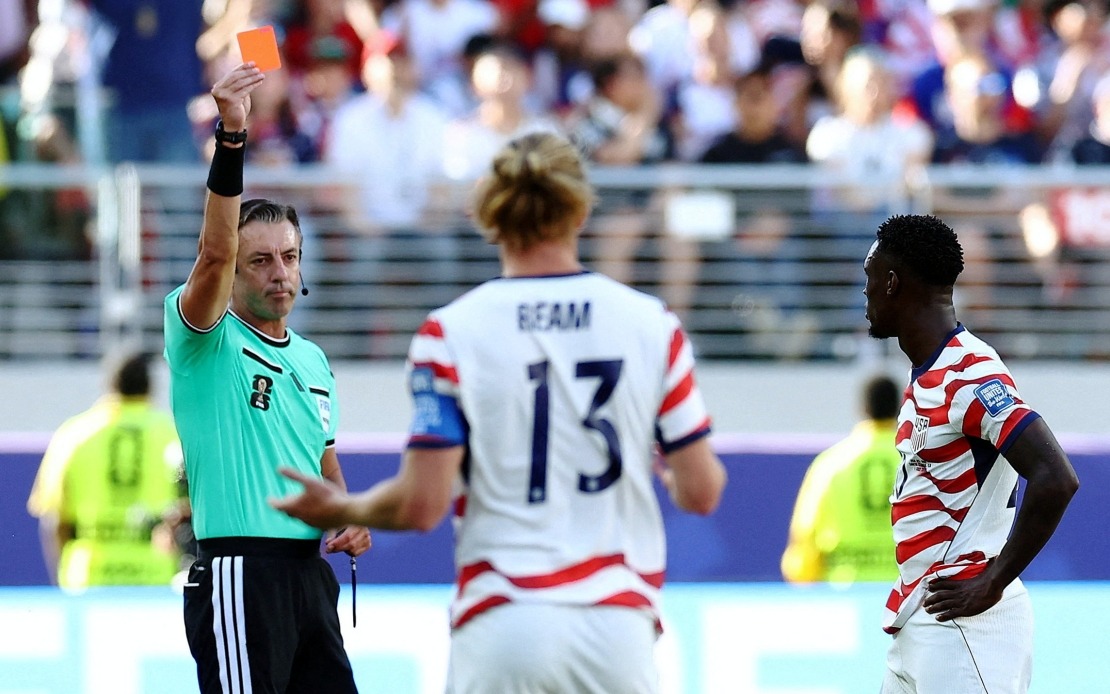
FIFA's decision to temporarily suspend enforcement of a one-match suspension against American striker Folarin Balogun has reignited debate over the consistency of disciplinary rules in elite football competitions. The move, announced on Sunday, clears the way for Balogun to participate in Monday's round-of-16 encounter between the United States and Belgium in Seattle, a match that will determine which nation advances toward the quarterfinals. The ruling has triggered immediate backlash from the Belgian Football Association, which argues that FIFA has departed from its own established protocols governing player misconduct during World Cup tournaments.
Balogun, who has emerged as a crucial attacking asset for the American team with three goals scored during the group phase, received a red card during the US's 2-0 victory over Bosnia and Herzegovina on July 1. His dismissal stemmed from an incident in which he stamped on Bosnia defender Tarik Muharemovic, a clear act of violent conduct that would ordinarily warrant automatic suspension for the subsequent match. The FIFA Disciplinary Committee determined that Balogun's actions constituted violations of Articles 14 and 66 of the FIFA Disciplinary Code, establishing grounds for a one-match ban.
However, FIFA exercised a discretionary power under Article 27 of its Disciplinary Code, which permits the disciplinary committee to suspend implementation of a sanction during a probationary period. In this instance, FIFA has imposed a one-year probationary window during which the ban remains in effect only if Balogun commits further infractions of comparable severity. Should he maintain disciplinary compliance, the suspended ban would ultimately lapse without penalty. This mechanism, while technically within FIFA's regulatory framework, represents an exceptional application of Article 27 authority in World Cup competition.
The strategic implications for the United States' tournament prospects are substantial. Balogun has demonstrated himself to be indispensable to the American attacking formation, and his availability fundamentally alters the tactical equation against Belgium. His absence would have forced substantial lineup adjustments and compelled the US coaching staff to redistribute attacking responsibility among alternative personnel. The reinstatement of Balogun as an eligible participant therefore provides the American team with a significant competitive advantage heading into a knockout stage fixture against a well-established European opponent.
Belgium's formal objection to FIFA's decision strikes at the foundational principle of uniform rule application across tournament competition. The Belgian Football Association has emphasized that every previous red card issued during this World Cup resulted in automatic suspension for the subsequent match, adhering to the explicit language of Article 66.4, which mandates that a player sent off by direct red card faces automatic suspension from the team's next fixture. By permitting Balogun to circumvent this consequence, Belgium contends that FIFA has created a precedent that undermines confidence in the impartial administration of competition rules.
The RBFA has further grounded its protest in the FIFA World Cup 2026 Competition Regulations, specifically citing Article 10.5, which unambiguously states that any player or team official dismissed by direct red card or second yellow card "will automatically be suspended from their team's subsequent match." These regulations were distributed to all participating member associations on May 12 and were reiterated during match coordination meetings and official tournament workshops conducted throughout the competition. Belgium's argument rests upon the proposition that FIFA has contradicted its own foundational competition framework through a selective and inconsistent application of its own rules.
The procedural consistency argument carries particular weight when viewed within the context of tournament fairness. Disciplinary enforcement mechanisms that vary based on the significance of a match or the profile of the player involved introduce subjective elements antithetical to the principles of impartiality that should govern international athletic competition. Belgium's concern extends beyond the immediate consequences for Monday's fixture; the federation has signaled broader apprehension that FIFA's decision establishes a troubling precedent for future World Cup editions and potentially other international competitions. If discretionary suspensions can be invoked based on tournament importance, the universal application of disciplinary codes becomes meaningless.
From a Southeast Asian perspective, this controversy underscores the governance challenges that plague international sports bodies. The Association of Southeast Asian Nations has diverse football development interests, and several member nations harbor aspirations for World Cup participation. The question of whether major tournaments operate under consistent, transparent rules affects not merely individual matches but the foundational credibility of the competition itself. When affluent football nations with greater political and economic influence within FIFA appear to receive preferential treatment, it potentially discourages investment and participation from smaller confederations that perceive inherent structural inequities.
The United States is pursuing its first appearance in a World Cup quarterfinal since 2002, and this tournament represents a significant marker of progress in the nation's football development trajectory. The Balogun situation, however, casts a shadow over any advancement the team achieves, as questions regarding the legitimacy of the path taken will persist. Similarly, Belgium enters the match aware that a victory, regardless of merit, will carry the asterisk of playing against an opponent bolstered by a controversial disciplinary intervention.
FIFA's statement indicates that should Balogun commit further infractions of similar nature and severity during the one-year probationary period, the suspension would take effect automatically, and additional sanctions could be imposed. This stipulation provides limited reassurance to Belgium, as it does not address the principle at stake—whether FIFA can selectively suspend enforcement of established automatic suspension rules based on discretionary judgment. The distinction between suspending a sanction during probation versus refusing to apply an automatic suspension in the first instance represents a critical jurisprudential question that FIFA has left deliberately ambiguous.
The broader implication of this decision extends to how international sports governance bodies balance rule consistency against perceived flexibility in exceptional circumstances. FIFA faces ongoing criticism regarding transparency and consistency in disciplinary matters, and this decision reinforces perceptions that rules are applied unevenly depending on tournament context and the stature of the players and nations involved. Belgium's formal protest, including its indication that it is exploring all available options to safeguard its rights, suggests that this matter may not conclude with Monday's match and could potentially trigger further formal challenges within FIFA's governance structures.
The resolution of this dispute will likely influence how FIFA approaches disciplinary matters in future tournaments and may prompt revisions to competition regulations designed to eliminate the discretionary ambiguity that permitted the Balogun suspension. Whether FIFA determines that Article 27 discretion supersedes Article 66's automatic suspension requirement will set precedent for years to come, affecting not merely this World Cup but the fundamental architecture of fairness in international football competition.

