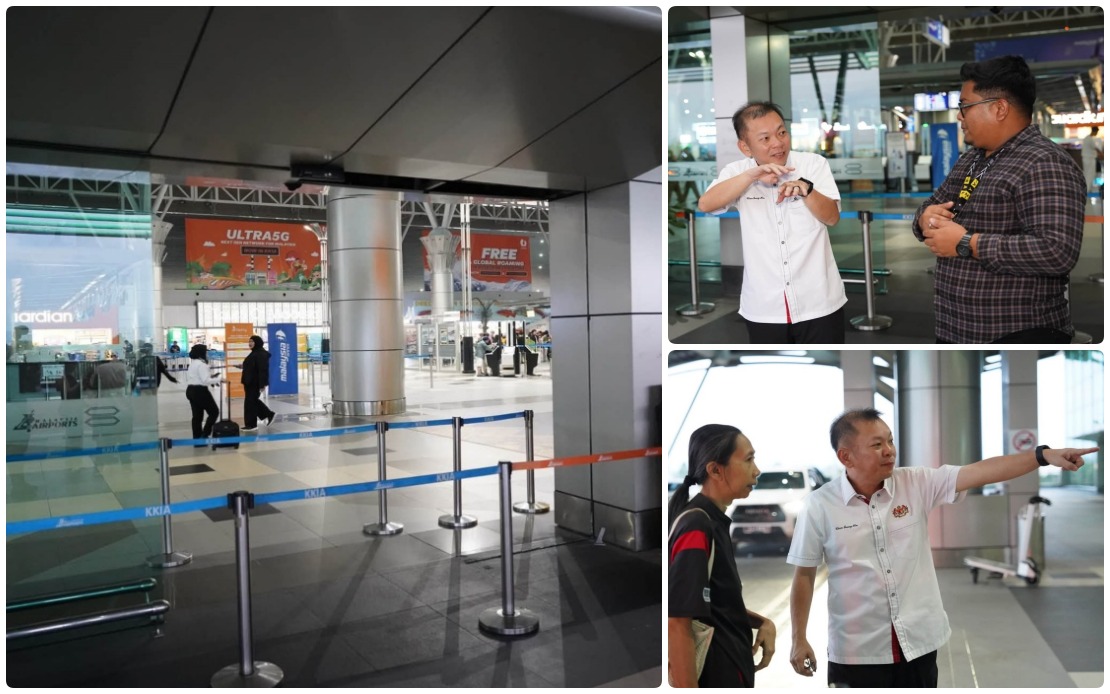
A woman driver was injured on Wednesday afternoon when her sport utility vehicle suddenly lost control and ploughed into the glass entrance structure of the departure hall at Kota Kinabalu International Airport. The collision occurred at the Level 3 kerbside of Terminal 1 at approximately 4:19 pm, shattering the automatic doors and leaving the front of the vehicle extensively damaged. The incident, while dramatic in its impact on the airport's infrastructure, was contained swiftly with no injuries reported among other passengers or airport personnel present at the scene.
The driver, who sustained minor injuries in the collision, was extracted from the vehicle and provided with immediate medical assistance by airport responders. She was subsequently transported by ambulance to a nearby hospital for treatment and observation. The rapid deployment of Aviation Security and Customer Service personnel at the scene ensured that the situation was stabilised quickly and that the injured motorist received prompt care without unnecessary delay.
Kota Kinabalu District Police Chief ACP Shahrudin Mat Husain confirmed the incident and indicated that investigations are ongoing to establish the precise circumstances that led to the vehicle's loss of control. Preliminary inquiries will likely examine mechanical factors, driver conditions, and whether any external variables contributed to the collision. The police investigation remains the primary avenue for determining whether this was an isolated mechanical failure, a medical episode affecting the driver, or another causative factor.
From an operational perspective, Malaysia Airports moved decisively to minimise disruption to normal airport functioning. The damaged vehicle and associated debris were removed from the departure kerbside by 6:00 pm, allowing the terminal to continue processing departing passengers without significant bottlenecks. The operator engaged contractors to commence repair work on the compromised glass entrance doors, ensuring that the facility's aesthetic and functional integrity would be restored within a reasonable timeframe.
Deputy Minister of Agriculture and Food Security Datuk Chan Foong Hin, who happened to be arriving at the airport at the time of the incident, publicly commended the airport's management and all personnel involved in the response. His remarks highlighted the importance of institutional preparedness in handling unexpected emergencies. He noted that alternative automatic doors remained fully operational, enabling passenger movement to continue uninterrupted despite the damaged entrance. His acknowledgement underscored the significance of redundancy in critical infrastructure design and the airport's capacity to manage such incidents without cascading failures.
The prompt restoration of normal operations is particularly noteworthy for a regional airport serving Sabah's capital, where travel disruptions can have considerable downstream effects on business, tourism, and government functions. Kota Kinabalu International Airport handles a substantial volume of domestic and international traffic, making operational resilience essential. The incident's containment prevents secondary effects that might otherwise ripple through flight schedules, ground transport operations, and commercial activities dependent on the airport's smooth functioning.
Malaysia Airports indicated in an official statement that all aspects of the incident have been referred to the Royal Malaysia Police for comprehensive investigation, with the operator pledging full cooperation with relevant authorities. This coordination between the airport operator and law enforcement ensures that all evidentiary requirements are met and that findings can inform future safety protocols if warranted. The incident provides an opportunity for reviewing security camera footage, interviewing witnesses, and conducting technical assessments that may yield insights applicable to airport safety management.
The structural damage to the departure hall entrance doors is not uncommon in airport settings, where such collisions occasionally occur despite safety measures. Airports typically employ bollards, barriers, and other physical deterrents to prevent vehicles from approaching terminal buildings, though these cannot eliminate all possibilities. The glass door itself serves both aesthetic and functional purposes, creating a transparent boundary that maintains climate control while permitting visual connection between the interior and exterior environments. Repair and replacement of such systems are standard operational considerations for airport facilities management teams.
For Malaysian and Southeast Asian readers, this incident serves as a reminder of the operational complexities inherent in managing large public facilities. Airports represent critical nodes in regional connectivity, and their resilience in the face of unforeseen events reflects broader questions about infrastructure robustness and emergency response capabilities. The incident also touches on public safety considerations, as the presence of vehicles in proximity to pedestrian areas remains a perennial challenge for terminal design and traffic management.
The investigation by Kota Kinabalu District Police will likely produce findings within the coming weeks, potentially offering clarity on whether any systemic factors contributed to the incident. Whether the cause is determined to be mechanical failure, driver error, or a medical event, the response demonstrates that institutional protocols functioned as intended. The efficiency with which the airport managed the aftermath—clearing debris, maintaining operations, and coordinating with authorities—suggests a reasonably mature approach to crisis management at the facility level.
Moving forward, the incident may prompt a review of traffic control measures at the airport's vehicle entry and circulation areas. Airports throughout the region have increasingly implemented vehicle access restrictions, elevated bollards, and traffic calming measures to reduce the risk of unintended collisions involving motor vehicles and terminal infrastructure. Such measures balance the operational need for vehicle access with the imperative to protect pedestrians and facilities from accidental or intentional vehicular incidents.

