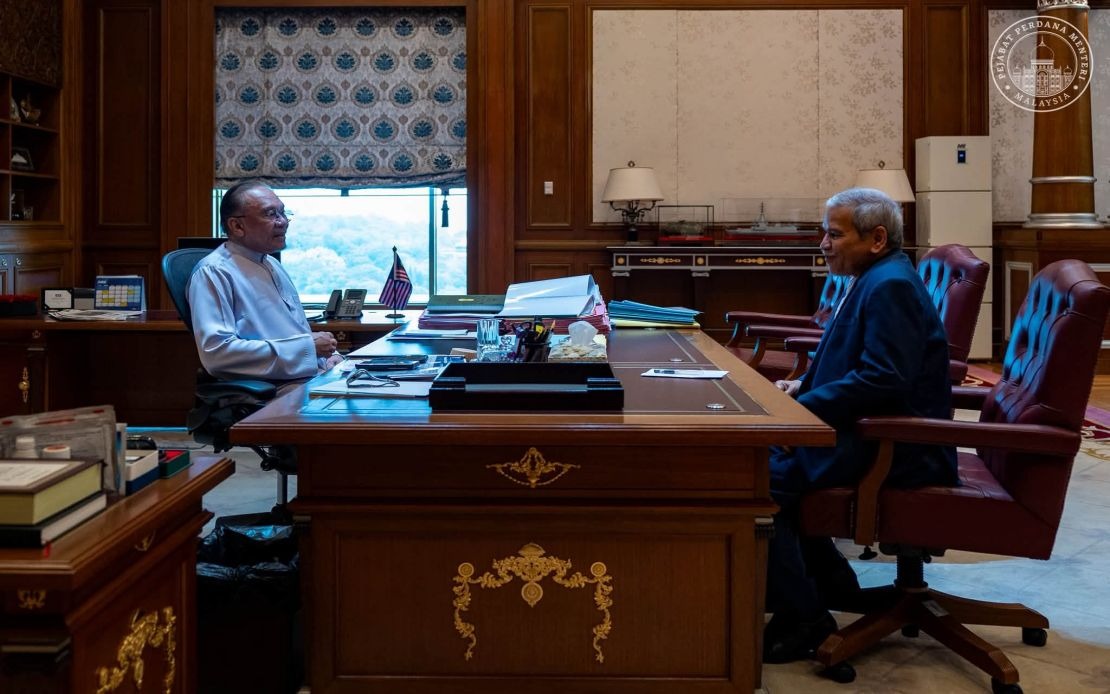
Prime Minister Datuk Seri Anwar Ibrahim has reiterated the government's commitment to bolstering the Federal Land Development Authority as a cornerstone institution responsible for enhancing the socioeconomic standing of settlers and their households. His remarks came during a courtesy meeting with newly appointed FELDA chairman Tan Sri Ahmad Badri Mohd Zahir at the Prime Minister's office in Putrajaya, where discussions centred on the agency's strategic direction and operational priorities.
The strengthening of FELDA represents a significant policy emphasis for the current administration, reflecting broader recognition that land settlement schemes remain relevant to Malaysia's developmental agenda. FELDA, as a statutory authority established decades ago, continues to oversee one of the country's largest organised smallholder communities. Its institutional health directly affects tens of thousands of families whose livelihoods depend on agricultural and commodity production activities coordinated through the scheme.
Anwar, who concurrently serves as Finance Minister, underscored that support for settlers must operate on two parallel tracks. On one hand, the government recognises its duty to protect and enhance living standards for current and future generations of farming families. On the other hand, FELDA itself must achieve operational efficiency and economic viability to sustain these welfare commitments over the long term. This balancing act has proven challenging for the authority historically, requiring careful financial management and strategic planning.
A particular area of focus identified by the Prime Minister involves addressing the distinctive challenges confronting younger generation settlers. Many second and third-generation FELDA members face pressures including agricultural sector volatility, commodity price fluctuations, and limited economic diversification opportunities within their communities. Younger settlers often seek pathways beyond traditional farming or express concerns about whether settlement schemes offer viable economic prospects compared to employment in urban centres.
Tan Sri Ahmad Badri assumed the FELDA chairmanship on July 15, succeeding Datuk Seri Ahmad Shabery Cheek whose tenure concluded on June 30. The leadership transition occurs at a moment when FELDA grapples with structural challenges requiring strategic direction. Ahmad Badri's appointment signals the government's intent to inject fresh perspectives into the institution's management and governance structures. His mandate extends to implementing reforms that restore stakeholder confidence while positioning FELDA for sustainable operations.
Anwar expressed confidence in Ahmad Badri's capacity to advance the agenda of institutional renewal and consolidation. The Prime Minister's endorsement carries weight as it signals executive branch backing for reform initiatives. This political support proves essential when implementing changes that might encounter resistance from entrenched interests or stakeholders accustomed to established operational patterns. The transition also provides an opportune moment to recalibrate FELDA's strategic priorities in alignment with broader national development objectives.
The MADANI Government framework, which underpins the current administration's policy direction, commits to continued comprehensive support for FELDA operations and settler communities. This encompasses financial allocations, policy interventions, and institutional backing necessary to maintain FELDA's relevance and functionality. The government recognises that FELDA communities constitute a significant constituency whose welfare carries both humanitarian and economic importance.
FELDA's sustainability directly connects to Malaysia's agricultural sector competitiveness. The authority manages substantial landholdings and coordinates production of commodities including palm oil, rubber, and other crops that contribute to export earnings and rural employment. Strengthening FELDA therefore extends beyond individual settler welfare to encompass broader agricultural sector resilience and national food security considerations. This systemic importance justifies government intervention and continued resource commitment.
For Malaysian readers and policymakers, the emphasis on FELDA renewal reflects ongoing tensions between rural development objectives and fiscal constraints. Land settlement schemes represent a specific approach to rural poverty alleviation and agricultural modernisation that successive governments have pursued. However, questions persist regarding their cost-effectiveness and long-term viability compared to alternative rural development strategies. The renewed focus on FELDA strengthening represents a reaffirmation that the government views settlement schemes as continuing instruments for settler uplift rather than antiquated institutions awaiting gradual obsolescence.
The appointment of new leadership and associated reform initiatives will likely include examination of FELDA's governance structures, financial management practices, and strategic planning processes. Success will be measured not only by settler satisfaction but also by organisational efficiency metrics and whether FELDA can generate sustainable returns on its asset base. These considerations demand that any strengthening efforts incorporate both welfare protection and economic rationality, avoiding approaches that provide short-term relief without addressing underlying structural challenges.
Looking ahead, FELDA's evolution will significantly influence rural development patterns across Malaysia. Should the institution successfully modernise and improve settler livelihoods, it may serve as a model for similar schemes elsewhere. Conversely, continued difficulties could prompt policy reconsiderations regarding government approaches to rural settlement and agricultural development. The stakes extend beyond FELDA itself to encompass broader questions about Malaysia's capacity to maintain viable rural communities whilst pursuing economic development. Anwar's statements therefore represent more than administrative support for a single institution—they reflect deeper government commitment to resolving persistent rural development challenges through institutional strengthening and sustained policy engagement.

