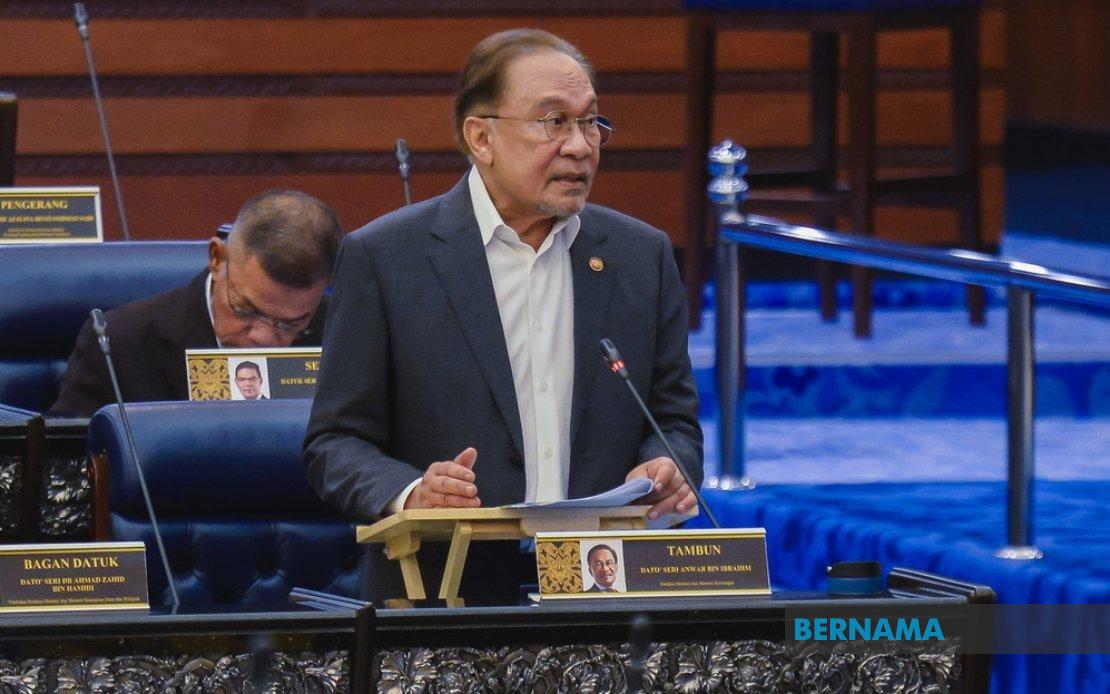
Prime Minister Datuk Seri Anwar Ibrahim has made clear that the Federal Government will not automatically rubber-stamp requests from state administrations for additional funding on development projects that involve a Notice of Change (NOC). Speaking in the Dewan Rakyat on June 30, Anwar outlined a framework that places significant responsibility on states to justify cost escalations and allows the federal centre to independently assess whether increased expenditure is warranted.
The statement comes as a response to growing pressure from states seeking supplementary allocations for ongoing infrastructure schemes. Kedah's request for additional funds for the Pulau Buniting Water Treatment Plant project, which requires NOC approval, prompted the clarification. The project exemplifies a broader challenge across Malaysia's federal structure: how to manage cost overruns in public works without undermining fiscal discipline or creating moral hazard among state-level administrators.
Anwar's position reflects a fundamental principle about the division of financial responsibility between federal and state governments. An NOC represents a formal acknowledgement that project parameters have changed—usually because construction costs have risen, scope has expanded, or unforeseen circumstances have emerged. When such changes occur, the Prime Minister indicated, the matter cannot simply be treated as a routine administrative matter. Instead, it demands fresh analysis and new negotiations to determine how costs should be apportioned.
Crucially, the Prime Minister highlighted that one of the first questions the Federal Government must answer is whether the contractor bears responsibility for the cost increase. This distinction carries major implications. If a contractor has mismanaged the project, provided inaccurate initial quotations, or performed below specification, the federal authorities may be less inclined to absorb additional costs. Conversely, if price escalations stem from factors beyond the contractor's control—material shortages, supply chain disruptions, or legitimate design modifications—the Federal Government's approach would likely differ substantially.
Anwar also underscored a critical constitutional and financial principle: the Federal Government cannot be held hostage to commitments made by state governments. When a state signs a contract or approves a project scope without proper financial planning, it does not automatically bind Putrajaya to provide supplementary resources whenever difficulties arise. This stance protects the federal budget from absorbing state-level mismanagement and sends a strong signal that state administrators must exercise greater prudence in project planning and cost estimation.
The Prime Minister's remarks carry particular weight given Malaysia's complex intergovernmental fiscal architecture. States depend substantially on federal allocations, yet they also manage significant development portfolios. The tension between state autonomy and federal oversight becomes acute when infrastructure projects encounter cost pressures. By insisting on renegotiation before approving additional funds, Anwar establishes that the federal level will exercise active gatekeeping rather than passive acceptance of state requests.
This approach has broader implications for infrastructure development across Southeast Asia's largest federation. If properly enforced, it could encourage more rigorous project preparation at the state level, better cost estimation, and more realistic timelines. Conversely, it may create friction between state governments and federal authorities, particularly in states governed by political opposition parties where trust is already strained. The mechanism for renegotiation itself will be critical—whether it proves to be a genuine joint assessment or a tool for political pressure.
Deputy Prime Minister and Energy Transition and Water Transformation Minister Datuk Seri Fadillah Yusof has been tasked with providing detailed technical guidance on how such renegotiations will be conducted. Fadillah's portfolio makes him the logical point person, given that the Pulau Buniting Water Treatment Plant involves water infrastructure, a sector under his purview. His clarifications will likely establish precedent for how other states' NOC requests are handled going forward.
The decision also reflects broader fiscal constraints facing the Malaysian Federal Government. Post-pandemic, with ongoing commitments to debt reduction and development spending, Kuala Lumpur faces difficult choices about how to allocate limited resources across competing priorities. By tightening the approval process for supplementary state funding, the Federal Government positions itself to redirect resources toward national-level initiatives or to projects demonstrating superior cost discipline and management.
For state governments, the message is unambiguous: initial project approval does not guarantee open-ended access to federal coffers. States must now present compelling justification for any cost increases, demonstrating that escalations were unavoidable and that state-level officials exercised proper oversight. This raises the stakes for state project managers and procurement specialists, who will face greater scrutiny regarding budget variances.
The renegotiation framework also creates space for more transparent discussion about project viability. Rather than states simply requesting additional funds as a fait accompli, the Federal Government will now conduct fresh assessments of whether projects remain economically justified at higher cost levels. This could lead to difficult decisions about project termination or significant scope reductions if cost-benefit ratios deteriorate substantially.
Looking ahead, the NOC renegotiation policy represents a significant shift in federal-state relations around infrastructure finance. How strictly it is implemented, whether exceptions are granted based on political considerations, and whether states adapt their procurement practices in response will all determine its ultimate impact on Malaysia's development trajectory and fiscal sustainability.

