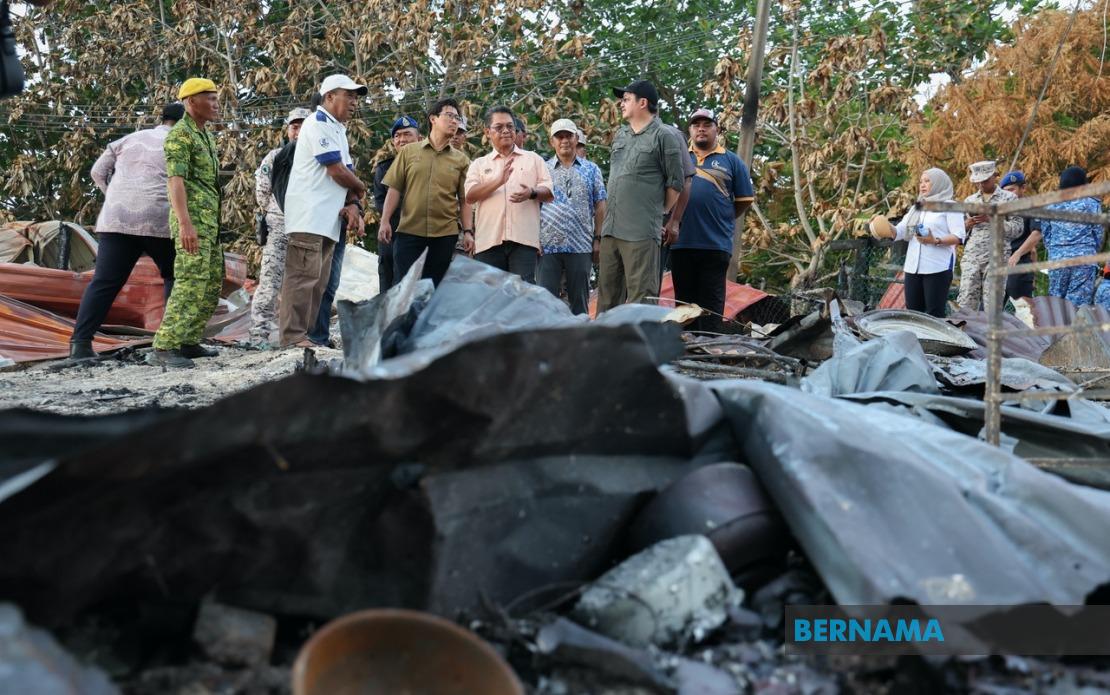
The Federal Government has mobilised immediate support for residents of Pulau Nunuyan Laut in Sandakan following a devastating fire that swept through the coastal settlement early yesterday morning. Through the Prime Minister's Department (JPM), federal authorities have begun distributing initial assistance to 29 household heads affected by the disaster, which claimed 28 residential structures and displaced more than 100 people. The rapid deployment of aid reflects the government's commitment to supporting vulnerable communities in East Malaysia during emergencies.
Datak Mustapha Sakmud, Minister in the Prime Minister's Department responsible for Sabah and Sarawak affairs, announced the relief measures following a site visit conducted alongside Sandakan Municipal Council president Datuk Walter Kenson. The minister emphasised that the Implementation Coordination Unit has already begun executing relief operations tailored to the immediate needs of affected residents. Among the targeted interventions are provisions of mobility assistance, specifically wheelchairs for elderly community members requiring support, demonstrating a deliberate focus on vulnerable population segments within the displaced group.
The coordinated response extends beyond emergency cash assistance. Recognising the cascading effects of the fire on essential services, Sakmud highlighted plans to rapidly assess and restore critical infrastructure damaged during the incident. The jetty serving as a primary transportation link for schoolchildren has been identified as requiring urgent repair. Sakmud's explicit commitment to preventing educational disruption underscores the government's awareness that disasters in isolated coastal communities can compound existing challenges for young residents who depend on maritime transport for school access. Instructions have been issued to the Sandakan Municipal Council to fast-track infrastructure assessments and submit repair proposals directly to the Implementation Coordination Unit for expedited processing.
The relocation and long-term resettlement of fire victims presents a more complex challenge requiring multi-agency coordination. Walter Kenson disclosed that the Rural Development Department would spearhead efforts to identify suitable resettlement locations, with consideration being given to village reserve land as a potential option. This approach suggests a preference for keeping displaced residents within established community structures rather than dispersing families across urban areas, which could help maintain social cohesion and traditional support networks.
A significant complicating factor in the resettlement process is the legal status of occupied land. Walter revealed that the affected residents have been living on private property encompassing two separate land titles owned by private landowners. This arrangement raises complex questions about tenure security and the government's obligation to negotiate with property owners during the relocation process. The council president's disclosure that discussions with both landowners would be necessary indicates potential negotiations regarding either compensation, temporary accommodation arrangements, or formal agreements permitting permanent settlement. Such situations often create delays in resettlement timelines and require careful legal navigation to balance government assistance with property rights.
Long-term rehabilitation planning incorporates provisions for essential modern amenities essential for dignified living in the coastal settlement. Plans currently under development include installation of reliable electricity supply, potable water systems, and reconstruction or improvement of the jetty infrastructure. These three components represent foundational requirements for sustainable habitation in a maritime community, suggesting the government's recognition that any resettlement must address not merely emergency shelter but the basic infrastructure required for residents to maintain livelihoods and access services. For a community dependent on fishing and maritime trade, jetty access is particularly crucial to economic survival.
The incident highlights recurring vulnerabilities in Sabah's scattered coastal and island communities, where rapid urbanisation, limited land availability, and sometimes precarious housing conditions create fire hazard concentrations. Kampung Nunuyan Laut's composition—with 28 houses destroyed in a single incident affecting over 100 residents—suggests densely packed residential structures, potentially in makeshift arrangements typical of informal settlements. The early morning timing of the fire, around 3 am, would have limited residents' escape time and complicated emergency response from the municipal council's mainland facilities.
For Malaysian policymakers and administrators, the Pulau Nunuyan incident reiterates the importance of proactive disaster preparedness in remote settlements. The government's swift response, involving inter-agency coordination and deployment of immediate resources, demonstrates institutional capacity. However, the subsequent complications involving private land tenure and resettlement logistics reveal ongoing challenges in balancing rapid humanitarian response with long-term sustainable development solutions in East Malaysian communities. The emphasis on maintaining school connectivity for affected children also signals growing federal attention to educational continuity during disasters, reflecting broader developmental priorities.
The broader Southeast Asian context suggests that such maritime community disasters are increasingly common across the region as climate variability and extreme weather patterns intensify. The Sandakan response model—combining immediate relief, infrastructure assessment, multi-agency coordination, and planned resettlement—may offer lessons applicable to similar situations in other Malaysian states and neighbouring countries experiencing equivalent challenges with vulnerable coastal populations.

