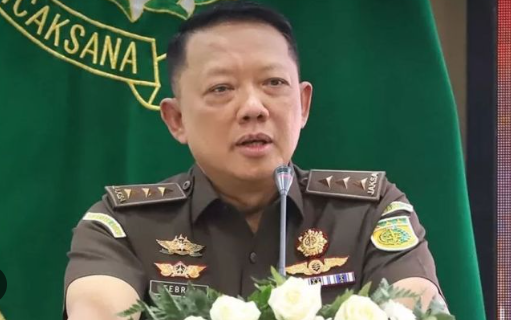
When President Prabowo Subianto took office, he drew a stark line in the sand: officials needed to purge themselves of corruption, or Indonesia's law-enforcement apparatus would do it for them. Now, fewer than two years into his presidency, his signature anti-graft agenda confronts its most uncomfortable moment, with the arrest and investigation of Febrie Adriansyah—a towering figure in Indonesia's prosecutorial machinery who served as deputy attorney general overseeing special crimes until his resignation last week. The seizure of US$26 million in cash and gold bars from a property linked to Febrie, coupled with his designation as a suspect in money-laundering cases, has crystallised a fundamental paradox: how does an anti-corruption crusade function when its targets come from within the institutions wielding investigative power?
The Febrie case arrives at a particularly fraught moment for Indonesia's fractured law-enforcement landscape. For decades, the police, the Attorney General's Office, and the Corruption Eradication Commission have occupied overlapping jurisdictions in corruption investigations, creating persistent jostling over authority, resource allocation, and control of high-profile cases. The transfer of three cases related to Febrie from police to prosecutors—ostensibly to strengthen coordination—has alarmed legal scholars and constitutional experts. Former Constitutional Court Chief Justice Mahfud MD has questioned whether Indonesia's criminal procedure code even permits such a transfer of an active police investigation, warning that the manoeuvre could become the basis for a pretrial challenge that derails the entire prosecution. The optics alone have triggered widespread concern: allowing the Attorney General's Office, the institution where Febrie spent the bulk of his career climbing to one of the nation's most powerful positions, to investigate him creates an inherent structural conflict of interest that no amount of procedural shuffling can entirely resolve.
The sensitivity of this particular investigation cannot be overstated. During his tenure as head of the Special Crimes Division, Febrie wielded extraordinary influence over Indonesia's most significant corruption probes. His portfolio encompassed investigations into some of the nation's largest state-owned enterprises—Pertamina, Timah, and Garuda Indonesia—alongside scrutiny of the Prabowo administration's marquee policy initiative, the free-meals programme, and various former cabinet ministers including Education Minister Nadiem Makarim. Few prosecutors in modern Indonesian history commanded comparable institutional leverage. When such a figure finds himself on the receiving end of a corruption investigation, the ramifications cascade through the entire prosecutorial establishment, creating incentives for institutional self-protection rather than objective inquiry.
Zaenur Rohman, an anti-corruption specialist at Gadjah Mada University, characterised the case transfer as fundamentally unmoored from legal principle, describing it instead as a pragmatic compromise designed to ease institutional tensions between police and prosecutors. He has suggested that Indonesia's Corruption Eradication Commission—a nominally independent state agency operating within the executive framework—possesses superior institutional positioning to handle such politically delicate cases without the inherent conflicts plaguing the current arrangement. Multiple lawmakers have subsequently established a monitoring working group and pressed the Attorney General's Office to assemble an independent investigative team insulated from ordinary prosecutorial hierarchies. Yet the coordinating minister for law, human rights, immigration and corrections, Yusril Ihza Mahendra, has defended the transfer as efficiency-enhancing while simultaneously acknowledging public anxiety about what Indonesians colloquially term "oranges eating oranges"—institutional dynamics where one agency ultimately protects its own.
Probably most telling is what has not occurred. Despite being named a suspect and having massive sums of currency and precious metals seized from his residence, Febrie remains at liberty rather than in detention. Police have furnished no public explanation for declining to arrest him, even as a separate suspect in the interconnected cases was detained on Friday. Immigration authorities imposed a twenty-day travel ban at police request, effectively confining him domestically, yet this falls considerably short of custody. The procedural asymmetry raises uncomfortable questions about whether Febrie's erstwhile prosecutorial status and network furnish protective insulation unavailable to other suspects confronting similar allegations. Police and prosecutors have publicly denied any institutional conflict, insisting coordination persists intact. Prabowo himself has called for "introspection" across law-enforcement agencies, and the National Police chief appeared jointly with the Attorney General on Monday to rebut suggestions of institutional rift. Yet, as Aditya Perdana, a political lecturer at the University of Indonesia, observes, the sequence of events—armed soldiers deployed around Febrie's residence during raids, the rapid case transfer, the detention of other suspects—constructs a narrative that speaks louder than official denials.
The investigation's technical dimensions further underscore the complexity. Evidence verification has required assistance from the FBI, the US Secret Service, and both US and Singapore embassies to authenticate seized foreign currency. Police remain substantively engaged in testing seized gold bars and managing staged case material handovers despite the formal transfer to prosecutors. This hybrid arrangement, intended ostensibly to strengthen institutional coordination, instead fragments investigative authority and accountability. Critics worry it provides opportunity for evidence to be lost, compromised, or selectively withheld as it passes between agencies with divergent institutional incentives. The Attorney General's Office simultaneously issued instructions to regional prosecutors to cease data collection related to the US$15 billion free-meals programme, citing conclusion of an initial collection phase yet cautioning against prosecutorial overreach. This directive followed the Office's own naming of an active police brigadier general as a suspect in the programme—suggesting the coordinating problems extend across multiple investigations and institutional layers.
Broader structural changes in Indonesia's law-enforcement architecture have complicated the landscape further. A 2025 revision to military law permits active-duty military officers to serve within the Attorney General's Office without first retiring or resigning their commissions, marking a significant evolution in civilian-military boundaries. Simultaneously, amendments that year authorised prosecutors to request military protection—a function previously monopolised by police. These legal modifications reflect Prabowo's apparent strategy of maintaining equilibrium among Indonesia's competing law-enforcement fiefdoms rather than permitting any single institution to achieve dominance. Jacqui Baker, a senior lecturer in Southeast Asian politics at Murdoch University, notes that successive Indonesian presidents have historically managed such balance-of-power dynamics among police, prosecutors, and military precisely because these institutions jealously guard their corruption-investigation prerogatives as essential sources of political leverage and economic power.
For Malaysia and broader Southeast Asia, the Febrie case illuminates persistent governance challenges afflicting the region's anti-corruption apparatus. While Malaysia has experimented with various institutional arrangements—from the Malaysian Anti-Corruption Commission's independence to periodic inter-agency coordinating mechanisms—Indonesia's struggle demonstrates how difficult it proves for any anti-corruption initiative to function effectively when investigative agencies retain overlapping mandates, internal career networks, and institutional survival instincts that can compromise objective inquiry. Febrie's position as the nation's most powerful anti-corruption prosecutor, subsequently transformed into its most prominent corruption suspect, embodies a fundamental paradox: those institutions designed to police corruption are simultaneously designed to protect their own when circumstances demand.
The implications for Prabowo's broader anti-corruption agenda remain ambiguous. His administration has undoubtedly escalated the visibility and scale of corruption investigations, orchestrating televised press conferences showcasing seized assets and generating media coverage that suggests seriousness of purpose. Yet the Febrie case suggests that rhetorical commitment to anti-corruption warfare diverges sharply from the institutional architecture required to execute it impartially and credibly. When high-ranking officials suspected of wrongdoing can engineer transfers of their own cases to institutions where they cultivated careers and networks, or when they can remain at liberty despite suspect designations that would result in detention for ordinary citizens, the anti-corruption narrative begins corroding from within. Prabowo's challenge lies not merely in prosecuting individual suspects but in reconstructing institutional mechanisms capable of investigating the investigators without appearing to criminalise one faction while protecting another. That reformation project, unquestionably more difficult than seizing cash and gold bars, remains wholly unresolved.

