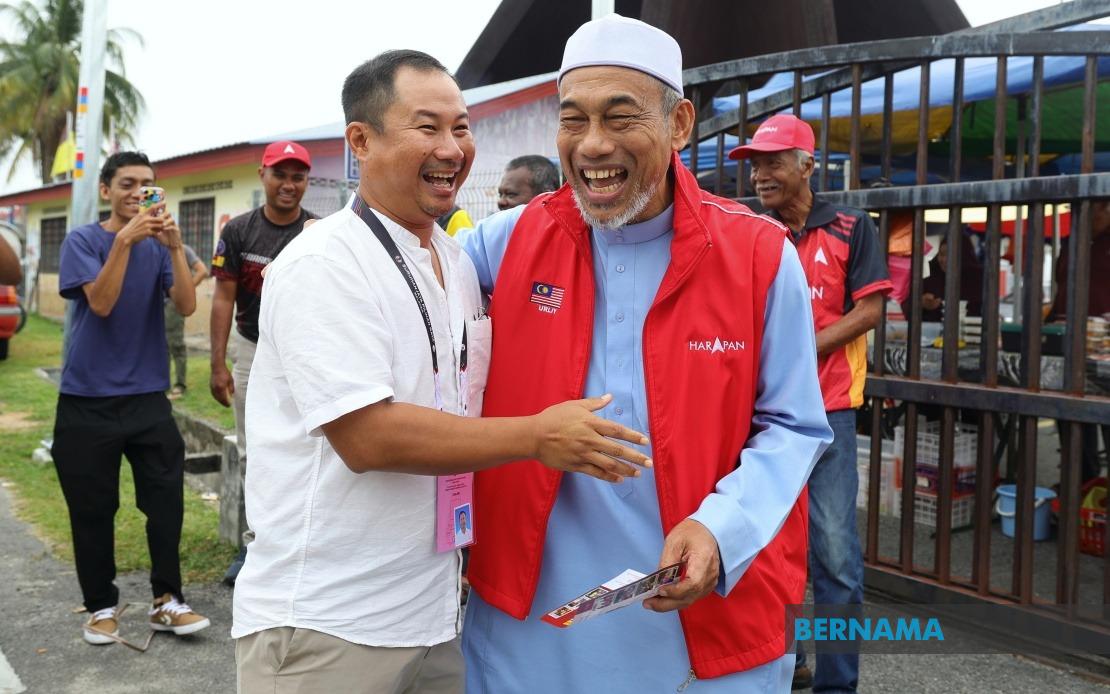
The Negeri Sembilan State Election has produced an intriguing personal narrative, with incumbent Datuk Bakri Sawir of Pakatan Harapan and his cousin Danni Rais of Perikatan Nasional both vying for the Klawang state seat. The two candidates crossed paths at Kuala Klawang weekend market in Jelebu as campaigning intensified on its second day, drawing attention from market shoppers and traders who seized the moment to interact with both contenders.
What could have been an awkward or confrontational encounter instead unfolded with remarkable civility. Both candidates worked the market separately, maintaining professional composure as they engaged with voters and local business operators. The sight of the cousins campaigning in close proximity sparked curiosity among residents, many of whom stopped to chat, exchange handshakes, and record videos of the unusual scene. Observers noted that despite competing for the same legislative seat under opposing political banners, the cousins managed to maintain a cordial tone throughout their market visits, even sharing light moments with humorous banter.
Bakri, speaking to media during the campaign trail, downplayed the novelty of facing his cousin at the ballot box. He framed the contest not as a personal rivalry but as an opportunity for both candidates to offer their respective visions and services to constituents. This measured perspective reflects a broader message he has been emphasising throughout the campaign: the primacy of conducting elections with integrity and restraint. The incumbent stressed that political competition should not override respect for institutional procedures and legal frameworks.
The Klawang incumbent cited a recent incident involving flag installation at a stadium fence as an example of his commitment to electoral discipline. When the Jelebu District Council raised objections to the placement, his team promptly removed the flags rather than contest the directive or attempt to circumvent the regulation. Bakri argued that candidates and party machinery must exemplify lawful conduct if they expect voters and the general public to do likewise. This emphasis on rules-based competition and institutional deference signals an attempt to set a standard for dignified electoral conduct in the state race.
Bakri also issued a broader appeal to all contesting parties and their campaign machinery to maintain orderly, respectful conduct throughout the election period. His call for harmony reflects concerns that spirited political competition can sometimes descend into acrimony or rule-breaking if not carefully managed. By publicly committing to civil standards and urging others to follow suit, the incumbent sought to frame the Negeri Sembilan election as a demonstration of mature democratic practice rather than a bare-knuckle power struggle. The message carries particular resonance in Malaysian electoral contexts, where concerns about campaign misconduct and heated rhetoric periodically surface.
The Klawang state seat represents a competitive three-way race rather than a direct bilateral contest. Beyond Bakri and Danni, Muhammad Adib Musa is contesting on a Bersatu ticket, adding complexity to voter calculations in the 13,355-strong registered electorate. The three-cornered fight means that victory may hinge on vote-splitting dynamics and the ability of candidates to mobilise their respective bases. With no single candidate guaranteed a clear majority, turnout and campaign effectiveness become critical variables in determining the eventual outcome.
The Election Commission has structured the voting process across two distinct phases. Early voting has been set for July 28, allowing public servants, security personnel, and other eligible voters to cast ballots in advance. The main polling day is scheduled for August 1, when the broader electorate will visit polling stations across the constituency. This two-stage approach aims to accommodate those unable to vote on the primary election day while maintaining administrative efficiency and security protocols.
The Klawang constituency sits within the larger Negeri Sembilan State Election framework, which carries implications for state governance and the composition of the legislative assembly. Outcomes in individual constituencies like Klawang will collectively determine which coalition secures the mandate to form government. Each seat thus represents both a local contest responding to community concerns and a component of the statewide political calculation. The performance of Pakatan Harapan and Perikatan Nasional in seats across Negeri Sembilan will influence the state's political trajectory and policy direction.
The family dimension of the Klawang race adds human interest to what might otherwise be routine electoral reporting, but it also underscores how Malaysian politics operates across multiple scales simultaneously. Personal relationships, community ties, and factional loyalties intersect with party affiliation and ideological positioning. The fact that Bakri and Danni have maintained civility despite contesting the same seat suggests that kinship and personal respect need not be casualties of political competition. However, the broader significance lies in whether such restraint and institutional respect prove characteristic of the wider Negeri Sembilan campaign or represent an exception to more heated contests elsewhere.
For Malaysian voters and political observers, the Klawang race encapsulates broader questions about the maturity of electoral democracy in the region. Can political opponents compete vigorously while maintaining civility and respecting institutional rules? Can family relationships survive and even thrive alongside political disagreement? The behaviour demonstrated by these two cousins suggests affirmative answers are possible, though sustained practice across multiple constituencies and elections remains necessary to establish a durable pattern. As the August 1 polling date approaches, Klawang will provide a microcosm of whether Negeri Sembilan voters prioritise harmony and institutional respect or reward other factors in their electoral choices.

