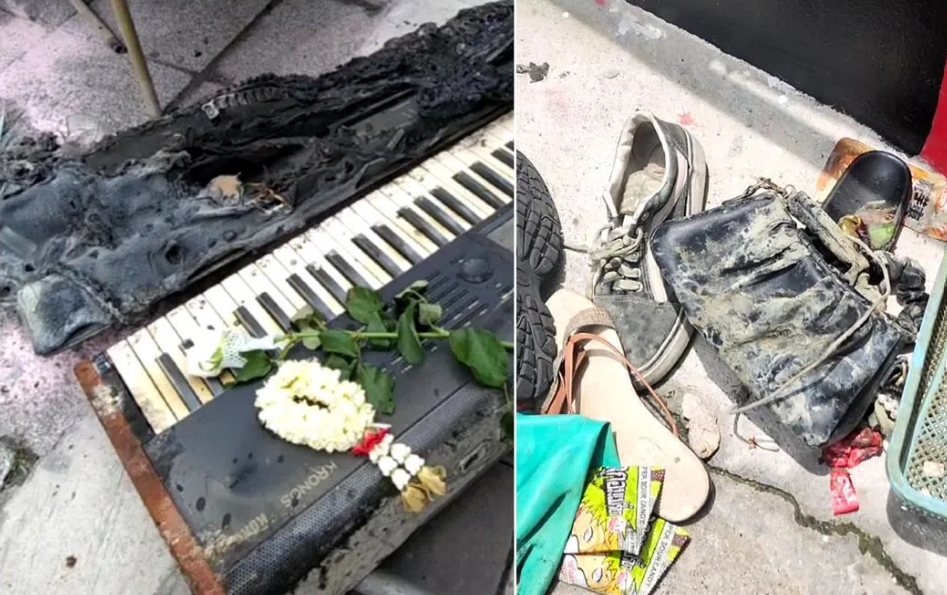
The anguish of not knowing gripped Suwanna Saeteaw when she saw her sister's mobile phone displayed on a live television news broadcast among items retrieved from the wreckage of the Rong Beer Na Lat Phrao bar. The discovery of that handset, unmistakably belonging to her 25-year-old sibling Jarawee Sermsiri, extinguished what fragile hope had flickered through the previous hours. The inferno that consumed the establishment near Phetchaburi Road just before midnight on July 12 left families across Bangkok in a state of desperate uncertainty, their emotional rollercoaster between fragments of possibility and devastating finality.
Suwanna's vigil typified the collective heartbreak unfolding across Thailand's capital. She traversed hospitals and forensic centres through the scorching day of July 13, cross-referencing survivor rosters and attempting to maintain composure as authorities prepared DNA analysis that would require approximately three days to yield results. For families locked in this purgatorial waiting period, each hour felt impossibly extended. When she finally reached through to the number that had belonged to her sister, a rescue worker's voice on the opposite end confirmed her deepest fears. "I'm extremely worried about her and devastated by what has happened," she confessed to journalists, her voice wavering as she clung to an increasingly threadbare possibility that Jarawee might be recovering in one of the capital's many medical facilities.
The tragedy marks Thailand's most catastrophic fire incident in nearly two decades. The death toll stands at 28 confirmed fatalities, with more than 70 individuals sustaining injuries ranging from moderate to severe. The last comparable disaster occurred in January 2009 when the Santika nightclub erupted into flames during New Year celebrations, claiming 67 lives and leaving over 200 injured. That earlier tragedy prompted extensive reviews of entertainment venue safety, yet this latest incident suggests those institutional lessons have failed to produce lasting systemic change or rigorous compliance.
The single-storey concrete structure operated as a licensed restaurant, and according to Bangkok Governor Chadchart Sittipunt, had successfully completed a safety inspection just three months earlier in April. Yet approximately 300 patrons occupied the venue when flames engulfed the premises—significantly below the establishment's typical nightly capacity of 600 to 700 customers, a detail that underscores how rapidly the disaster overwhelmed those present. Outside the charred skeleton of the building, abandoned footwear and personal effects remained strewn across the evacuation routes, silent testimony to the panic that seized occupants as toxic black smoke rolled through the darkened interior.
Investigative focus has zeroed in on multiple compounding factors that transformed the fire into a killing mechanism. National police chief Kitrat Panphet revealed that the majority of victims were discovered in toilet areas, suggesting that disoriented patrons sought refuge in familiar spaces when panic obliterated rational navigation. The absence of functional lighting during the evacuation proved catastrophic, whilst one of the principal exit doors was physically obstructed by a shelf unit, creating a bottleneck that allowed only sequential passage rather than mass egress. Authorities are scrutinising the electrical infrastructure of the fifty-year-old structure and examining whether decorative materials—potentially including combustible polyurethane foam fixtures—accelerated the fire's spread and contributed to toxic smoke generation.
Amorn Pimanmas, president of the Thailand Structural Engineers Association, conducted an on-site examination and identified the establishment's problematic architectural characteristics. The combination of an exceptionally low ceiling and highly flammable decorative components allowed acrid, noxious smoke to accumulate with unprecedented velocity, trapping occupants in an environment where visibility disappeared within seconds. His assessment crystallises a fundamental disconnect between regulatory frameworks and enforcement mechanisms. "It's not like we don't have the law. It's the problem of how the law can be strictly enforced," Amorn observed, articulating a reality that resonates across Thailand's hospitality sector where regulations exist but compliance remains inconsistent and consequences for violations remain insufficiently deterrent.
Governor Chadchart acknowledged that investigators would examine whether emergency exits were blocked and what role the ceiling materials played in propagating the blaze. The bar owner, currently hospitalised in intensive care, remains central to the investigation, though police have not yet secured statements. The speed of fire progression appears to have been exceptional—accounts indicate the flames reached structural ceiling elements within minutes, generating the thermal intensity and smoke density that proved lethal to those unable to locate viable escape routes in darkness. The incident exposes a troubling pattern wherein entertainment establishments operate with superficial compliance rather than genuine safety architecture.
Survivors articulate a prescient unease that apparently went unheeded by venue operators. Chaiyo Piwisol, a thirty-year-old waiter who had patronised the bar on multiple occasions, consistently observed spatial constraints and inadequate access design. The combination of numerous decorative elements, suspended lighting fixtures, and a generally cramped interior geometry created an environment where crowd egress during emergency circumstances was inherently compromised. "The place had a lot of decorations, lights and other things hanging from the ceiling. I think there should have been stronger safety measures," he remarked, a retrospective observation that captures the preventable nature of this catastrophe.
Prime Minister Anutin Charnvirakul visited the scene and identified critical gaps in fire safety infrastructure, specifically noting "blind spots" where emergency exit routes were not visibly accessible or adequately marked. His cautionary statement regarding accountability—warning that "there will be no leniency if any laws have been broken"—signals political acknowledgment of public fury, yet such pronouncements have historically preceded insufficient systemic reform in Thailand's hospitality sector. The absence of meaningful enforcement consequences for previous violations has cultivated an environment where cost-cutting supersedes safety investments.
Twenty-year-old survivor Panathaporn Thongyord escaped the inferno but lost a childhood companion of fourteen years. Their friendship had been forged through years of intimate familiarity, yet dissolved in minutes of catastrophic confusion. Her account of her friend's selfless insistence—"Just get out. Don't come back to help me"—encapsulates the tragedy's human dimension beyond statistical casualty counts. Most poignantly, her demand for accountability focuses on a specific, preventable failure: "I want to know why that back door couldn't be opened." This represents not abstract safety criticism but raw grief channelled into a concrete question that authorities must answer with specificity.
The tragedy has reignited scrutiny of Thailand's fire safety enforcement culture, particularly regarding entertainment venues where large congregations occupy spaces often designed with aesthetics prioritised over emergency functionality. This incident will likely prompt enhanced inspection protocols and stricter material regulations, yet sustainable change requires shifting institutional attitudes from minimum compliance toward genuine safety prioritisation. For families still searching through hospital records and awaiting DNA identification results, the pace of administrative investigation feels glacially slow against the urgency of closure and the need to comprehend how preventable design failures transformed a night of entertainment into devastation.

